

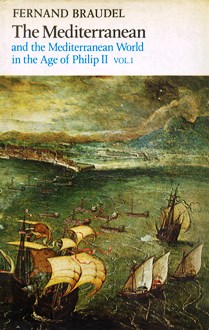
The Mediterranean and the Mediterranean world in the age of Philip II / Fernand Braudel ; translated from the French by Siân Reynolds.
Yer Numarası
A.IV/1735
ISBN
0002115360 (1. c.)
000211549 (2. c.)
000211549 (2. c.)
Dil Kodu
İngilizce
Kütüphane
Türk Tarih Kurumu Kütüphanesi
Basım Bildirimi
Reprinted.
Yayın Bilgisi
London : Collins, 1974.
Fiziksel Niteleme
2 c. (642, [1] s. ; [1] s., s. 650-1375) : resim, harita, portre ; 23 cm.
Genel Not
İndeks s. [1317]-1375 (2. cilt).
Bibliyografi, vb. Notu
Bibliyografya s. [1245]-1313 (2. cilt).
Özet, vb.
Summary: Like the great sea of which he writes Braudel's vision transcends the limits so instinctive to the pigeon-holing mind and moves with a force, a colour and a depth that carries the study of man beyond its familiar horizons.
Perhaps no historical work published since 1945 has received greater acclaim than this book. Professor Braudel who acknowledges his own debt to Lucien Fe Like the great sea of which he writes Braudel's vision transcends the limits so instinctive to the pigeon-holing mind and moves with a force, a colour and a depth that carries the study of man beyond its familiar horizons.
Perhaps no historical work published since 1945 has received greater acclaim than this book. Professor Braudel who acknowledges his own debt to Lucien Febvre and Marc Bloch has like them gone far to enrich and enhance our conception of history and to break down the barriers erected by intellectual smallholders in defense of particular specializations.
The focus of the book is the Mediterranean world in the second half of the sixteenth century. But the perspective of time stretches back from the age of Philip II to the world of Odysseus and the foreground reaches to the life of our own time. The same unconcerned, unconfined mastery reveals itself in the treatment of space. The Mediterranean is not to be defined in hydrographic terms as a sea, or even as a series of seas; nor in ecological terms as the area of sea and land that lies between the northernmost date palm and the northernmost olive. It reaches across to the Americas for the silver that submerged its price structures; down the Red Sea and across Asia for the spices that dominated its trade; up to England, Germany, Holland, Russia for grain and wool and ships and men; down the West African coast or across the Sahara for slaves and gold and ivory.
And in considering its history it is not treaties and wars and dynastic marriages that claim our attention but the time it took for a cargo ship to work her way from Alicante to Alexandria; how much it cost to send a special courier from Madrid to Paris; how people lived and what they lived on; what happened in the great cities like Venice, Naples or Constantinople when plague or famine or war intensified an already furious struggle for existence. Climate, landscape, diet, rhythms of trade, the operations of financiers and the hard life of the peasant and the seaman, all the rich variety and colour of this most magnetic area of human history have their place in a brilliant mosaic. The harmonizing of individual detail with the broad sweep of description and analysis is achieved with mastery. The whole work is informed by a sense of the physical presence of the Mediterranean, its sun and sea and the characteristic landscape of vine and olive. No true lover of the Mediterranean should be without a copy; no one seriously interested in Europe and its history could afford to be.
Orijinal Versiyon Notu
Eserin orijinali: La Méditerranée et le Méditerranéen a l'Époque de Philippe II. 1949.
Çeviriye esas alınan baskı: 1966, 2nd revised edition.
Çeviriye esas alınan baskı: 1966, 2nd revised edition.
Konu
Emeği Geçenler
Reynolds, Siân, çeviren.
Eseri Alıntıla
Referansları kullanmadan önce gözden geçirmeniz ve varsa gerekli düzeltmeleri yapmanız önerilir.
Dijital Kaynak
MARC Görünümü
LEADER 04688ntm 2200385 a 4500
001 498722
003 TR_AnAIT
005 20250628151410
008 141017s1974 enk#### 000 eng##
020 |a0002115360 (1. c.)
020 |a000211549 (2. c.)
040 |aTTK
041 |aeng|hfre
049 |aTürk Tarih Kurumu Kütüphanesi
090 |aA.IV/1735
100 1 |aBraudel, Fernand,|d1902-1985.
245 14|aThe Mediterranean and the Mediterranean world in the age of Philip II /|cFernand Braudel ; translated from the French by Siân Reynolds.
250 |aReprinted.
260 |aLondon :|bCollins,|c1974.
300 |a2 c. (642, [1] s. ; [1] s., s. 650-1375) :|bresim, harita, portre ;|c23 cm.
500 |aİndeks s. [1317]-1375 (2. cilt).
504 |aBibliyografya s. [1245]-1313 (2. cilt).
520 |aSummary: Like the great sea of which he writes Braudel's vision transcends the limits so instinctive to the pigeon-holing mind and moves with a force, a colour and a depth that carries the study of man beyond its familiar horizons.
Perhaps no historical work published since 1945 has received greater acclaim than this book. Professor Braudel who acknowledges his own debt to Lucien Fe Like the great sea of which he writes Braudel's vision transcends the limits so instinctive to the pigeon-holing mind and moves with a force, a colour and a depth that carries the study of man beyond its familiar horizons.
Perhaps no historical work published since 1945 has received greater acclaim than this book. Professor Braudel who acknowledges his own debt to Lucien Febvre and Marc Bloch has like them gone far to enrich and enhance our conception of history and to break down the barriers erected by intellectual smallholders in defense of particular specializations.
The focus of the book is the Mediterranean world in the second half of the sixteenth century. But the perspective of time stretches back from the age of Philip II to the world of Odysseus and the foreground reaches to the life of our own time. The same unconcerned, unconfined mastery reveals itself in the treatment of space. The Mediterranean is not to be defined in hydrographic terms as a sea, or even as a series of seas; nor in ecological terms as the area of sea and land that lies between the northernmost date palm and the northernmost olive. It reaches across to the Americas for the silver that submerged its price structures; down the Red Sea and across Asia for the spices that dominated its trade; up to England, Germany, Holland, Russia for grain and wool and ships and men; down the West African coast or across the Sahara for slaves and gold and ivory.
And in considering its history it is not treaties and wars and dynastic marriages that claim our attention but the time it took for a cargo ship to work her way from Alicante to Alexandria; how much it cost to send a special courier from Madrid to Paris; how people lived and what they lived on; what happened in the great cities like Venice, Naples or Constantinople when plague or famine or war intensified an already furious struggle for existence. Climate, landscape, diet, rhythms of trade, the operations of financiers and the hard life of the peasant and the seaman, all the rich variety and colour of this most magnetic area of human history have their place in a brilliant mosaic. The harmonizing of individual detail with the broad sweep of description and analysis is achieved with mastery. The whole work is informed by a sense of the physical presence of the Mediterranean, its sun and sea and the characteristic landscape of vine and olive. No true lover of the Mediterranean should be without a copy; no one seriously interested in Europe and its history could afford to be.
534 |pEserin orijinali:|tLa Méditerranée et le Méditerranéen a l'Époque de Philippe II.|c1949.
534 |pÇeviriye esas alınan baskı:|c1966,|b2nd revised edition.
650 |aPhilip II (İspanya Kralı ; 1527-1598).
650 |aİnsan coğrafyası|xAkdeniz dünyası.
650 |aFiziki Coğrafya|xAkdeniz dünyası.
650 |aAkdeniz dünyası|xTarih|y16. yy.
650 |aAkdeniz dünyası|xYönetim ve politikalar.
650 |aAkdeniz dünyası|xTarih|y1517-1789.
700 1 |aReynolds, Siân,|eçeviren.
001 498722
003 TR_AnAIT
005 20250628151410
008 141017s1974 enk#### 000 eng##
020 |a0002115360 (1. c.)
020 |a000211549 (2. c.)
040 |aTTK
041 |aeng|hfre
049 |aTürk Tarih Kurumu Kütüphanesi
090 |aA.IV/1735
100 1 |aBraudel, Fernand,|d1902-1985.
245 14|aThe Mediterranean and the Mediterranean world in the age of Philip II /|cFernand Braudel ; translated from the French by Siân Reynolds.
250 |aReprinted.
260 |aLondon :|bCollins,|c1974.
300 |a2 c. (642, [1] s. ; [1] s., s. 650-1375) :|bresim, harita, portre ;|c23 cm.
500 |aİndeks s. [1317]-1375 (2. cilt).
504 |aBibliyografya s. [1245]-1313 (2. cilt).
520 |aSummary: Like the great sea of which he writes Braudel's vision transcends the limits so instinctive to the pigeon-holing mind and moves with a force, a colour and a depth that carries the study of man beyond its familiar horizons.
Perhaps no historical work published since 1945 has received greater acclaim than this book. Professor Braudel who acknowledges his own debt to Lucien Fe Like the great sea of which he writes Braudel's vision transcends the limits so instinctive to the pigeon-holing mind and moves with a force, a colour and a depth that carries the study of man beyond its familiar horizons.
Perhaps no historical work published since 1945 has received greater acclaim than this book. Professor Braudel who acknowledges his own debt to Lucien Febvre and Marc Bloch has like them gone far to enrich and enhance our conception of history and to break down the barriers erected by intellectual smallholders in defense of particular specializations.
The focus of the book is the Mediterranean world in the second half of the sixteenth century. But the perspective of time stretches back from the age of Philip II to the world of Odysseus and the foreground reaches to the life of our own time. The same unconcerned, unconfined mastery reveals itself in the treatment of space. The Mediterranean is not to be defined in hydrographic terms as a sea, or even as a series of seas; nor in ecological terms as the area of sea and land that lies between the northernmost date palm and the northernmost olive. It reaches across to the Americas for the silver that submerged its price structures; down the Red Sea and across Asia for the spices that dominated its trade; up to England, Germany, Holland, Russia for grain and wool and ships and men; down the West African coast or across the Sahara for slaves and gold and ivory.
And in considering its history it is not treaties and wars and dynastic marriages that claim our attention but the time it took for a cargo ship to work her way from Alicante to Alexandria; how much it cost to send a special courier from Madrid to Paris; how people lived and what they lived on; what happened in the great cities like Venice, Naples or Constantinople when plague or famine or war intensified an already furious struggle for existence. Climate, landscape, diet, rhythms of trade, the operations of financiers and the hard life of the peasant and the seaman, all the rich variety and colour of this most magnetic area of human history have their place in a brilliant mosaic. The harmonizing of individual detail with the broad sweep of description and analysis is achieved with mastery. The whole work is informed by a sense of the physical presence of the Mediterranean, its sun and sea and the characteristic landscape of vine and olive. No true lover of the Mediterranean should be without a copy; no one seriously interested in Europe and its history could afford to be.
534 |pEserin orijinali:|tLa Méditerranée et le Méditerranéen a l'Époque de Philippe II.|c1949.
534 |pÇeviriye esas alınan baskı:|c1966,|b2nd revised edition.
650 |aPhilip II (İspanya Kralı ; 1527-1598).
650 |aİnsan coğrafyası|xAkdeniz dünyası.
650 |aFiziki Coğrafya|xAkdeniz dünyası.
650 |aAkdeniz dünyası|xTarih|y16. yy.
650 |aAkdeniz dünyası|xYönetim ve politikalar.
650 |aAkdeniz dünyası|xTarih|y1517-1789.
700 1 |aReynolds, Siân,|eçeviren.
Materyaller
Depodan talep edilen materyal sadece kütüphane içerisinde kullanılmaktadır.
Materyal dışarıya ödünç verilmemektedir.
Materyal dışarıya ödünç verilmemektedir.
