

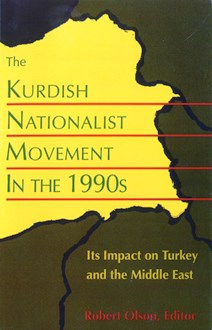
The Kurdish nationalist movement in the 1990s : its impact on Turkey and the Middle East / edited with a new introduction by Robert Olson.
Yer Numarası
A.VIII/3779
ISBN
9781568592565 (alk. paper)
Dil Kodu
İngilizce
Kütüphane
Türk Tarih Kurumu Kütüphanesi
Basım Bildirimi
1st paperback edition.
Yayın Bilgisi
Costa Mesa, California : Mazda Publishers, ©2015.
Fiziksel Niteleme
xxxi, 208 s. ; 23 cm.
Genel Not
İndeks s. [202]-208.
Bibliyografi, vb. Notu
Bibliyografya, makale sonlarındadır.
Özet, vb.
"The Kurds are the fourth largely ethnic group in the Middle East, numbering between 32-35 million. The vast majority of them live in contiguous regions of Turkey, Iraq, Iran and Syria, yet they do not have a country of their own. Formal attempts to establish such a state, or states, were crushed by the larger and more powerful countries in the region both after World War I and World War II. But the Iran-Iraq war (1980-1988), the collapse of the Soviet Union ( 1991), the end of the cold war and the U.S. invasion of Iraq in 1991 and 2003 have resulted in reinvigorating Kurdish nationalist movements across the Middle East.
These movements are now exploding power kegs. With the majority of Kurds living within its borders, no country faces this threat more squarely than Turkey. Turkey’s concept of a unified, cohesive state—in which the existence of ethnic minorities are only grudgingly acknowledged—creates tensions that makes it difficult to negotiate a peace process that is mutually agreed upon, such as occurred among the Kurds and Arabs in Iraq.
The nine essays in this collection are divided into three sections. The first examines the development of the nationalist movements in the 1980s, traces their growth into the present and discusses their development in the 1980s and first half of the 1990s. The second explores the movements influence on Turkey’s foreign policy toward Syria, Iraq, Iran, Russia and Europe, particularly in response to the 1991 Persian Gulf war, U.S. attitudes toward the Iraqi Kurds and the death of Turkish President Turgut Özal in 1993. The third analyzes Turkey’s domestic and human rights policies and discusses their adverse effects on any peace process with the Kurds that may be negotiated." -- Yayıncı.
Orijinal Versiyon Notu
Eserin orijinal baskısı: 1996.
Konu
Emeği Geçenler
Olson, Robert, editör.
