LEADER 02976naaaa2200397aa 4500
001 590462
003 TR_AnAIT
005 20250627185217
006 a||||e |||| 001 0
007 ta
008 230913s2017 uk ||||e |||| 00||0 eng c
020 |a9781784537968
020 |a9781786722317|q(eISBN)
020 |a9781786732316|q(ePDF)
040 |aTTK
041 |aeng
049 |aTürk Tarih Kurumu Kütüphanesi
090 |aA.VIII/8013
100 1 |aÖnol, Onur.
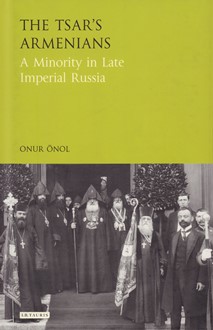
245 14|aThe Tsar's Armenians :|ba minority in late imperial Russia /|cOnur Önol.
260 |aLondon ;|aNew York :|bI. B. Tauris,|c©2017.
300 |axii, 275 sayfa ;|c22 cm.
490 0 |aLibrary of modern Russian history ;|v11
500 |aİndeks s. [269]-275.
504 |aBibliyografya s. [253]-268.
504 |aBibliyografik notlar s. [195]-251.
505 |tThe Russian Armenians in a ‘Sea of troubles’ : from confiscation to revolution, 1903-7 --|tRussia against the Dashnakstutiun, 1907-12 --|tSt. Petersburg against Tiflis : Relations between the Russian administration and the Armenian Church, 1907-12 --|tThe national question in the South Caucasus and relations between the viceroyalty and the Armenian bourgeoisie, 1907-12 --|tRussia as patron and defender : the Armenian reforms in the Ottoman Empire and their impact on Russian Armenians, 1912-14.
520 |a“In 1903 Tsar Nicholas II issued a decree allowing the confiscation of Armenian Church property, marking the low point in relations between imperial Russia and its Armenian subjects. Yet just over a decade later, Russian Armenians were fully supportive of the Russian war effort. Drawing on previously untouched archival material and a range of secondary sources published in English, French, Russian and Turkish, this is the first English-language study of this drastic change in relations in the Caucasus. Onur Onol explains how and why the shift took place by looking in detail at the imperial Russian authorities and their relationship with the three pillars of the Russian Armenian community: the Armenian Church, the Armenian bourgeoisie and the Armenian Revolutionary Federation (Dashnaktsutiun). Onol places the evolution within a context of wider political questions, such as the Russian revolutionary movement, Russia's nationalities question, Tsarist fears of pan-Islamism, the path to World War I and the influence of key characters in Russian policy making, from Pyotr Stolypin to Illarion Vorontsov-Dashkov.This book fills a conspicuous void in the extant historiography, and will be of interest to scholars working on Russian, Armenian and Ottoman history“ --|cArka kapak.
610 24|aErmeni Kilisesi|zRusya.
610 24|aTaşnaksutyun.
650 4|aErmeniler|zRusya|xTarih|y20. yy.
650 4|aErmeniler|zRusya|xTarih|y20. yy.|vKaynaklar.
650 4|aErmeni burjuvazisi|zRusya.
651 4|aRusya|xTarih|yNikolay II Dönemi, 1894-1917.
830 0|aLMRH ;|v11.