

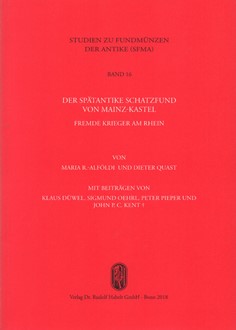
Der spätantike Schatzfund von Mainz-Kastel : fremde Krieger am Rhein / von Maria R. Alföldi, Dieter Quast ; mit beiträgen von Klaus Düwel, Sigmund Oehrl, Peter Pieper, John P. C. Kent.
Yer Numarası
A.IX/2189
ISBN
9783774941397
Dil Kodu
Almanca
Kütüphane
Türk Tarih Kurumu Kütüphanesi
Yazar
Yayın Bilgisi
Bonn : Verlag Dr. Rudolf Habelt GmbH, 2018.
Fiziksel Niteleme
274 sayfa : resim, harita, plan, tablo ; 24 cm.
Dizi
Studien zu Fundmünzen der Antike (SFMA) ; Band 16
Bibliyografi, vb. Notu
Bibliyografya s. [211]-237.
Özet, vb.
“Der Schatz wurde Anfang Februar 1962 in Mainz-Kastel, Ortsteil von Wiesbaden, der Hauptstadt des Bundeslandes Hessen (zur Römerzeit: Castellum Mattiacorum) gefunden, im rechtsrheinisches Brückenkopf zum linksrheinischen Mogontiacum/Mainz, dem wichtigen Militärlager und der ebenso wichtigen Stadt in römischer Zeit, bedeutend auch in der Spätantike, wie der ausführlich dargestellte Kontext zeigt. Beide sind mit deutender Beischrift auf dem bekannten Lyoner Bleimedaillon abgebildet, das hier 297 n.Chr. datiert wird. Der Schatz besteht aus wenigen Solidi und zahlreichen Siliquen, sowie aus Metall-Kleinfunden, einer Fibel, mehreren Ringen, Beschlägen, Schuhschnallen und anderes mehr. Der Schwerpunkt der Münzreihe liegt im späten 4. bzw. angehenden 5. Jh. Die Zahlungen kommen aus der Regie des Honorius, es sind vorwiegend Donativa. Die Reihe endet mit Siliquen Constantins III. spätestens Anfang 408. Merkwürdig sind die Kleinfunde: abmontierte Teile der persönlichen Ausstattung. Spätrömische Märtyrerakten vermerken, dass die Rekruten der Armee neu eingekleidet und mit Waffen versehen werden. Die Analyse der Kleinfunde zeigt, dass der Besitzer - wohl Anführer einer Gruppe - weit aus dem Osten kommt. Möglicherweise geht es um 383 angeworbenen Hunnen, die nach der Niederlage des Usurpators Eugenius offenbar als Rekruten auf Theodosius I. neu eingeschworen und am Rhein stationiert wurden.Spätetens 408 Frühjahr (Ende der Münzreihe) kam der Schatz in den ersten Kämpfen des Gegenkaisers Constantin III. in die Erde und wurde - warum auch immer - nicht mehr gehoben. Anhänge I-V, 36 Tafeln und zahlreiche Abbildungen runden die Darstellung ab. Abschliessend: eine ausführliche Englische Zusammenfassung.“-- Back cover.
“The treasure was discovered in early February 1962 in Mainz-Kastel (in Roman times Castellum Mattiacorum) - now part of the city of Wiesbaden, the capital of the Federal state of Hesse - in the fortified bridgehead on the right bank of the Rhine opposite Mainz/Mogontiacum on the river's left bank. Mainz was an important military base and equally important city in the Roman era, but also significant in the Late Antiquity as shown by the detailed descrption of the historical context. Both sites are depicted with explanatory inscriptions on the well-known Lyon led medallion, here dated to the year AD 297. The treasure includes a few solidi and numerous siliquae, as well as metal small finds, a fibula, several rings, fittings, shoe-buckles and other items. The crucial point of the coin sequence lies in the late 4th- early 5th century. The payments originate in the reign of Honorius and are predominantly donativa. The sequence ends in early 408, at the latest, with siliquae of Constantin III. The small finds are remarkable, dismantled parts of personal equipment. The Late Roman Acts of the Martyrs note that the army's recruits were outfitted with new clothing and weapons. The analysis of the small finds shows that their owner - probably the leader of a group of men - came from far to the east. This possibly concerns the Huns recruited around 383 who, after the defeat of Eugenius the Usurper, apparently were newly sworn in under Theodosius I. and were stationed on the Rhine. In the spring of 408 at the latest (the end of the coin sequence), during the first battles of the usurper Constantin III., the treasure was buried and - for whatever reason - was never retrieved.“-- Back cover.
“The treasure was discovered in early February 1962 in Mainz-Kastel (in Roman times Castellum Mattiacorum) - now part of the city of Wiesbaden, the capital of the Federal state of Hesse - in the fortified bridgehead on the right bank of the Rhine opposite Mainz/Mogontiacum on the river's left bank. Mainz was an important military base and equally important city in the Roman era, but also significant in the Late Antiquity as shown by the detailed descrption of the historical context. Both sites are depicted with explanatory inscriptions on the well-known Lyon led medallion, here dated to the year AD 297. The treasure includes a few solidi and numerous siliquae, as well as metal small finds, a fibula, several rings, fittings, shoe-buckles and other items. The crucial point of the coin sequence lies in the late 4th- early 5th century. The payments originate in the reign of Honorius and are predominantly donativa. The sequence ends in early 408, at the latest, with siliquae of Constantin III. The small finds are remarkable, dismantled parts of personal equipment. The Late Roman Acts of the Martyrs note that the army's recruits were outfitted with new clothing and weapons. The analysis of the small finds shows that their owner - probably the leader of a group of men - came from far to the east. This possibly concerns the Huns recruited around 383 who, after the defeat of Eugenius the Usurper, apparently were newly sworn in under Theodosius I. and were stationed on the Rhine. In the spring of 408 at the latest (the end of the coin sequence), during the first battles of the usurper Constantin III., the treasure was buried and - for whatever reason - was never retrieved.“-- Back cover.
Dil Notu
Almanca ve İngilizce özet içerir.
Konu
Emeği Geçenler
Quast, Dieter, ortak yazar.
Düwel, Klaus, katkıda bulunan.
Oehrl, Sigmund, katkıda bulunan.
Pieper, Peter, katkıda bulunan.
Kent, John P. C., katkıda bulunan.
Düwel, Klaus, katkıda bulunan.
Oehrl, Sigmund, katkıda bulunan.
Pieper, Peter, katkıda bulunan.
Kent, John P. C., katkıda bulunan.
Dizi Ek Girişi- Tek Biçim Başlık
Studien zu Fundmünzen der Antike ; Band 16
SFMA ; 16
SFMA ; 16
Eseri Alıntıla
Referansları kullanmadan önce gözden geçirmeniz ve varsa gerekli düzeltmeleri yapmanız önerilir.
Dijital Kaynak
MARC Görünümü
LEADER 04884naaa22200397 a04500
001 597750
003 TR_AnAIT
005 20250627145559
006 aobede |||| 000 0
007 ta
008 210623s2018 gw obe|e |||| 000 0 ger c
020 |a9783774941397
040 |aTTK
041 |ager
049 |aTürk Tarih Kurumu Kütüphanesi
090 |aA.IX/2189
100 1 |aAlföldi, Maria R.
245 10|aDer spätantike Schatzfund von Mainz-Kastel :|bfremde Krieger am Rhein /|cvon Maria R. Alföldi, Dieter Quast ; mit beiträgen von Klaus Düwel, Sigmund Oehrl, Peter Pieper, John P. C. Kent.
260 |aBonn :|bVerlag Dr. Rudolf Habelt GmbH,|c2018.
300 |a274 sayfa :|bresim, harita, plan, tablo ;|c24 cm.
490 1 |aStudien zu Fundmünzen der Antike (SFMA) ;|vBand 16
504 |aBibliyografya s. [211]-237.
520 |a“Der Schatz wurde Anfang Februar 1962 in Mainz-Kastel, Ortsteil von Wiesbaden, der Hauptstadt des Bundeslandes Hessen (zur Römerzeit: Castellum Mattiacorum) gefunden, im rechtsrheinisches Brückenkopf zum linksrheinischen Mogontiacum/Mainz, dem wichtigen Militärlager und der ebenso wichtigen Stadt in römischer Zeit, bedeutend auch in der Spätantike, wie der ausführlich dargestellte Kontext zeigt. Beide sind mit deutender Beischrift auf dem bekannten Lyoner Bleimedaillon abgebildet, das hier 297 n.Chr. datiert wird. Der Schatz besteht aus wenigen Solidi und zahlreichen Siliquen, sowie aus Metall-Kleinfunden, einer Fibel, mehreren Ringen, Beschlägen, Schuhschnallen und anderes mehr. Der Schwerpunkt der Münzreihe liegt im späten 4. bzw. angehenden 5. Jh. Die Zahlungen kommen aus der Regie des Honorius, es sind vorwiegend Donativa. Die Reihe endet mit Siliquen Constantins III. spätestens Anfang 408. Merkwürdig sind die Kleinfunde: abmontierte Teile der persönlichen Ausstattung. Spätrömische Märtyrerakten vermerken, dass die Rekruten der Armee neu eingekleidet und mit Waffen versehen werden. Die Analyse der Kleinfunde zeigt, dass der Besitzer - wohl Anführer einer Gruppe - weit aus dem Osten kommt. Möglicherweise geht es um 383 angeworbenen Hunnen, die nach der Niederlage des Usurpators Eugenius offenbar als Rekruten auf Theodosius I. neu eingeschworen und am Rhein stationiert wurden.Spätetens 408 Frühjahr (Ende der Münzreihe) kam der Schatz in den ersten Kämpfen des Gegenkaisers Constantin III. in die Erde und wurde - warum auch immer - nicht mehr gehoben. Anhänge I-V, 36 Tafeln und zahlreiche Abbildungen runden die Darstellung ab. Abschliessend: eine ausführliche Englische Zusammenfassung.“--|cBack cover.
520 |a“The treasure was discovered in early February 1962 in Mainz-Kastel (in Roman times Castellum Mattiacorum) - now part of the city of Wiesbaden, the capital of the Federal state of Hesse - in the fortified bridgehead on the right bank of the Rhine opposite Mainz/Mogontiacum on the river's left bank. Mainz was an important military base and equally important city in the Roman era, but also significant in the Late Antiquity as shown by the detailed descrption of the historical context. Both sites are depicted with explanatory inscriptions on the well-known Lyon led medallion, here dated to the year AD 297. The treasure includes a few solidi and numerous siliquae, as well as metal small finds, a fibula, several rings, fittings, shoe-buckles and other items. The crucial point of the coin sequence lies in the late 4th- early 5th century. The payments originate in the reign of Honorius and are predominantly donativa. The sequence ends in early 408, at the latest, with siliquae of Constantin III. The small finds are remarkable, dismantled parts of personal equipment. The Late Roman Acts of the Martyrs note that the army's recruits were outfitted with new clothing and weapons. The analysis of the small finds shows that their owner - probably the leader of a group of men - came from far to the east. This possibly concerns the Huns recruited around 383 who, after the defeat of Eugenius the Usurper, apparently were newly sworn in under Theodosius I. and were stationed on the Rhine. In the spring of 408 at the latest (the end of the coin sequence), during the first battles of the usurper Constantin III., the treasure was buried and - for whatever reason - was never retrieved.“--|cBack cover.
546 |aAlmanca ve İngilizce özet içerir.
650 4|aMadeni paralar, Roma|zAlmanya|zHessen.
650 4|aArkeolojik kazılar|zAlmanya|zHessen.
651 4|aHessen (Almanya)|xEski eserler, Roma.
700 1 |aQuast, Dieter,|eortak yazar.
700 1 |aDüwel, Klaus,|ekatkıda bulunan.
700 1 |aOehrl, Sigmund,|ekatkıda bulunan.
700 1 |aPieper, Peter,|ekatkıda bulunan.
700 1 |aKent, John P. C.,|ekatkıda bulunan.
830 0|aStudien zu Fundmünzen der Antike ;|vBand 16
830 0|aSFMA ;|v16
001 597750
003 TR_AnAIT
005 20250627145559
006 aobede |||| 000 0
007 ta
008 210623s2018 gw obe|e |||| 000 0 ger c
020 |a9783774941397
040 |aTTK
041 |ager
049 |aTürk Tarih Kurumu Kütüphanesi
090 |aA.IX/2189
100 1 |aAlföldi, Maria R.
245 10|aDer spätantike Schatzfund von Mainz-Kastel :|bfremde Krieger am Rhein /|cvon Maria R. Alföldi, Dieter Quast ; mit beiträgen von Klaus Düwel, Sigmund Oehrl, Peter Pieper, John P. C. Kent.
260 |aBonn :|bVerlag Dr. Rudolf Habelt GmbH,|c2018.
300 |a274 sayfa :|bresim, harita, plan, tablo ;|c24 cm.
490 1 |aStudien zu Fundmünzen der Antike (SFMA) ;|vBand 16
504 |aBibliyografya s. [211]-237.
520 |a“Der Schatz wurde Anfang Februar 1962 in Mainz-Kastel, Ortsteil von Wiesbaden, der Hauptstadt des Bundeslandes Hessen (zur Römerzeit: Castellum Mattiacorum) gefunden, im rechtsrheinisches Brückenkopf zum linksrheinischen Mogontiacum/Mainz, dem wichtigen Militärlager und der ebenso wichtigen Stadt in römischer Zeit, bedeutend auch in der Spätantike, wie der ausführlich dargestellte Kontext zeigt. Beide sind mit deutender Beischrift auf dem bekannten Lyoner Bleimedaillon abgebildet, das hier 297 n.Chr. datiert wird. Der Schatz besteht aus wenigen Solidi und zahlreichen Siliquen, sowie aus Metall-Kleinfunden, einer Fibel, mehreren Ringen, Beschlägen, Schuhschnallen und anderes mehr. Der Schwerpunkt der Münzreihe liegt im späten 4. bzw. angehenden 5. Jh. Die Zahlungen kommen aus der Regie des Honorius, es sind vorwiegend Donativa. Die Reihe endet mit Siliquen Constantins III. spätestens Anfang 408. Merkwürdig sind die Kleinfunde: abmontierte Teile der persönlichen Ausstattung. Spätrömische Märtyrerakten vermerken, dass die Rekruten der Armee neu eingekleidet und mit Waffen versehen werden. Die Analyse der Kleinfunde zeigt, dass der Besitzer - wohl Anführer einer Gruppe - weit aus dem Osten kommt. Möglicherweise geht es um 383 angeworbenen Hunnen, die nach der Niederlage des Usurpators Eugenius offenbar als Rekruten auf Theodosius I. neu eingeschworen und am Rhein stationiert wurden.Spätetens 408 Frühjahr (Ende der Münzreihe) kam der Schatz in den ersten Kämpfen des Gegenkaisers Constantin III. in die Erde und wurde - warum auch immer - nicht mehr gehoben. Anhänge I-V, 36 Tafeln und zahlreiche Abbildungen runden die Darstellung ab. Abschliessend: eine ausführliche Englische Zusammenfassung.“--|cBack cover.
520 |a“The treasure was discovered in early February 1962 in Mainz-Kastel (in Roman times Castellum Mattiacorum) - now part of the city of Wiesbaden, the capital of the Federal state of Hesse - in the fortified bridgehead on the right bank of the Rhine opposite Mainz/Mogontiacum on the river's left bank. Mainz was an important military base and equally important city in the Roman era, but also significant in the Late Antiquity as shown by the detailed descrption of the historical context. Both sites are depicted with explanatory inscriptions on the well-known Lyon led medallion, here dated to the year AD 297. The treasure includes a few solidi and numerous siliquae, as well as metal small finds, a fibula, several rings, fittings, shoe-buckles and other items. The crucial point of the coin sequence lies in the late 4th- early 5th century. The payments originate in the reign of Honorius and are predominantly donativa. The sequence ends in early 408, at the latest, with siliquae of Constantin III. The small finds are remarkable, dismantled parts of personal equipment. The Late Roman Acts of the Martyrs note that the army's recruits were outfitted with new clothing and weapons. The analysis of the small finds shows that their owner - probably the leader of a group of men - came from far to the east. This possibly concerns the Huns recruited around 383 who, after the defeat of Eugenius the Usurper, apparently were newly sworn in under Theodosius I. and were stationed on the Rhine. In the spring of 408 at the latest (the end of the coin sequence), during the first battles of the usurper Constantin III., the treasure was buried and - for whatever reason - was never retrieved.“--|cBack cover.
546 |aAlmanca ve İngilizce özet içerir.
650 4|aMadeni paralar, Roma|zAlmanya|zHessen.
650 4|aArkeolojik kazılar|zAlmanya|zHessen.
651 4|aHessen (Almanya)|xEski eserler, Roma.
700 1 |aQuast, Dieter,|eortak yazar.
700 1 |aDüwel, Klaus,|ekatkıda bulunan.
700 1 |aOehrl, Sigmund,|ekatkıda bulunan.
700 1 |aPieper, Peter,|ekatkıda bulunan.
700 1 |aKent, John P. C.,|ekatkıda bulunan.
830 0|aStudien zu Fundmünzen der Antike ;|vBand 16
830 0|aSFMA ;|v16
Materyaller
Depodan talep edilen materyal sadece kütüphane içerisinde kullanılmaktadır.
Materyal dışarıya ödünç verilmemektedir.
Materyal dışarıya ödünç verilmemektedir.
