LEADER 03408naaa22200361 a04500
001 599335
003 TR_AnAIT
005 20250627140601
006 ab|||e |||| 001 0
007 ta
008 211111s2021 ne b|||e |||| 001 0 eng c
020 |a9789004467620|q(hardback)
020 |a9789004467637|q(ebook)
040 |aTTK
041 |aeng
049 |aTürk Tarih Kurumu Kütüphanesi
090 |aA.IX/2828
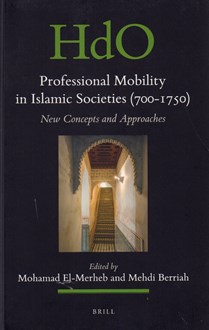
245 10|aProfessional mobility in Islamic societies, 700-1750 :|bnew concepts and approaches /|cedited by Mohamad El-Merheb, Mehdi Berriah.
260 |aLeiden ;|aBoston :|bBrill,|c©2021.
300 |axii, 245 sayfa :|bharita, grafik, şema ;|c24 cm.
490 1 |aHandbook of Oriental studies. Section one.|aThe Near and Middle East,|x0169-9423 ;|vvolume 157
500 |aİndeks s. [231]-245.
504 |aBibliyografya makale sonlarındadır.
505 |tMedinan scholars on the move : Professional mobility at the Umayyad court /|rMehmetcan Akpınar --|tProfessional mobility and social capital : a note on the muḥaddithāt in Kitāb Tārīkh Baghdād /|rNadia Maria El Cheikh --|tThe Aqīt household : Professional mobility of a Berber learned elite in premodern West Africa /|rMarta G. Novo --|tThe Professional mobility of Qāḍī ‘Abd al-Jabbār between the quest for knowledge and the confluence with power /|rAmal Belkamel --|tMobility and versatility of the ‘ulamā in the Mamluk period : the case of Ibn Taymiyya /|rMehdi Berriah --|tMobility among the Andalusī quḍāt : social advancement and spatial displacement in a professional context /|rAdday Hernández López --|tImām al-Ḥaramayn al-Juwaynī’s mobility and the Saljūq’s project of Sunnī political unity /|rM. Syifa Amin Widigdo --|tIran’s state literatüre under Afghan rule (1722-1729) /|rM. A. H. Parsa --|tIslamic political thought and professional mobility : the intellectual and empirical worlds of Ibn Ṭalḥa and Ibn Jamā’a /|rMohamad El-Merheb.
520 |a“The present edited volume offers a collection of new concepts and approaches to the study of mobility in pre-modern Islamic societies. It includes nine remarkable case studies from different parts of the Islamic world that examine the professional mobility within the literati and, especially, the social-cum-cultural group of Muslim scholars (“ulamā“) between the eighth and the eighteenth centuries. Based on individual case studies and quantitative mining of biographical dictionaries and other primary sources from Islamic Iberia, North and West Africa, Umayyad Damascus and the Hejaz, Abbasid Baghdad, Ayyubid and Mamluk Syria and Egypt, various parts of the Seljuq Empire, and Hotakid Iran, this edited volume presents professional mobility as a defining characteristic of pre-modern Islamic societies. Contributors Mehmetcan Akpinar, Amal Belkamel, Mehdi Berriah, Nadia Maria El Cheikh, Adday Hernández López, Konrad Hirschler, Mohamad El Merheb, Marta G. Novo, M. A. H. Parsa, M. Syifa A. Widigdo“ --|cYayıncı.
650 4|aSosyal hareketlilik|zİslam ülkeleri|xTarih.
651 4|aİslam ülkeleri|xMedeniyet.
700 1 |aEl-Merheb, Mohamad,|eeditör.
700 1 |aBerriah, Mehdi,|eeditör.
830 0|aHandbook of Oriental Studies,|nSection 1.|pThe Near and Middle East ;|vvolume 157.
830 0|aHandbuch der Orientalistik ;|v157.
830 0|aHdO,|nI ;|vvol. 157.