

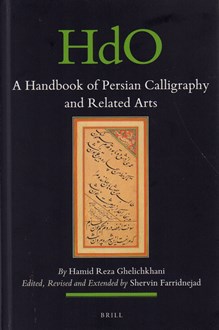
A handbook of Persian calligraphy and related arts / by Hamid Reza Ghelichkhani ; translated by Rebecca Stengel ; edited, revised and extended by Shervin Farridnejad.
Yer Numarası
A.IX/3613
ISBN
9789004277472 (hardback)
9789004432895 (ebook)
9789004432895 (ebook)
Dil Kodu
İngilizce
Kütüphane
Türk Tarih Kurumu Kütüphanesi
Yayın Bilgisi
Leiden ; Boston : Brill, 2022.
Fiziksel Niteleme
xxvii, 396 sayfa : resim (renkli), çizim, harita, şema, tıpkıbasım, tablo ; 24 cm.
Dizi
Handbook of Oriental Studies. Section one. The Near and Middle East, 0169-9423 ; volume 109
Genel Not
İndeks s. [367]-396.
Bibliyografi, vb. Notu
Bibliyografya s. [345]-366.
Özet, vb.
“Persian Calligraphy and related traditional arts of books make up the most important forms of Iranian-Islamic art, which are still living practiced traditions up to today. This volume puts together a first-of-a-kind handbook and contains the most important termini technici as well as expressions and techniques connected to the traditional art of Persian calligraphy (mostly Nasta'līq), calligraphy tools such as the reed pen, paper and ink as well as some related fields, like taz̲hīb (illumination), taš'īr (historiated painting), book binding, etc. The content is based on thirty prominent classical Persian treatises, composed between twelfth and twentieth centuries. All terms and expressions are followed by an English description and often accompanied by an illustration. These expressions, which are key to understanding old calligraphic treatises and many relevant sources on Islamic art, are meant to familiarise the reader with both common and forgotten techniques and terminology of calligraphic traditions. The volume addresses not only the artists and scholars of Iranian and Islamic art history, but also those, who have dealt with Islamic and Iranian manuscripts, manuscript cultures, codicology and palaeography. Both the author and the editor of this volume are trained practicing calligraphers and illuminators, who learned the art of calligraphy and illumination through long, traditional study under masters of this art.“ -- Yayıncı.
Emeği Geçenler
Stengel, Rebecca, çeviren.
Farridnejad, Shervin, editör.
Farridnejad, Shervin, editör.
Dizi Ek Girişi- Tek Biçim Başlık
Handbook of Oriental Studies, Section 1. The Near and Middle East ; volume 109.
Handbuch der Orientalistik ; 109.
HdO, I ; vol. 109.
Handbuch der Orientalistik ; 109.
HdO, I ; vol. 109.
