LEADER 03406naaa22200361 a 4500
001 600513
003 TR_AnAIT
005 20250627131508
006 aa|||e ||||o001 0
007 ta
008 220617q2017 xxua|||e ||||o001 0 eng c
020 |a9780231181808
020 |a9780231543804 (ebook)
040 |aTTK
041 |aeng
049 |aTürk Tarih Kurumu Kütüphanesi
090 |aA.IX/3876
100 1 |aAkan, Murat,|d1973-
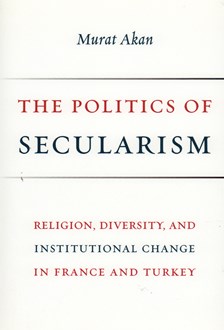
245 10|aThe politics of secularism :|breligion, diversity, and institutional change in France and Turkey /|cMurat Akan.
260 |aNew York :|bColumbia University Press,|c[2017]
300 |axiv, 357 sayfa :|bgrafik, tablo ;|c24 cm
490 0 |aReligion, culture, and public life.
500 |aEserin iç kapağı eksik olup, bilgiler dış kapaktan alınmıştır.
500 |aİndeks s. 341-357.
504 |aBibliyografya s. 325-340.
505 |tTraveling through analytical and hermeneutical approaches --|tAccounting for Institutional outcomes and trajectories: political ends, ideas, and institutions --|tThe institutional politics of Laïcité in the French Third Republic --|tThe politics of Laïcité positive and diversity in contemporary France --|tThe institutional politics of laiklik in Kemalist Turkey --|tThe sincere government (Samimi Hükümet), the institutional politics of religion, and diversity in contemporary Turkey.
520 |a“Discussions of modernity—or alternative and multiple modernities—often hinge on the question of secularism, especially how it travels outside its original European context. Too often, attempts to answer this question either imagine a universal model derived from the history of Western Europe, which neglects the experience of much of the world, or emphasize a local, non-European context that limits the potential for comparison. In The Politics of Secularism, Murat Akan reframes the question of secularism, exploring its presence both outside and inside Europe and offering a rich empirical account of how it moves across borders and through time.
Akan uses France and Turkey to analyze political actors' comparative discussions of secularism, struggles for power, and historical contextual constraints at potential moments of institutional change. France and Turkey are critical sites of secularism: France exemplifies European political modernity, and Turkey has long been the model of secularism in a Muslim-majority country. Akan analyzes prominent debates in both countries on topics such as the visibility of the headscarf and other religious symbols, religion courses in the public school curriculum, and state salaries for clerics and imams. Akan lays out the institutional struggles between three distinct political currents—anti-clericalism, liberalism, and what he terms state-civil religionism—detailing the nuances of how political movements articulate the boundary between the secular and the religious. Disputing the prevalent idea that diversity is a new challenge to secularism and focusing on comparison itself as part of the politics of secularism, this book makes a major contribution to understanding secular politics and its limits“ -- Yayıncı.
650 4|aLaiklik|xSiyasi yönler|zFransa.
650 4|aLaiklik|xSiyasi yönler|zTürkiye.
650 4|aKilise ve devlet|zFransa.
650 4|aİslam ve devlet|zTürkiye.