

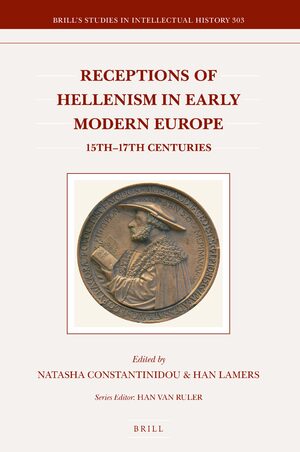
Receptions of Hellenism in early modern Europe : 15th-17th centuries / Han Lamers, Natasha Constantinidou.
Erişim Adresi
ISBN
9789004402461 (electronic book)
9789004343856 (print)
9789004343856 (print)
Dil Kodu
İngilizce
Yer Numarası
DK/0656
Yayın Bilgisi
Leiden Boston : BRILL, 2019.
Fiziksel Niteleme
1 online resource.
Dizi
Brill's Studies in Intellectual History; volume303
Brill's Studies in Intellectual History Online, Supplement 2020, ISBN: 9789004414211
Brill's Studies in Intellectual History Online, Supplement 2020, ISBN: 9789004414211
İçindekiler Notu
Front Matter -- Copyright page -- Preface / Natasha Constantinidou and Han Lamers -- Figures and Tables -- Abbreviations -- Contributors -- Receptions of Hellenism in Early Modern Europe / Natasha Constantinidou and Han Lamers -- Access and Dissemination -- Learning, Teaching, and Printing Greek -- Aldus Manutius and the Learning of Greek: the Aldine Appendix / Paola Tomè (†) -- From a Thirsty Desert to the Rise of the Collège de France: Greek Studies in Paris, c.1490–1540 / Luigi-Alberto Sanchi -- Teaching Greek with Aristophanes in the French Renaissance, 1528–1549 / Malika Bastin-Hammou -- A Professor at Work: Hadrianus Amerotius (c.1495–1560) and the Study of Greek in Sixteenth-Century Louvain / Raf Van Rooy -- Greek History in the Early-Modern Classroom: Lectures on Herodotus by Johannes Rosa and School Notes by Jacques Bongars (Jena, 1568) / Anthony Ellis -- Migration, Exchange, and Identity -- Cultural Encounters and Exchanges between “Greek East” and “Latin West” -- From “Bounteous Flux of Matter” to Hellenic City: Late Byzantine Representations of Constantinople and the Western Audience / Aslıhan Akışık-Karakullukçu -- Icons of Narratives: Greek-Venetian Artistic Interchange, Thirteenth–Fifteenth Centuries / Michele Bacci -- Barbaric and Assimilated Hellenes: Textual and Visual Images of Greek Scholars between Lapo da Castiglionchio (c.1405–1438) and Paolo Giovio (1483–1552) / Peter Bell -- Maximos Margounios (c.1549–1602), his Anacreontic Hymns, and the Byzantine Revival in Early Modern Germany / Federica Ciccolella -- Perspectives on Greek Migrants in the West -- Love and Exile in Michael Marullus Tarchaniota: Geographical Exile, Spiritual Homelessness / Niketas Siniossoglou -- The Longs and Shorts of an Emergent Nation: Nikolaos Loukanes’s 1526 Iliad and the Unprosodic New Trojans / Calliope Dourou -- From Courts to Cities: Greek Migration, Community Formation, and Networks of Mutual Assistance in Sixteenth-Century Italy / Niccolò Fattori -- Appropriations and Use: Cultural & Religious -- History, Archaeology, and Antiquarianism -- The Greekness of Greek Inscriptions: Ancient Inscriptions in Early Modern Scholarship / William Stenhouse -- Pirro Ligorio (c.1513–1583) and Greek Antiquity / Michail Chatzidakis -- Ancient Coins and the Use of Greek History in Sicilia et Magna Graecia by Hubertus Goltzius (1526–1583) / Maria Luisa Napolitano -- Humanist Greek and the Reformation -- Graecia transvolavit Alpes: Humanist Greek Writing in Germany (15th–17th Centuries) Through the Eyes of Georg Lizel (1694–1761) / Stefan Weise -- Hyperborean Flowers: Humanist Greek Around the Baltic Sea (16th–17th Centuries) / Janika Päll -- Back Matter -- General Bibliography -- Index.
Özet, vb.
This volume, edited by Natasha Constantinidou and Han Lamers, investigates modes of receiving and responding to Greeks, Greece, and Greek in early modern Europe (15th-17th centuries). The book's 17 detailed studies illuminate the reception of Greek culture (the classical, Byzantine, and even post-Byzantine traditions), the Greek language (ancient, vernacular, and 'humanist'), as well as the people claiming, or being assigned, Greek identities during this period in different geographical and cultural contexts. Discussing subjects as diverse as, for example, Greek studies and the Reformation, artistic interchange between Greek East and Latin West, networks of communication in the Greek diaspora, and the ramifications of Greek antiquarianism, the book aims at encouraging a more concerted debate about the role of Hellenism in early modern Europe that goes beyond disciplinary boundaries, and opening ways towards a more over-arching understanding of this multifaceted cultural phenomenon. Contributors include Aslıhan Akışık-Karakullukçu, Michele Bacci, Malika Bastin-Hammou, Peter Bell, Michail Chatzidakis, Federica Ciccolella, Calliope Dourou, Anthony Ellis, Niccolò Fattori, Maria Luisa Napolitano, Janika Päll, Luigi-Alberto Sanchi, Niketas Siniossoglou, William Stenhouse, Paola Tomè, Raf Van Rooy, and Stefan Weise
Diğer Yazarlar
Eseri Alıntıla
Referansları kullanmadan önce gözden geçirmeniz ve varsa gerekli düzeltmeleri yapmanız önerilir.
Dijital Kaynak
MARC Görünümü
LEADER 05654cam a22003975i 4500
001 601523
003 TR_AnAIT
005 20250627123247
006 m d
007 cr un uuuua
008 190716s2019 mau 000 0 eng
020 |a9789004402461|q(electronic book)
020 |z9789004343856|q(print)
024 7 |a10.1163/9789004402461|2DOI
035 |a(OCoLC)1091913223 (print ed.)
040 |aNL-LeKB|cNL-LeKB|erda
041 |aeng
049 |aTürk Tarih Kurumu Kütüphanesi
072 7|aLAN|x000000|2bisacsh
090 |aDK/0656
245 00|aReceptions of Hellenism in early modern Europe :|b15th-17th centuries /|cHan Lamers, Natasha Constantinidou.
264 1|aLeiden Boston :|bBRILL,|c2019.
300 |a1 online resource.
336 |atext|btxt|2rdacontent
337 |acomputer|bc|2rdamedia
338 |aonline resource|2rdacarrier
490 1 |aBrill's Studies in Intellectual History;|vvolume303
490 1 |aBrill's Studies in Intellectual History Online, Supplement 2020, ISBN: 9789004414211
505 00|tFront Matter -- Copyright page -- Preface /|rNatasha Constantinidou and Han Lamers -- Figures and Tables -- Abbreviations -- Contributors -- Receptions of Hellenism in Early Modern Europe /|rNatasha Constantinidou and Han Lamers -- Access and Dissemination -- Learning, Teaching, and Printing Greek -- Aldus Manutius and the Learning of Greek: the Aldine Appendix /|rPaola Tomè (†) -- From a Thirsty Desert to the Rise of the Collège de France: Greek Studies in Paris, c.1490–1540 /|rLuigi-Alberto Sanchi -- Teaching Greek with Aristophanes in the French Renaissance, 1528–1549 /|rMalika Bastin-Hammou -- A Professor at Work: Hadrianus Amerotius (c.1495–1560) and the Study of Greek in Sixteenth-Century Louvain /|rRaf Van Rooy -- Greek History in the Early-Modern Classroom: Lectures on Herodotus by Johannes Rosa and School Notes by Jacques Bongars (Jena, 1568) /|rAnthony Ellis -- Migration, Exchange, and Identity -- Cultural Encounters and Exchanges between “Greek East” and “Latin West” -- From “Bounteous Flux of Matter” to Hellenic City: Late Byzantine Representations of Constantinople and the Western Audience /|rAslıhan Akışık-Karakullukçu -- Icons of Narratives: Greek-Venetian Artistic Interchange, Thirteenth–Fifteenth Centuries /|rMichele Bacci -- Barbaric and Assimilated Hellenes: Textual and Visual Images of Greek Scholars between Lapo da Castiglionchio (c.1405–1438) and Paolo Giovio (1483–1552) /|rPeter Bell -- Maximos Margounios (c.1549–1602), his Anacreontic Hymns, and the Byzantine Revival in Early Modern Germany /|rFederica Ciccolella -- Perspectives on Greek Migrants in the West -- Love and Exile in Michael Marullus Tarchaniota: Geographical Exile, Spiritual Homelessness /|rNiketas Siniossoglou -- The Longs and Shorts of an Emergent Nation: Nikolaos Loukanes’s 1526 Iliad and the Unprosodic New Trojans /|rCalliope Dourou -- From Courts to Cities: Greek Migration, Community Formation, and Networks of Mutual Assistance in Sixteenth-Century Italy /|rNiccolò Fattori -- Appropriations and Use: Cultural & Religious -- History, Archaeology, and Antiquarianism -- The Greekness of Greek Inscriptions: Ancient Inscriptions in Early Modern Scholarship /|rWilliam Stenhouse -- Pirro Ligorio (c.1513–1583) and Greek Antiquity /|rMichail Chatzidakis -- Ancient Coins and the Use of Greek History in Sicilia et Magna Graecia by Hubertus Goltzius (1526–1583) /|rMaria Luisa Napolitano -- Humanist Greek and the Reformation -- Graecia transvolavit Alpes: Humanist Greek Writing in Germany (15th–17th Centuries) Through the Eyes of Georg Lizel (1694–1761) /|rStefan Weise -- Hyperborean Flowers: Humanist Greek Around the Baltic Sea (16th–17th Centuries) /|rJanika Päll -- Back Matter -- General Bibliography -- Index.
520 |aThis volume, edited by Natasha Constantinidou and Han Lamers, investigates modes of receiving and responding to Greeks, Greece, and Greek in early modern Europe (15th-17th centuries). The book's 17 detailed studies illuminate the reception of Greek culture (the classical, Byzantine, and even post-Byzantine traditions), the Greek language (ancient, vernacular, and 'humanist'), as well as the people claiming, or being assigned, Greek identities during this period in different geographical and cultural contexts. Discussing subjects as diverse as, for example, Greek studies and the Reformation, artistic interchange between Greek East and Latin West, networks of communication in the Greek diaspora, and the ramifications of Greek antiquarianism, the book aims at encouraging a more concerted debate about the role of Hellenism in early modern Europe that goes beyond disciplinary boundaries, and opening ways towards a more over-arching understanding of this multifaceted cultural phenomenon. Contributors include Aslıhan Akışık-Karakullukçu, Michele Bacci, Malika Bastin-Hammou, Peter Bell, Michail Chatzidakis, Federica Ciccolella, Calliope Dourou, Anthony Ellis, Niccolò Fattori, Maria Luisa Napolitano, Janika Päll, Luigi-Alberto Sanchi, Niketas Siniossoglou, William Stenhouse, Paola Tomè, Raf Van Rooy, and Stefan Weise
700 1 |aLamers, Han,|eeditor.
700 1 |aConstantinidou, Natasha,|eeditor.
776 08|iPrint version:|tReceptions of Hellenism in early modern Europe: 15th-17th centuries,|dLeiden Boston: BRILL, 2019|w9789004343856
830 0|aBrill's Studies in Intellectual History;|vvolume303.
830 0|aBrill's Studies in Intellectual History Online, Supplement 2020, ISBN: 9789004414211.
856 4 |zDOI:|uhttp://dx.doi.org/10.1163/9789004402461
001 601523
003 TR_AnAIT
005 20250627123247
006 m d
007 cr un uuuua
008 190716s2019 mau 000 0 eng
020 |a9789004402461|q(electronic book)
020 |z9789004343856|q(print)
024 7 |a10.1163/9789004402461|2DOI
035 |a(OCoLC)1091913223 (print ed.)
040 |aNL-LeKB|cNL-LeKB|erda
041 |aeng
049 |aTürk Tarih Kurumu Kütüphanesi
072 7|aLAN|x000000|2bisacsh
090 |aDK/0656
245 00|aReceptions of Hellenism in early modern Europe :|b15th-17th centuries /|cHan Lamers, Natasha Constantinidou.
264 1|aLeiden Boston :|bBRILL,|c2019.
300 |a1 online resource.
336 |atext|btxt|2rdacontent
337 |acomputer|bc|2rdamedia
338 |aonline resource|2rdacarrier
490 1 |aBrill's Studies in Intellectual History;|vvolume303
490 1 |aBrill's Studies in Intellectual History Online, Supplement 2020, ISBN: 9789004414211
505 00|tFront Matter -- Copyright page -- Preface /|rNatasha Constantinidou and Han Lamers -- Figures and Tables -- Abbreviations -- Contributors -- Receptions of Hellenism in Early Modern Europe /|rNatasha Constantinidou and Han Lamers -- Access and Dissemination -- Learning, Teaching, and Printing Greek -- Aldus Manutius and the Learning of Greek: the Aldine Appendix /|rPaola Tomè (†) -- From a Thirsty Desert to the Rise of the Collège de France: Greek Studies in Paris, c.1490–1540 /|rLuigi-Alberto Sanchi -- Teaching Greek with Aristophanes in the French Renaissance, 1528–1549 /|rMalika Bastin-Hammou -- A Professor at Work: Hadrianus Amerotius (c.1495–1560) and the Study of Greek in Sixteenth-Century Louvain /|rRaf Van Rooy -- Greek History in the Early-Modern Classroom: Lectures on Herodotus by Johannes Rosa and School Notes by Jacques Bongars (Jena, 1568) /|rAnthony Ellis -- Migration, Exchange, and Identity -- Cultural Encounters and Exchanges between “Greek East” and “Latin West” -- From “Bounteous Flux of Matter” to Hellenic City: Late Byzantine Representations of Constantinople and the Western Audience /|rAslıhan Akışık-Karakullukçu -- Icons of Narratives: Greek-Venetian Artistic Interchange, Thirteenth–Fifteenth Centuries /|rMichele Bacci -- Barbaric and Assimilated Hellenes: Textual and Visual Images of Greek Scholars between Lapo da Castiglionchio (c.1405–1438) and Paolo Giovio (1483–1552) /|rPeter Bell -- Maximos Margounios (c.1549–1602), his Anacreontic Hymns, and the Byzantine Revival in Early Modern Germany /|rFederica Ciccolella -- Perspectives on Greek Migrants in the West -- Love and Exile in Michael Marullus Tarchaniota: Geographical Exile, Spiritual Homelessness /|rNiketas Siniossoglou -- The Longs and Shorts of an Emergent Nation: Nikolaos Loukanes’s 1526 Iliad and the Unprosodic New Trojans /|rCalliope Dourou -- From Courts to Cities: Greek Migration, Community Formation, and Networks of Mutual Assistance in Sixteenth-Century Italy /|rNiccolò Fattori -- Appropriations and Use: Cultural & Religious -- History, Archaeology, and Antiquarianism -- The Greekness of Greek Inscriptions: Ancient Inscriptions in Early Modern Scholarship /|rWilliam Stenhouse -- Pirro Ligorio (c.1513–1583) and Greek Antiquity /|rMichail Chatzidakis -- Ancient Coins and the Use of Greek History in Sicilia et Magna Graecia by Hubertus Goltzius (1526–1583) /|rMaria Luisa Napolitano -- Humanist Greek and the Reformation -- Graecia transvolavit Alpes: Humanist Greek Writing in Germany (15th–17th Centuries) Through the Eyes of Georg Lizel (1694–1761) /|rStefan Weise -- Hyperborean Flowers: Humanist Greek Around the Baltic Sea (16th–17th Centuries) /|rJanika Päll -- Back Matter -- General Bibliography -- Index.
520 |aThis volume, edited by Natasha Constantinidou and Han Lamers, investigates modes of receiving and responding to Greeks, Greece, and Greek in early modern Europe (15th-17th centuries). The book's 17 detailed studies illuminate the reception of Greek culture (the classical, Byzantine, and even post-Byzantine traditions), the Greek language (ancient, vernacular, and 'humanist'), as well as the people claiming, or being assigned, Greek identities during this period in different geographical and cultural contexts. Discussing subjects as diverse as, for example, Greek studies and the Reformation, artistic interchange between Greek East and Latin West, networks of communication in the Greek diaspora, and the ramifications of Greek antiquarianism, the book aims at encouraging a more concerted debate about the role of Hellenism in early modern Europe that goes beyond disciplinary boundaries, and opening ways towards a more over-arching understanding of this multifaceted cultural phenomenon. Contributors include Aslıhan Akışık-Karakullukçu, Michele Bacci, Malika Bastin-Hammou, Peter Bell, Michail Chatzidakis, Federica Ciccolella, Calliope Dourou, Anthony Ellis, Niccolò Fattori, Maria Luisa Napolitano, Janika Päll, Luigi-Alberto Sanchi, Niketas Siniossoglou, William Stenhouse, Paola Tomè, Raf Van Rooy, and Stefan Weise
700 1 |aLamers, Han,|eeditor.
700 1 |aConstantinidou, Natasha,|eeditor.
776 08|iPrint version:|tReceptions of Hellenism in early modern Europe: 15th-17th centuries,|dLeiden Boston: BRILL, 2019|w9789004343856
830 0|aBrill's Studies in Intellectual History;|vvolume303.
830 0|aBrill's Studies in Intellectual History Online, Supplement 2020, ISBN: 9789004414211.
856 4 |zDOI:|uhttp://dx.doi.org/10.1163/9789004402461
Materyaller
Depodan talep edilen materyal sadece kütüphane içerisinde kullanılmaktadır.
Materyal dışarıya ödünç verilmemektedir.
Materyal dışarıya ödünç verilmemektedir.
