

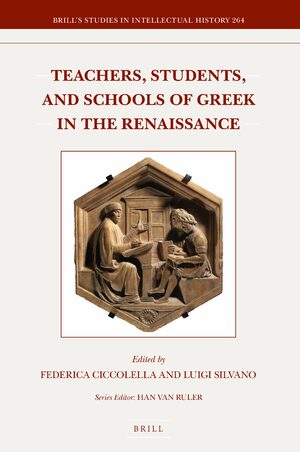
Teachers, students, and schools of Greek in the Renaissance / edited by Federica Ciccolella, Luigi Silvano.
Erişim Adresi
ISBN
9789004338043 (electronic book)
9789004338036 (print)
9789004338036 (print)
Dil Kodu
İngilizce
Yer Numarası
DK/0658
Yayın Bilgisi
Leiden ; Boston : Brill, [2017]
Fiziksel Niteleme
1 online resource (xv, 471 pages) : illustrations (some color)
Dizi
Brill's studies in intellectual history ; v. 264
Bibliyografi, vb. Notu
Includes bibliographical references and indexes.
İçindekiler Notu
Front Matter -- The Transmission and Reception of Manuel Moschopoulos’ Schedography in the West / Fevronia Nousia -- Study Tools in the Humanist Greek School: Preliminary Observations on Greek-Latin Lexica / Antonio Rollo -- Greek at the School of Vittorino da Feltre / Mariarosa Cortesi -- Greek Studies in Giovanni Tortelli’s Orthographia: A World in Transition / Paola Tomè -- Working with Plotinus: A Study of Marsilio Ficino’s Textual and Divinatory Philology / Denis J.-J. Robichaud -- Praeclara librorum suppellectilis: Cretan Manuscripts in Pietro da Portico’s Library / David Speranzi -- Learning Greek in the Land of Otranto: Some Remarks on Sergio Stiso of Zollino and His School / Francesco G. Giannachi -- Antonio Allegri da Correggio: The Greek Inscription in the Hermitage Portrait / Kalle O. Lundahl -- Teaching Greek in Renaissance Rome: Basil Chalcondyles and His Courses on the Odyssey / Luigi Silvano -- Vettor Fausto (1490–1546), Professor of Greek at the School of Saint Mark / Lilia Campana -- Franciscus Bovius Ferrarensis and Joannes Sagomalas Naupliensis: Teaching Elementary Greek in the Mid-Sixteenth Century / Erika Nuti -- Greek in Venetian Crete: Grammars and Schoolbooks from the Library of Francesco Barocci / Federica Ciccolella -- Bibliography -- Indexes.
Özet, vb.
The beginning of the Greek revival in the West is generally attributed to the teaching of the Byzantine scholar Manuel Chrysoloras in Florence between 1397 and 1400. Causes, aspects, and consequences of this important cultural phenomenon still need to be analyzed in depth. The essays collected in this volume examine the development of the study of Greek from the fifteenth to the early sixteenth century, reconstructing its spread and impact on early modern literatures, philosophy, and visual arts. An analysis of the methods and tools used to teach and learn Greek sheds light on the complex cultural relationships between Byzantium and the West and enlarges the traditional picture of the Greek revival in early modern Europe. Contributors are: Lilia Campana, Federica Ciccolella, Mariarosa Cortesi, Francesco G. Giannachi, Fevronia Nousia, Kalle Lundahl, Erika Nuti, Denis Robichaud, Antonio Rollo, Luigi Silvano, David Speranzi, and Paola Tomé.
Konu
Greek philology __ Study and teaching __ History. __ Italy
Renaissance __ Italy.
Humanists __ Italy.
Civilization __ Greek influences. __ fast
Greek philology __ Study and teaching. __ fast
Humanists. __ fast
Intellectual life. __ fast
Renaissance. __ fast
Italy __ Civilization __ Greek influences.
Italy __ Intellectual life __ 1268-1559.
Italy. __ fast
History. __ fast
Renaissance __ Italy.
Humanists __ Italy.
Civilization __ Greek influences. __ fast
Greek philology __ Study and teaching. __ fast
Humanists. __ fast
Intellectual life. __ fast
Renaissance. __ fast
Italy __ Civilization __ Greek influences.
Italy __ Intellectual life __ 1268-1559.
Italy. __ fast
History. __ fast
Diğer Yazarlar
Eseri Alıntıla
Referansları kullanmadan önce gözden geçirmeniz ve varsa gerekli düzeltmeleri yapmanız önerilir.
Dijital Kaynak
MARC Görünümü
LEADER 04537nam 2200613 i 4500
001 601525
003 TR_AnAIT
005 20250627123244
006 m d
007 cr un uuuua
008 170109s2017 ne a sb 001 0 eng d
010 |a2016059359
020 |a9789004338043|q(electronic book)
020 |z9789004338036|q(print)
024 7 |a10.1163/9789004338043|2DOI
035 |a(OCoLC)962553148
040 |aNL-LeKB|cNL-LeKB|erda
041 |aeng
043 |ae-it---
049 |aTürk Tarih Kurumu Kütüphanesi
050 4|aPA78.I8|bT43 2017
072 7|aHIS000000|2bisacsh
082 04|a488.0071/045|223
090 |aDK/0658
245 00|aTeachers, students, and schools of Greek in the Renaissance /|cedited by Federica Ciccolella, Luigi Silvano.
264 1|aLeiden ;|aBoston :|bBrill,|c[2017]
300 |a1 online resource (xv, 471 pages) :|billustrations (some color)
336 |atext|btxt|2rdacontent
337 |acomputer|bc|2rdamedia
338 |aonline resource|2rdacarrier
490 1 |aBrill's studies in intellectual history ;|vv. 264
504 |aIncludes bibliographical references and indexes.
505 00|tFront Matter --|tThe Transmission and Reception of Manuel Moschopoulos’ Schedography in the West /|rFevronia Nousia --|tStudy Tools in the Humanist Greek School: Preliminary Observations on Greek-Latin Lexica /|rAntonio Rollo --|tGreek at the School of Vittorino da Feltre /|rMariarosa Cortesi --|tGreek Studies in Giovanni Tortelli’s Orthographia: A World in Transition /|rPaola Tomè --|tWorking with Plotinus: A Study of Marsilio Ficino’s Textual and Divinatory Philology /|rDenis J.-J. Robichaud --|tPraeclara librorum suppellectilis: Cretan Manuscripts in Pietro da Portico’s Library /|rDavid Speranzi --|tLearning Greek in the Land of Otranto: Some Remarks on Sergio Stiso of Zollino and His School /|rFrancesco G. Giannachi --|tAntonio Allegri da Correggio: The Greek Inscription in the Hermitage Portrait /|rKalle O. Lundahl --|tTeaching Greek in Renaissance Rome: Basil Chalcondyles and His Courses on the Odyssey /|rLuigi Silvano --|tVettor Fausto (1490–1546), Professor of Greek at the School of Saint Mark /|rLilia Campana --|tFranciscus Bovius Ferrarensis and Joannes Sagomalas Naupliensis: Teaching Elementary Greek in the Mid-Sixteenth Century /|rErika Nuti --|tGreek in Venetian Crete: Grammars and Schoolbooks from the Library of Francesco Barocci /|rFederica Ciccolella --|tBibliography --|tIndexes.
506 |aAvailable to subscribing member institutions only.
520 |aThe beginning of the Greek revival in the West is generally attributed to the teaching of the Byzantine scholar Manuel Chrysoloras in Florence between 1397 and 1400. Causes, aspects, and consequences of this important cultural phenomenon still need to be analyzed in depth. The essays collected in this volume examine the development of the study of Greek from the fifteenth to the early sixteenth century, reconstructing its spread and impact on early modern literatures, philosophy, and visual arts. An analysis of the methods and tools used to teach and learn Greek sheds light on the complex cultural relationships between Byzantium and the West and enlarges the traditional picture of the Greek revival in early modern Europe. Contributors are: Lilia Campana, Federica Ciccolella, Mariarosa Cortesi, Francesco G. Giannachi, Fevronia Nousia, Kalle Lundahl, Erika Nuti, Denis Robichaud, Antonio Rollo, Luigi Silvano, David Speranzi, and Paola Tomé.
648 7|a1268-1559|2fast
650 0|aGreek philology|xStudy and teaching|xHistory.|zItaly
650 0|aRenaissance|zItaly.
650 0|aHumanists|zItaly.
650 7|aCivilization|xGreek influences.|2fast
650 7|aGreek philology|xStudy and teaching.|2fast
650 7|aHumanists.|2fast
650 7|aIntellectual life.|2fast
650 7|aRenaissance.|2fast
651 0|aItaly|xCivilization|xGreek influences.
651 0|aItaly|xIntellectual life|y1268-1559.
651 7|aItaly.|2fast
655 7|aHistory.|2fast
700 1 |aCiccolella, Federica.
700 1 |aSilvano, Luigi.
776 08|iOnline version:|tTeachers, students, and schools of Greek in the Renaissance.|dLeiden ; Boston : Brill, 2017|z9789004338043|w(DLC) 2017008166
830 0|aBrill's Studies in Intellectual History|v264.
830 0|aBrill's Studies in Intellectual History Online, Supplement 2017, ISBN: 9789004327979.
856 4 |zDOI:|uhttp://dx.doi.org/10.1163/9789004338043
001 601525
003 TR_AnAIT
005 20250627123244
006 m d
007 cr un uuuua
008 170109s2017 ne a sb 001 0 eng d
010 |a2016059359
020 |a9789004338043|q(electronic book)
020 |z9789004338036|q(print)
024 7 |a10.1163/9789004338043|2DOI
035 |a(OCoLC)962553148
040 |aNL-LeKB|cNL-LeKB|erda
041 |aeng
043 |ae-it---
049 |aTürk Tarih Kurumu Kütüphanesi
050 4|aPA78.I8|bT43 2017
072 7|aHIS000000|2bisacsh
082 04|a488.0071/045|223
090 |aDK/0658
245 00|aTeachers, students, and schools of Greek in the Renaissance /|cedited by Federica Ciccolella, Luigi Silvano.
264 1|aLeiden ;|aBoston :|bBrill,|c[2017]
300 |a1 online resource (xv, 471 pages) :|billustrations (some color)
336 |atext|btxt|2rdacontent
337 |acomputer|bc|2rdamedia
338 |aonline resource|2rdacarrier
490 1 |aBrill's studies in intellectual history ;|vv. 264
504 |aIncludes bibliographical references and indexes.
505 00|tFront Matter --|tThe Transmission and Reception of Manuel Moschopoulos’ Schedography in the West /|rFevronia Nousia --|tStudy Tools in the Humanist Greek School: Preliminary Observations on Greek-Latin Lexica /|rAntonio Rollo --|tGreek at the School of Vittorino da Feltre /|rMariarosa Cortesi --|tGreek Studies in Giovanni Tortelli’s Orthographia: A World in Transition /|rPaola Tomè --|tWorking with Plotinus: A Study of Marsilio Ficino’s Textual and Divinatory Philology /|rDenis J.-J. Robichaud --|tPraeclara librorum suppellectilis: Cretan Manuscripts in Pietro da Portico’s Library /|rDavid Speranzi --|tLearning Greek in the Land of Otranto: Some Remarks on Sergio Stiso of Zollino and His School /|rFrancesco G. Giannachi --|tAntonio Allegri da Correggio: The Greek Inscription in the Hermitage Portrait /|rKalle O. Lundahl --|tTeaching Greek in Renaissance Rome: Basil Chalcondyles and His Courses on the Odyssey /|rLuigi Silvano --|tVettor Fausto (1490–1546), Professor of Greek at the School of Saint Mark /|rLilia Campana --|tFranciscus Bovius Ferrarensis and Joannes Sagomalas Naupliensis: Teaching Elementary Greek in the Mid-Sixteenth Century /|rErika Nuti --|tGreek in Venetian Crete: Grammars and Schoolbooks from the Library of Francesco Barocci /|rFederica Ciccolella --|tBibliography --|tIndexes.
506 |aAvailable to subscribing member institutions only.
520 |aThe beginning of the Greek revival in the West is generally attributed to the teaching of the Byzantine scholar Manuel Chrysoloras in Florence between 1397 and 1400. Causes, aspects, and consequences of this important cultural phenomenon still need to be analyzed in depth. The essays collected in this volume examine the development of the study of Greek from the fifteenth to the early sixteenth century, reconstructing its spread and impact on early modern literatures, philosophy, and visual arts. An analysis of the methods and tools used to teach and learn Greek sheds light on the complex cultural relationships between Byzantium and the West and enlarges the traditional picture of the Greek revival in early modern Europe. Contributors are: Lilia Campana, Federica Ciccolella, Mariarosa Cortesi, Francesco G. Giannachi, Fevronia Nousia, Kalle Lundahl, Erika Nuti, Denis Robichaud, Antonio Rollo, Luigi Silvano, David Speranzi, and Paola Tomé.
648 7|a1268-1559|2fast
650 0|aGreek philology|xStudy and teaching|xHistory.|zItaly
650 0|aRenaissance|zItaly.
650 0|aHumanists|zItaly.
650 7|aCivilization|xGreek influences.|2fast
650 7|aGreek philology|xStudy and teaching.|2fast
650 7|aHumanists.|2fast
650 7|aIntellectual life.|2fast
650 7|aRenaissance.|2fast
651 0|aItaly|xCivilization|xGreek influences.
651 0|aItaly|xIntellectual life|y1268-1559.
651 7|aItaly.|2fast
655 7|aHistory.|2fast
700 1 |aCiccolella, Federica.
700 1 |aSilvano, Luigi.
776 08|iOnline version:|tTeachers, students, and schools of Greek in the Renaissance.|dLeiden ; Boston : Brill, 2017|z9789004338043|w(DLC) 2017008166
830 0|aBrill's Studies in Intellectual History|v264.
830 0|aBrill's Studies in Intellectual History Online, Supplement 2017, ISBN: 9789004327979.
856 4 |zDOI:|uhttp://dx.doi.org/10.1163/9789004338043
Materyaller
Depodan talep edilen materyal sadece kütüphane içerisinde kullanılmaktadır.
Materyal dışarıya ödünç verilmemektedir.
Materyal dışarıya ödünç verilmemektedir.
