

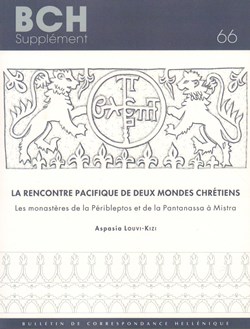
La rencontre pacifique de deux mondes Chrétiens : les monastères de la Péribleptos et de la Pantanassa à Mistra / Aspasia Louvi-Kizi.
Yer Numarası
A.IX/4684
ISBN
9782869585744
Dil Kodu
Fransızca
Kütüphane
Türk Tarih Kurumu Kütüphanesi
Yayın Bilgisi
Athènes : École française d'Athènes (EfA), 2022.
Fiziksel Niteleme
xviii, 416 sayfa : resim (çoğu renkli), harita, plan ; 24 cm.
Dizi
BCH. Supplément, 0304-2456 ; 66
Genel Not
İndeks s. [187]-188.
Bibliyografi, vb. Notu
Seçilmiş bibliyografya s. [161]-185.
Özet, vb.
“En publiant en français cet ouvrage, dont une première version a d'abord paru en grec sous les auspices de l'Académie d'Athènes, l'Ecole française d'Athènes fait connaître les recherches d'une grande spécialiste du Péloponnèse franc et byzantin, Aspasia Louvi-Kizi, dont le travail révèle toute la complexité des formes architecturales, des emprunts et des modèles repérables dans les monuments de la ville byzantine et médiévale de Mistra. Parmi les créations architecturales du couple de despotes, Manuel Cantacuzène (1349-1380) et son épouse Isabelle de Lusignan, qui a façonné Mistra en un centre de pouvoir, Aspasia Louvi-Kizi analyse deux de ses monuments emblématiques, les monastères de la Péribleptos et de la Pantanassa, proposant une nouvelle histoire de leur construction. Des éléments de l'art franc, c'est-à-dire occidental ou gothique, étrangers à la tradition byzantine locale, ont été incorporés dans leur architecture. Distincts de la production franco-byzantine de la principauté voisine d'Achaïe, ces éléments gothiques de Mistra ont plutôt à voir avec l'art occidental de Chypre ; la contribution d'Isabelle à leur introduction dans le Péloponnèse est alors déterminante. Ces éléments occidentaux, qui ornent les clochers et les tours sur les façades, sont combinés avec les éléments byzantins et constituent une véritable expression de la politique pro-occidentale du couple de despotes, en symbiose avec la politique impériale de Constantinople à l'époque. Dans le monde fragmenté et multipolaire de la Méditerranée orientale à la veille de la conquête ottomane, ce livre met ainsi en lumière le rôle de Mistra en tant que centre régional de pouvoir et contribue à sa réinterprétation. En poursuivant ce dialogue international sur un site de renom, l'Ecole française d'Athènes dit aussi son attachement aux regards croisés qui font émerger la complexité des échanges à l'oeuvre dans cette histoire d'un monde grec en transition.“ -- Yayıncı.
“In publishing this book, an early version of which was first published under the auspices of the Academy of Athens, the French School at Athens highlights the research work of Aspasia Louvi-Kizi, an eminent specialist in the Frank and Byzantine Peloponnese, whose work reveals all of the complexity of the architectural forms, influences and models at work in the monuments of the medieval Byzantine city of Mystras. Out of all of the architecture created by the despotic couple formed by Manuel Cantacuzène (1349-1380) and his wife Isabelle de Lusignan, who were instrumental in turning Mystras into a centre of power, Aspasia Louvi-Kizi focuses on two of the city’s most iconic monuments, the monasteries of Peribleptos and Pantanassa, proposing a new history of their construction. Their architecture incorporates elements of Frank art, meaning western or gothic art, which were foreign to the local Byzantine tradition. The gothic aspect of Mystras’ architecture, as distinct from the Franco-Byzantine influences in the neighbouring crusader principality of Achaea, has more to do with Western art in Cyprus, and its introduction by Isabelle to the Peloponnese was to prove decisive. The Western elements that decorate the facades of clocks and towers, combined with the Byzantine features to constitute a concrete expression of the despotic couple’s pro-Western politics, in line with the imperial politics of Constantinople at the time. In the fragmented and multipolar world of the Eastern Mediterranean on the eve of the Ottoman conquest, this book highlights the role Mystras played as a centre of power in the region and, in doing so, contributes to a fresh take on the city as a whole.” -- Arka kapak.
“In publishing this book, an early version of which was first published under the auspices of the Academy of Athens, the French School at Athens highlights the research work of Aspasia Louvi-Kizi, an eminent specialist in the Frank and Byzantine Peloponnese, whose work reveals all of the complexity of the architectural forms, influences and models at work in the monuments of the medieval Byzantine city of Mystras. Out of all of the architecture created by the despotic couple formed by Manuel Cantacuzène (1349-1380) and his wife Isabelle de Lusignan, who were instrumental in turning Mystras into a centre of power, Aspasia Louvi-Kizi focuses on two of the city’s most iconic monuments, the monasteries of Peribleptos and Pantanassa, proposing a new history of their construction. Their architecture incorporates elements of Frank art, meaning western or gothic art, which were foreign to the local Byzantine tradition. The gothic aspect of Mystras’ architecture, as distinct from the Franco-Byzantine influences in the neighbouring crusader principality of Achaea, has more to do with Western art in Cyprus, and its introduction by Isabelle to the Peloponnese was to prove decisive. The Western elements that decorate the facades of clocks and towers, combined with the Byzantine features to constitute a concrete expression of the despotic couple’s pro-Western politics, in line with the imperial politics of Constantinople at the time. In the fragmented and multipolar world of the Eastern Mediterranean on the eve of the Ottoman conquest, this book highlights the role Mystras played as a centre of power in the region and, in doing so, contributes to a fresh take on the city as a whole.” -- Arka kapak.
Konu
Peribleptos Manastırı (Mistra, Yunanistan)
Pantanassa Manastırı (Mistra, Yunanistan)
Bizans mimarisi__Yunanistan__Mistra__Orta Çağ.
Manastırlar__Yunanistan__Mistra__Orta Çağ.
Mimari, Bizans__Yunanistan__Mistra.
Dekoratif sanatlar, Frenk__Yunanistan__Mistra.
Mistra (Yunanistan)__Tarih.
Mistra (Yunanistan)__Binalar ve yapılar.
Mistra (Yunanistan)__Eski eserler, Bizans.
Pantanassa Manastırı (Mistra, Yunanistan)
Bizans mimarisi__Yunanistan__Mistra__Orta Çağ.
Manastırlar__Yunanistan__Mistra__Orta Çağ.
Mimari, Bizans__Yunanistan__Mistra.
Dekoratif sanatlar, Frenk__Yunanistan__Mistra.
Mistra (Yunanistan)__Tarih.
Mistra (Yunanistan)__Binalar ve yapılar.
Mistra (Yunanistan)__Eski eserler, Bizans.
Dizi Ek Girişi- Tek Biçim Başlık
Bulletin de correspondance hellénique. Supplément ; 66.
BCH. Supplément ; 66.
BCH. Supplément ; 66.
Eseri Alıntıla
Referansları kullanmadan önce gözden geçirmeniz ve varsa gerekli düzeltmeleri yapmanız önerilir.
Dijital Kaynak
MARC Görünümü
LEADER 05288naaa22200409 a04500
001 601619
003 TR_AnAIT
005 20250627122918
006 aobe|e |||| 001 0
007 ta
008 221125s2022 gr obe|e |||| 001 0 fre c
020 |a9782869585744
040 |aTTK
041 |afre
049 |aTürk Tarih Kurumu Kütüphanesi
090 |aA.IX/4684
100 1 |aLouvi-Kizi, Aspasia,|d1952-
245 13|aLa rencontre pacifique de deux mondes Chrétiens :|bles monastères de la Péribleptos et de la Pantanassa à Mistra /|cAspasia Louvi-Kizi.
260 |aAthènes :|bÉcole française d'Athènes (EfA),|c2022.
300 |axviii, 416 sayfa :|bresim (çoğu renkli), harita, plan ;|c24 cm.
490 1 |aBCH.|aSupplément,|x0304-2456 ;|v66
500 |aİndeks s. [187]-188.
504 |aSeçilmiş bibliyografya s. [161]-185.
520 |a“En publiant en français cet ouvrage, dont une première version a d'abord paru en grec sous les auspices de l'Académie d'Athènes, l'Ecole française d'Athènes fait connaître les recherches d'une grande spécialiste du Péloponnèse franc et byzantin, Aspasia Louvi-Kizi, dont le travail révèle toute la complexité des formes architecturales, des emprunts et des modèles repérables dans les monuments de la ville byzantine et médiévale de Mistra. Parmi les créations architecturales du couple de despotes, Manuel Cantacuzène (1349-1380) et son épouse Isabelle de Lusignan, qui a façonné Mistra en un centre de pouvoir, Aspasia Louvi-Kizi analyse deux de ses monuments emblématiques, les monastères de la Péribleptos et de la Pantanassa, proposant une nouvelle histoire de leur construction. Des éléments de l'art franc, c'est-à-dire occidental ou gothique, étrangers à la tradition byzantine locale, ont été incorporés dans leur architecture. Distincts de la production franco-byzantine de la principauté voisine d'Achaïe, ces éléments gothiques de Mistra ont plutôt à voir avec l'art occidental de Chypre ; la contribution d'Isabelle à leur introduction dans le Péloponnèse est alors déterminante. Ces éléments occidentaux, qui ornent les clochers et les tours sur les façades, sont combinés avec les éléments byzantins et constituent une véritable expression de la politique pro-occidentale du couple de despotes, en symbiose avec la politique impériale de Constantinople à l'époque. Dans le monde fragmenté et multipolaire de la Méditerranée orientale à la veille de la conquête ottomane, ce livre met ainsi en lumière le rôle de Mistra en tant que centre régional de pouvoir et contribue à sa réinterprétation. En poursuivant ce dialogue international sur un site de renom, l'Ecole française d'Athènes dit aussi son attachement aux regards croisés qui font émerger la complexité des échanges à l'oeuvre dans cette histoire d'un monde grec en transition.“ --|cYayıncı.
520 |a“In publishing this book, an early version of which was first published under the auspices of the Academy of Athens, the French School at Athens highlights the research work of Aspasia Louvi-Kizi, an eminent specialist in the Frank and Byzantine Peloponnese, whose work reveals all of the complexity of the architectural forms, influences and models at work in the monuments of the medieval Byzantine city of Mystras. Out of all of the architecture created by the despotic couple formed by Manuel Cantacuzène (1349-1380) and his wife Isabelle de Lusignan, who were instrumental in turning Mystras into a centre of power, Aspasia Louvi-Kizi focuses on two of the city’s most iconic monuments, the monasteries of Peribleptos and Pantanassa, proposing a new history of their construction. Their architecture incorporates elements of Frank art, meaning western or gothic art, which were foreign to the local Byzantine tradition. The gothic aspect of Mystras’ architecture, as distinct from the Franco-Byzantine influences in the neighbouring crusader principality of Achaea, has more to do with Western art in Cyprus, and its introduction by Isabelle to the Peloponnese was to prove decisive. The Western elements that decorate the facades of clocks and towers, combined with the Byzantine features to constitute a concrete expression of the despotic couple’s pro-Western politics, in line with the imperial politics of Constantinople at the time. In the fragmented and multipolar world of the Eastern Mediterranean on the eve of the Ottoman conquest, this book highlights the role Mystras played as a centre of power in the region and, in doing so, contributes to a fresh take on the city as a whole.” --|cArka kapak.
610 24|aPeribleptos Manastırı (Mistra, Yunanistan)
610 24|aPantanassa Manastırı (Mistra, Yunanistan)
650 4|aBizans mimarisi|zYunanistan|zMistra|yOrta Çağ.
650 4|aManastırlar|zYunanistan|zMistra|yOrta Çağ.
650 4|aMimari, Bizans|zYunanistan|zMistra.
650 4|aDekoratif sanatlar, Frenk|zYunanistan|zMistra.
651 4|aMistra (Yunanistan)|xTarih.
651 4|aMistra (Yunanistan)|xBinalar ve yapılar.
651 4|aMistra (Yunanistan)|xEski eserler, Bizans.
830 0|aBulletin de correspondance hellénique.|pSupplément ;|v66.
830 0|aBCH.|aSupplément ;|v66.
001 601619
003 TR_AnAIT
005 20250627122918
006 aobe|e |||| 001 0
007 ta
008 221125s2022 gr obe|e |||| 001 0 fre c
020 |a9782869585744
040 |aTTK
041 |afre
049 |aTürk Tarih Kurumu Kütüphanesi
090 |aA.IX/4684
100 1 |aLouvi-Kizi, Aspasia,|d1952-
245 13|aLa rencontre pacifique de deux mondes Chrétiens :|bles monastères de la Péribleptos et de la Pantanassa à Mistra /|cAspasia Louvi-Kizi.
260 |aAthènes :|bÉcole française d'Athènes (EfA),|c2022.
300 |axviii, 416 sayfa :|bresim (çoğu renkli), harita, plan ;|c24 cm.
490 1 |aBCH.|aSupplément,|x0304-2456 ;|v66
500 |aİndeks s. [187]-188.
504 |aSeçilmiş bibliyografya s. [161]-185.
520 |a“En publiant en français cet ouvrage, dont une première version a d'abord paru en grec sous les auspices de l'Académie d'Athènes, l'Ecole française d'Athènes fait connaître les recherches d'une grande spécialiste du Péloponnèse franc et byzantin, Aspasia Louvi-Kizi, dont le travail révèle toute la complexité des formes architecturales, des emprunts et des modèles repérables dans les monuments de la ville byzantine et médiévale de Mistra. Parmi les créations architecturales du couple de despotes, Manuel Cantacuzène (1349-1380) et son épouse Isabelle de Lusignan, qui a façonné Mistra en un centre de pouvoir, Aspasia Louvi-Kizi analyse deux de ses monuments emblématiques, les monastères de la Péribleptos et de la Pantanassa, proposant une nouvelle histoire de leur construction. Des éléments de l'art franc, c'est-à-dire occidental ou gothique, étrangers à la tradition byzantine locale, ont été incorporés dans leur architecture. Distincts de la production franco-byzantine de la principauté voisine d'Achaïe, ces éléments gothiques de Mistra ont plutôt à voir avec l'art occidental de Chypre ; la contribution d'Isabelle à leur introduction dans le Péloponnèse est alors déterminante. Ces éléments occidentaux, qui ornent les clochers et les tours sur les façades, sont combinés avec les éléments byzantins et constituent une véritable expression de la politique pro-occidentale du couple de despotes, en symbiose avec la politique impériale de Constantinople à l'époque. Dans le monde fragmenté et multipolaire de la Méditerranée orientale à la veille de la conquête ottomane, ce livre met ainsi en lumière le rôle de Mistra en tant que centre régional de pouvoir et contribue à sa réinterprétation. En poursuivant ce dialogue international sur un site de renom, l'Ecole française d'Athènes dit aussi son attachement aux regards croisés qui font émerger la complexité des échanges à l'oeuvre dans cette histoire d'un monde grec en transition.“ --|cYayıncı.
520 |a“In publishing this book, an early version of which was first published under the auspices of the Academy of Athens, the French School at Athens highlights the research work of Aspasia Louvi-Kizi, an eminent specialist in the Frank and Byzantine Peloponnese, whose work reveals all of the complexity of the architectural forms, influences and models at work in the monuments of the medieval Byzantine city of Mystras. Out of all of the architecture created by the despotic couple formed by Manuel Cantacuzène (1349-1380) and his wife Isabelle de Lusignan, who were instrumental in turning Mystras into a centre of power, Aspasia Louvi-Kizi focuses on two of the city’s most iconic monuments, the monasteries of Peribleptos and Pantanassa, proposing a new history of their construction. Their architecture incorporates elements of Frank art, meaning western or gothic art, which were foreign to the local Byzantine tradition. The gothic aspect of Mystras’ architecture, as distinct from the Franco-Byzantine influences in the neighbouring crusader principality of Achaea, has more to do with Western art in Cyprus, and its introduction by Isabelle to the Peloponnese was to prove decisive. The Western elements that decorate the facades of clocks and towers, combined with the Byzantine features to constitute a concrete expression of the despotic couple’s pro-Western politics, in line with the imperial politics of Constantinople at the time. In the fragmented and multipolar world of the Eastern Mediterranean on the eve of the Ottoman conquest, this book highlights the role Mystras played as a centre of power in the region and, in doing so, contributes to a fresh take on the city as a whole.” --|cArka kapak.
610 24|aPeribleptos Manastırı (Mistra, Yunanistan)
610 24|aPantanassa Manastırı (Mistra, Yunanistan)
650 4|aBizans mimarisi|zYunanistan|zMistra|yOrta Çağ.
650 4|aManastırlar|zYunanistan|zMistra|yOrta Çağ.
650 4|aMimari, Bizans|zYunanistan|zMistra.
650 4|aDekoratif sanatlar, Frenk|zYunanistan|zMistra.
651 4|aMistra (Yunanistan)|xTarih.
651 4|aMistra (Yunanistan)|xBinalar ve yapılar.
651 4|aMistra (Yunanistan)|xEski eserler, Bizans.
830 0|aBulletin de correspondance hellénique.|pSupplément ;|v66.
830 0|aBCH.|aSupplément ;|v66.
Materyaller
Depodan talep edilen materyal sadece kütüphane içerisinde kullanılmaktadır.
Materyal dışarıya ödünç verilmemektedir.
Materyal dışarıya ödünç verilmemektedir.
