

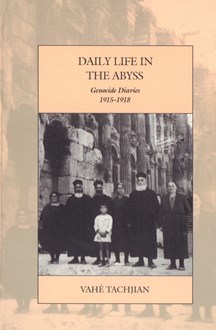
Daily life in the abyss : genocide diaries, 1915-1918 / Vahé Tachjian.
Yer Numarası
A.IX/5656
ISBN
9781785334948 (hardback)
9781785334955 (ebook)
9781785334955 (ebook)
Dil Kodu
İngilizce
Kütüphane
Türk Tarih Kurumu Kütüphanesi
Yazar
Yayın Bilgisi
New York : Berghahn, 2017.
Fiziksel Niteleme
ix, 208, [2] sayfa : resim, portre, harita, tablo ; 24 cm.
Dizi
War and genocide ; volume 25
Genel Not
Sözlük s. [199]-200.
İndeks s. [201]-208.
İndeks s. [201]-208.
Bibliyografi, vb. Notu
Bibliyografya bölüm sonlarındadır.
İçindekiler Notu
The diarist, his environment, and the reasons for keeping a diary -- The deportees in the region of Bilad al-Sham: a race against time at breakneck -- Speed -- The circle of salvation in extreme conditions: money-food-connections -- Descriptions of the deportees' decline: the deaths of Shoghagat, Hagop, Krikor, Diruhi, and many others -- From forced Islamacization to emancipation: two historical episodes and their Contradictions -- Afterword.
Özet, vb.
“Historical research into the Armenian Genocide has grown tremendously in recent years, but much of it has focused on large-scale questions related to Ottoman policy or the scope of the killing. Consequently, surprisingly little is known about the actual experiences of the genocide’s victims. Daily Life in the Abyss illuminates this aspect through the intertwined stories of two Armenian families who endured forced relocation and deprivation in and around modern-day Syria. Through analysis of diaries and other source material, it reconstructs the rhythms of daily life within an often bleak and hostile environment, in the face of a gradually disintegrating social fabric“ -- Yayıncı.
Konu
Dizi Ek Girişi- Tek Biçim Başlık
War and genocide ; v. 25.
