

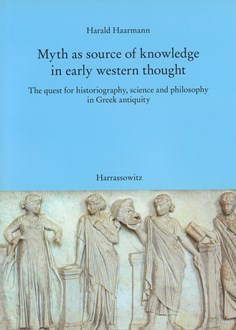
Myth as source of knowledge in early Western thought : the quest for historiography, science and philosophy in Greek antiquity / Harald Haarmann.
Yer Numarası
A.IX/5137
ISBN
9783447103626
Dil Kodu
İngilizce
Kütüphane
Türk Tarih Kurumu Kütüphanesi
Yazar
Eser Adının Farklı Biçimi
The quest for historiography, science and philosophy in Greek antiquit
Yayın Bilgisi
Wiesbaden : Harrassowitz, 2015.
Fiziksel Niteleme
viii, 282 sayfa : resim, şekil, harita, tablo ; 24 cm.
Genel Not
İndeks s. [277]-282.
Bibliyografi, vb. Notu
Bibliyografya s. [253]-273.
İçindekiler Notu
Myth through the ages: Crafting realities in a mythopoeic key -- Myth and knowledge: An intimate yet little known relationship -- Exploring the world through myth: The organic whole and its mythopoeic conceptualizations -- History before writing: Foundational myths as building-blocks for knowledge-construction -- Myth-making as social and political agency: Myths as vehicles for group solidarity and ethnic self-identification -- Preconditions for the making of history and of philosophy: The inter-relation of orality and literacy -- Conceptualizing divinely inspired order: The endeavour of pre-Socratic philosophers to rationalize mythical truths -- Myth into historiography: Herodotus and his mytho-historical world -- Myth into philosophy -- Hellenistic transformations: Stigmatizing myth as source of knowledge -- Epilogue: The ideology of myth-dismissal and the cult of reason in the New Era.
Özet, vb.
“The perception of intellectual life in Greek antiquity by the representatives of the European Enlightenment of the 18th century favoured the establishment of the cult of reason. Myth as a potential source of knowledge was disregarded: instead, the monopoly of truth-finding through pure rationalisation was asserted. This tendency, positing, as it did, reason in opposition to myth, did a signal disservice to the realities of intellectual life among the ancient Greeks. Nevertheless, these distortions of the Enlightenment have conditioned our approach to education and have led to our privileging of reason as a mode of enquiry right up to the present day.
The ancient Greek intellectuals (i.e. the pre-Socratic philosophers, the early historiographers, philosophers of the classical age) did not set myth (mythos) and reason (logos) in opposition to each other. In fact, they benefited from both as differing modes of enquiry, each in its own right and possessing its own value. Plato, in his reasoning, was much concerned with the proper use of mythical narrative. In one of his dialogues, he even coined a new term for explaining how mythical topics and motifs should be exploited as a source of knowledge. This term is mythologia, and it first occurs in Plato’s Republic (394b).
The present study aims to offer a corrective to traditional clichés and received wisdom about intellectual life in ancient Greece. The work proposes, and aims to reconstruct, a mental landscape in which myth and reason connect and vividly interact, and in which the concepts of mythos and logos are intertwined in the terminological network of the ancient Greek language“ -- Yayıncı.
Eseri Alıntıla
Referansları kullanmadan önce gözden geçirmeniz ve varsa gerekli düzeltmeleri yapmanız önerilir.
Dijital Kaynak
MARC Görünümü
LEADER 03812nama222003618a 4500
001 601892
003 TR_AnAIT
005 20250627121705
006 aobd|e |||| 001 0
007 ta
008 230103s2015 gw obd|e |||| 001 0 eng c
020 |a9783447103626
041 |aeng
049 |aTürk Tarih Kurumu Kütüphanesi
090 |aA.IX/5137
100 1 |aHaarmann, Harald,|d1946-
245 10|aMyth as source of knowledge in early Western thought :|bthe quest for historiography, science and philosophy in Greek antiquity /|cHarald Haarmann.
246 14|aThe quest for historiography, science and philosophy in Greek antiquit
260 |aWiesbaden :|bHarrassowitz,|c2015.
300 |aviii, 282 sayfa :|bresim, şekil, harita, tablo ;|c24 cm.
500 |aİndeks s. [277]-282.
504 |aBibliyografya s. [253]-273.
505 |tMyth through the ages: Crafting realities in a mythopoeic key --|tMyth and knowledge: An intimate yet little known relationship --|tExploring the world through myth: The organic whole and its mythopoeic conceptualizations --|tHistory before writing: Foundational myths as building-blocks for knowledge-construction --|tMyth-making as social and political agency: Myths as vehicles for group solidarity and ethnic self-identification --|tPreconditions for the making of history and of philosophy: The inter-relation of orality and literacy --|tConceptualizing divinely inspired order: The endeavour of pre-Socratic philosophers to rationalize mythical truths --|tMyth into historiography: Herodotus and his mytho-historical world --|tMyth into philosophy --|tHellenistic transformations: Stigmatizing myth as source of knowledge --|tEpilogue: The ideology of myth-dismissal and the cult of reason in the New Era.
520 |a“The perception of intellectual life in Greek antiquity by the representatives of the European Enlightenment of the 18th century favoured the establishment of the cult of reason. Myth as a potential source of knowledge was disregarded: instead, the monopoly of truth-finding through pure rationalisation was asserted. This tendency, positing, as it did, reason in opposition to myth, did a signal disservice to the realities of intellectual life among the ancient Greeks. Nevertheless, these distortions of the Enlightenment have conditioned our approach to education and have led to our privileging of reason as a mode of enquiry right up to the present day.
The ancient Greek intellectuals (i.e. the pre-Socratic philosophers, the early historiographers, philosophers of the classical age) did not set myth (mythos) and reason (logos) in opposition to each other. In fact, they benefited from both as differing modes of enquiry, each in its own right and possessing its own value. Plato, in his reasoning, was much concerned with the proper use of mythical narrative. In one of his dialogues, he even coined a new term for explaining how mythical topics and motifs should be exploited as a source of knowledge. This term is mythologia, and it first occurs in Plato’s Republic (394b).
The present study aims to offer a corrective to traditional clichés and received wisdom about intellectual life in ancient Greece. The work proposes, and aims to reconstruct, a mental landscape in which myth and reason connect and vividly interact, and in which the concepts of mythos and logos are intertwined in the terminological network of the ancient Greek language“ --|cYayıncı.
650 4|aFelsefe, Antik.
650 4|aFelsefe, Antik|xEtki.
650 4|aMitoloji, Antik Yunan.
651 4|aYunanistan, Antik|xEntelektüel yaşam.
651 4|aYunanistan, Antik|xTarih yazıcılığı.
651 4|aYunanistan, Antik|xBilim.
651 4|aYunanistan, Antik|xMedeniyet.
651 4|aYunanistan, Antik|xEski eserler.
001 601892
003 TR_AnAIT
005 20250627121705
006 aobd|e |||| 001 0
007 ta
008 230103s2015 gw obd|e |||| 001 0 eng c
020 |a9783447103626
041 |aeng
049 |aTürk Tarih Kurumu Kütüphanesi
090 |aA.IX/5137
100 1 |aHaarmann, Harald,|d1946-
245 10|aMyth as source of knowledge in early Western thought :|bthe quest for historiography, science and philosophy in Greek antiquity /|cHarald Haarmann.
246 14|aThe quest for historiography, science and philosophy in Greek antiquit
260 |aWiesbaden :|bHarrassowitz,|c2015.
300 |aviii, 282 sayfa :|bresim, şekil, harita, tablo ;|c24 cm.
500 |aİndeks s. [277]-282.
504 |aBibliyografya s. [253]-273.
505 |tMyth through the ages: Crafting realities in a mythopoeic key --|tMyth and knowledge: An intimate yet little known relationship --|tExploring the world through myth: The organic whole and its mythopoeic conceptualizations --|tHistory before writing: Foundational myths as building-blocks for knowledge-construction --|tMyth-making as social and political agency: Myths as vehicles for group solidarity and ethnic self-identification --|tPreconditions for the making of history and of philosophy: The inter-relation of orality and literacy --|tConceptualizing divinely inspired order: The endeavour of pre-Socratic philosophers to rationalize mythical truths --|tMyth into historiography: Herodotus and his mytho-historical world --|tMyth into philosophy --|tHellenistic transformations: Stigmatizing myth as source of knowledge --|tEpilogue: The ideology of myth-dismissal and the cult of reason in the New Era.
520 |a“The perception of intellectual life in Greek antiquity by the representatives of the European Enlightenment of the 18th century favoured the establishment of the cult of reason. Myth as a potential source of knowledge was disregarded: instead, the monopoly of truth-finding through pure rationalisation was asserted. This tendency, positing, as it did, reason in opposition to myth, did a signal disservice to the realities of intellectual life among the ancient Greeks. Nevertheless, these distortions of the Enlightenment have conditioned our approach to education and have led to our privileging of reason as a mode of enquiry right up to the present day.
The ancient Greek intellectuals (i.e. the pre-Socratic philosophers, the early historiographers, philosophers of the classical age) did not set myth (mythos) and reason (logos) in opposition to each other. In fact, they benefited from both as differing modes of enquiry, each in its own right and possessing its own value. Plato, in his reasoning, was much concerned with the proper use of mythical narrative. In one of his dialogues, he even coined a new term for explaining how mythical topics and motifs should be exploited as a source of knowledge. This term is mythologia, and it first occurs in Plato’s Republic (394b).
The present study aims to offer a corrective to traditional clichés and received wisdom about intellectual life in ancient Greece. The work proposes, and aims to reconstruct, a mental landscape in which myth and reason connect and vividly interact, and in which the concepts of mythos and logos are intertwined in the terminological network of the ancient Greek language“ --|cYayıncı.
650 4|aFelsefe, Antik.
650 4|aFelsefe, Antik|xEtki.
650 4|aMitoloji, Antik Yunan.
651 4|aYunanistan, Antik|xEntelektüel yaşam.
651 4|aYunanistan, Antik|xTarih yazıcılığı.
651 4|aYunanistan, Antik|xBilim.
651 4|aYunanistan, Antik|xMedeniyet.
651 4|aYunanistan, Antik|xEski eserler.
Materyaller
Depodan talep edilen materyal sadece kütüphane içerisinde kullanılmaktadır.
Materyal dışarıya ödünç verilmemektedir.
Materyal dışarıya ödünç verilmemektedir.
