LEADER 03470nama222004578a 4500
001 601897
003 TR_AnAIT
005 20250627121639
006 aobede |||| 000 0
007 ta
008 230206s2021 gw obede |||| 000 0 eng c
020 |a9783447108294
020 |a9783447196086|q(ebook)
041 |aeng
049 |aTürk Tarih Kurumu Kütüphanesi
090 |aA.IX/5216
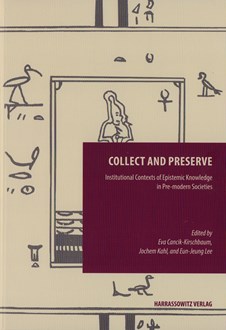
245 00|aCollect and preserve :|binstitutional contexts of epistemic knowledge in pre-modern societies /|cedited by Eva Cancik-Kirschbaum, Jochem Kahl, Eun-Jung Lee.
246 1 |aInstitutional contexts of epistemic knowledge in pre-modern societies
260 |aWiesbaden :|bHarrassowitz Verlag,|c2021.
300 |ax, 230 sayfa, [10] sayfa resim (renkli) :|bresim (renkli), harita, plan, grafik, tablo ;|c24 cm.
490 1 |aEpisteme in Bewegung,|x2365-5666 ;|vband 9
504 |aBibliyografya makale sonlarındadır.
505 |tIntroduction --|tThe Epistemic Legacy: Studying the collection, preservation, and transfer of knowledge in premodern societies /|rEva Cancik-Kirschbaum, Jochem Kahl, Eun-Jeung Lee --|tThe Storage of Papyri in Ancient Egypt /|rKim Ryholt --|tThe Egyptian Tomb as an Epistemic Site /|rJochem Kahl --|tThe network of the Babylonian Libraries in the First Millennium BC /|rPhilippe Clancier --|tCitation and Counter-citation in Classical Sumerian Scholastic Dialogue /|rJ. Cale Johnson --|tThe Hōzō, Treasure House, as Topos of Knowledge or Archive: The Formation and Expansion of the Legacy of Intellectual Knowledge in Japan /|rYasurō Abe --|t“No Books to Leave, No Women to Enter”: Confucian Academies in Pre-Modern Korea and Their Book Collections /|rVladimír Glomb, Eun-Jeung Lee --|tThe Archives of the P’ungsan Ryu Clan /|rMyungja Kim --|tThe Libraries of Royal Palaces in the Late Chosŏn Dynasty /|rOk Young Jung --|tList of Contributors --|tPlates
520 |a“The use of writing for the preservation and transmission of administrative, scientific, literary and sacred knowledge has a long history. From the third millennium BCE on, many forms of social processes - intellectual, religious, political and others - have been increasingly materialized in the form of a variety of document types (tablets, bones, papyri, scrolls, parchments, books). Some of them were collected in archives or libraries that were dependent on royal palaces, governmental institutions and temples but also in private contexts. The publication 'Collect and Preserve' assembles a number of studies devoted to material aspects of collecting texts in ancient Egypt, Mesopotamia, Medieval Japan, and Korea” –|cArka kapak.
650 4|aArşivler|xTarih|y500'e kadar.
650 4|aArşivler|xTarih|yOrta Çağ.
650 4|aArşivler|zMısır|xTarih|y500'e kadar.
650 4|aArşivler|zMısır|xTarih|yOrta Çağ.
650 4|aArşivler|zOrta Doğu|xTarih|y500'e kadar.
650 4|aArşivler|zOrta Doğu|xTarih|yOrta Çağ.
650 4|aArşivler|zJaponya|xTarih|y500-1500.
650 4|aArşivler|zJaponya|xTarih|yOrta Çağ.
650 4|aArşivler|zKore|xTarih.
650 4|aArşivler|zKore|xTarih|yOrta Çağ.
650 4|aKütüphaneler|xTarih|y400'e kadar.
650 4|aBilgi felsefesi|xTarih.
650 4|aBilgi sosyolojisi.
700 1 |aCancik-Kirschbaum, Eva Christiane,|eeditör.
700 1 |aKahl, Jochem,|d1961-|eeditör.
700 1 |aLee, Eun-Jung,|eeditör.
830 |aEpisteme in Bewegung ;|vband 9