LEADER 03303nama222003498a 4500
001 601917
003 TR_AnAIT
005 20250627121501
006 aocabe |||| 101 0
007 ta
008 230120s2021 ocabe |||| 101 0 eng
020 |a9783447116831|q(Hardback)
020 |a9783447391696|q(e-book)
041 |aeng
049 |aTürk Tarih Kurumu Kütüphanesi
090 |aA.IX/5180
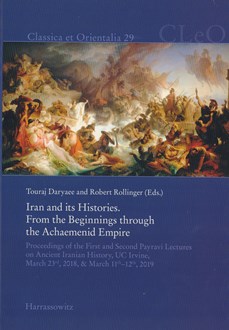
245 00|aIran and its histories :|bfrom the beginnings through the Achaemenid Empire : proceedings of the first and second Payravi lectures on Ancient Iranian history, UC Irvine, March 23rd, 2018, & March 11th-12th, 2019 /|cedited by Touraj Daryaee and Robert Rollinger.
260 |aWiesbaden :|bHarrassowitz Verlag,|c2021.
300 |aix, 386 sayfa :|bresim (kimi renkli), portre, çizim, harita (renkli), tıpkıbasım, tablo ;|c24 cm.
490 1 |aClassica et orientalia,|x2190-3638 ;|vband 29
500 |aİndeks s. [379]-386.
504 |aBibliyografya bildiri sonlarındadır.
520 |a“Dealing with the “history” of Iran is a challenge for many reasons. “Iran” is a term with different meanings through the ages. Today, it refers to the boundaries of modern Iran, but historically and culturally it covers a much larger territory. The western term “Persia” exemplifies these uncertainties for it is used colloquially as a synonym for “Iran,” but can also refer to the Achaemenid, Arsacid or Sasanian Empires and later empires on the Iranian Plateau. Besides these geographical ambiguities there is also the “ethnic” and linguistic dimension of the term “Iran”. Iranian languages are a major branch of the Indo-European language family and people using these languages have played a decisive role in the history of “Iran” since the first millennium BCE. How should we situate the ‘autochthonous՚ civilizations on the plateau, such as those at Konar Sandal (Jiroft), Sialk in Kashan, or for that matter the region of Elam with its longue durée history and influence? So what does it mean when we talk about “Persia” and “Iran” from a historical point of view?
This volume brings together the contributions of the first and second Payravi conferences on Ancient Iranian History, held at the University of California Irvine in 2018 and 2019. The 16 contributions united in this volume tackle various problems of early Iranian history in many ways. They cover a wide range of time, from the Paleolithic to the end of the Achaemenid empire and Alexander III (“the Great”) and give vibrant insights into the dynamic processes of the history of Iran within the framework of the most recent results of scholarly research“ --|cYayıncı.
651 4|aİran|xTarih|y640’a kadar|vKongreler.
651 4|aİran|xTarih|zAhameniş Hanedanı, MÖ 550-330|vKongreler.
651 4|aİran|xTarih|yMÖ 330’a kadar|vKongreler.
651 4|aİran|xTarih|yİslam öncesi|vKongreler.
700 1 |aDaryaee, Touraj,|d1967-|eeditör.
700 1 |aRollinger, Robert,|d1964-|eeditör.
711 2 |aPayravi Conferences on Ancient Iranian History|n(1. :|d2018 :|cUniversity of California, Irvine)
711 |aPayravi Conferences on Ancient Iranian History|n(2. :|d2019 :|cUniversity of California, Irvine)
830 0|aClassica et orientalia ;|vband 29.