

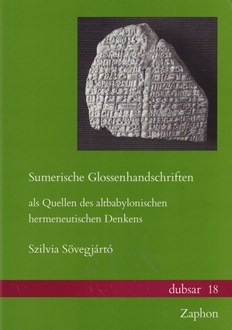
Sumerische Glossenhandschriften als Quellen des altbabylonischen hermeneutischen Denkens / Szilvia Sövegjártó.
Yer Numarası
A.IX/5195
ISBN
9783963271045
Dil Kodu
Almanca
Kütüphane
Türk Tarih Kurumu Kütüphanesi
Yayın Bilgisi
Münster : Zaphon, 2020.
Fiziksel Niteleme
viii, 425 sayfa : resim, harita, grafik, tablo ; 24 cm.
Dizi
Dubsar. Altorientalische Publikationen ; band 18
Genel Not
Eser yazarın, 2017 yılında Université d'Iéna’ya sunduğu Doktora tezine dayanmaktadır.
Bibliyografi, vb. Notu
Bibliyografya s. [405]-425.
Özet, vb.
“Szilvia Sövegjártó's study discusses the multilingualism in Mesopotamia of the Old Babylonian period, specifically those Sumerian manuscripts, which are supplemented by Akkadian glosses. First, the cultural-historical background that brought the glosses to life is presented; the glosses are placed in context and compared with other phenomena, especially linguistic and written-historical phenomena, which shaped the bilingual milieu of the ancient Babylonian period (Chapter 2). This is followed by an overview of the glossed manuscripts as part of a praxeologically oriented analysis; This investigation aims to determine the level of education or the qualifications of the authors in more detail with regard to the question of whether the glosses (i) with training, (ii) with scientific, especially cultic-magical practice or (iii ) are to be linked with the transmission and research of a (literary) corpus that emerged earlier (Chapter 3). Chapter 4 is devoted to examining the glosses themselves. Formal and functional aspects are taken into account to show how and for what the glosses were written. An excursus on the bilingual texts of the ancient Babylonian period supplements these considerations (Chapter 5). Then the question of how hermeneutic thinking functioned in the Old Babylonian period and in what way the glosses can be classified in this premodern philological tradition is discussed. This epistemological approach attempts to place the glosses in a broader context of ancient oriental scientific practice (Chapter 6). Chapter 7 introduces glossing as a text-critical apparatus and compares it with other methods of textual criticism that were available in Old Babylonian times. Following the conclusion (Chapter 8), all of the glosses examined are presented in separate editions and extensively commented on (Chapter 9). Detailed glossaries, catalogues and directories complete the study” -- Yayıncı.
Dizi Ek Girişi- Tek Biçim Başlık
Dubsar. Publications on the Ancient Near Eaast ; 18.
Dubsar, 2627-7174 ; 18.
Dubsar ; band 18.
Dubsar, 2627-7174 ; 18.
Dubsar ; band 18.
