

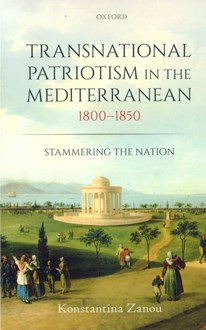
Transnational patriotism in the Mediterranean, 1800-1850 : stammering the nation / Konstantina Zanou.
Yer Numarası
A.IX/5067
ISBN
9780198788706
Dil Kodu
İngilizce
Kütüphane
Türk Tarih Kurumu Kütüphanesi
Basım Bildirimi
First edition [1. baskı]
Yayın Bilgisi
Oxford : Oxford University Press, 2018.
Fiziksel Niteleme
xviii sayfa, [1] sayfa harita, 248 sayfa : resim, harita ; 24 cm
Genel Not
İndeks s. [243]-248.
Bibliyografi, vb. Notu
Bibliyografya s. [215]-241.
İçindekiler Notu
PART I: ONE ISLAND, THREE (TRANS)NATIONAL POETS. Ugo Foscolo: a life of stammering in exile -- The staggering of Andreas Kalvos -- Dionysios Solomos: a life in translation -- PART II. IMPERIAL NATIONALISM BETWEEN RELIGION AND REVOLUTION. The Russian Adriatic -- Diasporic lives across empires and nations -- Conservative liberalism and Pan-Christian utopianism in Post-Napoleonic Europe -- The Greek revolution through the eyes of Orthodox Enlightenment -- PART III: MEMOIRS OF LIVES SUSPENDED BETWEEN PATRIAS. A life in absence: Mario Pieri -- Andrea Papadopoulo Vretto between East and West -- PART IV: INTELLECTUALS AS 'BRIDGES' ACROSS THE SEA -- An unknown 'Miracle': Andrea Mustoxidi -- The Greco- and Dalmato-Venetian intellectuals after the end of the Serenissima -- A Trans-Adriatic Programme for the regeneration of Greek Letters
Özet, vb.
“Transnational Patriotism in the Mediterranean investigates the long process of transition from a world of empires to a world of nation-states by narrating the biographies of a group of people who were born within empires but came of age surrounded by the emerging vocabulary of nationalism, much of which they themselves created.
It is the story of a generation of intellectuals and political thinkers from the Ionian Islands who experienced the collapse of the Republic of Venice and the dissolution of the common cultural and political space of the Adriatic, and who contributed to the creation of Italian and Greek nationalisms. By uncovering this forgotten intellectual universe, Transnational Patriotism in the Mediterranean retrieves a world characterized by multiple cultural, intellectual, and political affiliations that have since been buried by the conventional narrative of the formation of nation-states.
Transnational Patriotism in the Mediterranean rethinks the origins of Italian and Greek nationalisms and states, highlighting the intellectual connection between the Italian peninsula, Greece, and Russia, and reestablishing the lost link between the changing geopolitical contexts of western Europe, the Mediterranean, and the Balkans in the Age of Revolutions. It re-inscribes important intellectuals and political figures, considered 'national fathers' of Italy and Greece (such as Ugo Foscolo, Dionysios Solomos, Ioannis Kapodistrias and Niccolò Tommaseo), into their regional and multicultural context, and shows how nations emerged from an intermingling, rather than a clash, of ideas concerning empire and liberalism, Enlightenment and religion, revolution and conservatism, and East and West“ -- Yayıncı.
Eseri Alıntıla
Referansları kullanmadan önce gözden geçirmeniz ve varsa gerekli düzeltmeleri yapmanız önerilir.
Dijital Kaynak
MARC Görünümü
LEADER 03627naaa22200337 a04500
001 602093
003 TR_AnAIT
005 20250627120615
006 aob||e |||| 001 0d
007 ta
008 221228s2018 uk ob||e |||| 001 0deng c
020 |a9780198788706
040 |aTTK
041 |aeng
049 |aTürk Tarih Kurumu Kütüphanesi
090 |aA.IX/5067
100 1 |aZanou, Konstantina,|d1976-
245 10|aTransnational patriotism in the Mediterranean, 1800-1850 :|bstammering the nation /|cKonstantina Zanou.
250 |aFirst edition [1. baskı]
260 |aOxford :|bOxford University Press,|c2018.
300 |axviii sayfa, [1] sayfa harita, 248 sayfa :|bresim, harita ;|c24 cm
500 |aİndeks s. [243]-248.
504 |aBibliyografya s. [215]-241.
505 |gPART I:|tONE ISLAND, THREE (TRANS)NATIONAL POETS.|tUgo Foscolo: a life of stammering in exile --|tThe staggering of Andreas Kalvos --|tDionysios Solomos: a life in translation --|gPART II.|tIMPERIAL NATIONALISM BETWEEN RELIGION AND REVOLUTION.|tThe Russian Adriatic --|tDiasporic lives across empires and nations --|tConservative liberalism and Pan-Christian utopianism in Post-Napoleonic Europe --|tThe Greek revolution through the eyes of Orthodox Enlightenment --|gPART III:|tMEMOIRS OF LIVES SUSPENDED BETWEEN PATRIAS.|tA life in absence: Mario Pieri --|tAndrea Papadopoulo Vretto between East and West --|gPART IV:|tINTELLECTUALS AS 'BRIDGES' ACROSS THE SEA --|tAn unknown 'Miracle': Andrea Mustoxidi --|tThe Greco- and Dalmato-Venetian intellectuals after the end of the Serenissima --|tA Trans-Adriatic Programme for the regeneration of Greek Letters
520 |a“Transnational Patriotism in the Mediterranean investigates the long process of transition from a world of empires to a world of nation-states by narrating the biographies of a group of people who were born within empires but came of age surrounded by the emerging vocabulary of nationalism, much of which they themselves created.
It is the story of a generation of intellectuals and political thinkers from the Ionian Islands who experienced the collapse of the Republic of Venice and the dissolution of the common cultural and political space of the Adriatic, and who contributed to the creation of Italian and Greek nationalisms. By uncovering this forgotten intellectual universe, Transnational Patriotism in the Mediterranean retrieves a world characterized by multiple cultural, intellectual, and political affiliations that have since been buried by the conventional narrative of the formation of nation-states.
Transnational Patriotism in the Mediterranean rethinks the origins of Italian and Greek nationalisms and states, highlighting the intellectual connection between the Italian peninsula, Greece, and Russia, and reestablishing the lost link between the changing geopolitical contexts of western Europe, the Mediterranean, and the Balkans in the Age of Revolutions. It re-inscribes important intellectuals and political figures, considered 'national fathers' of Italy and Greece (such as Ugo Foscolo, Dionysios Solomos, Ioannis Kapodistrias and Niccolò Tommaseo), into their regional and multicultural context, and shows how nations emerged from an intermingling, rather than a clash, of ideas concerning empire and liberalism, Enlightenment and religion, revolution and conservatism, and East and West“ --|cYayıncı.
650 4|aVatanseverlik|zİtalya|y19. yy
650 4|aMilliyetçilik|zİtalya|y19. yy.
650 4|aVatanseverlik|zYunanistan|y19. yy.
650 4|aMilliyetçilik|zYunanistan|y19. yy.
001 602093
003 TR_AnAIT
005 20250627120615
006 aob||e |||| 001 0d
007 ta
008 221228s2018 uk ob||e |||| 001 0deng c
020 |a9780198788706
040 |aTTK
041 |aeng
049 |aTürk Tarih Kurumu Kütüphanesi
090 |aA.IX/5067
100 1 |aZanou, Konstantina,|d1976-
245 10|aTransnational patriotism in the Mediterranean, 1800-1850 :|bstammering the nation /|cKonstantina Zanou.
250 |aFirst edition [1. baskı]
260 |aOxford :|bOxford University Press,|c2018.
300 |axviii sayfa, [1] sayfa harita, 248 sayfa :|bresim, harita ;|c24 cm
500 |aİndeks s. [243]-248.
504 |aBibliyografya s. [215]-241.
505 |gPART I:|tONE ISLAND, THREE (TRANS)NATIONAL POETS.|tUgo Foscolo: a life of stammering in exile --|tThe staggering of Andreas Kalvos --|tDionysios Solomos: a life in translation --|gPART II.|tIMPERIAL NATIONALISM BETWEEN RELIGION AND REVOLUTION.|tThe Russian Adriatic --|tDiasporic lives across empires and nations --|tConservative liberalism and Pan-Christian utopianism in Post-Napoleonic Europe --|tThe Greek revolution through the eyes of Orthodox Enlightenment --|gPART III:|tMEMOIRS OF LIVES SUSPENDED BETWEEN PATRIAS.|tA life in absence: Mario Pieri --|tAndrea Papadopoulo Vretto between East and West --|gPART IV:|tINTELLECTUALS AS 'BRIDGES' ACROSS THE SEA --|tAn unknown 'Miracle': Andrea Mustoxidi --|tThe Greco- and Dalmato-Venetian intellectuals after the end of the Serenissima --|tA Trans-Adriatic Programme for the regeneration of Greek Letters
520 |a“Transnational Patriotism in the Mediterranean investigates the long process of transition from a world of empires to a world of nation-states by narrating the biographies of a group of people who were born within empires but came of age surrounded by the emerging vocabulary of nationalism, much of which they themselves created.
It is the story of a generation of intellectuals and political thinkers from the Ionian Islands who experienced the collapse of the Republic of Venice and the dissolution of the common cultural and political space of the Adriatic, and who contributed to the creation of Italian and Greek nationalisms. By uncovering this forgotten intellectual universe, Transnational Patriotism in the Mediterranean retrieves a world characterized by multiple cultural, intellectual, and political affiliations that have since been buried by the conventional narrative of the formation of nation-states.
Transnational Patriotism in the Mediterranean rethinks the origins of Italian and Greek nationalisms and states, highlighting the intellectual connection between the Italian peninsula, Greece, and Russia, and reestablishing the lost link between the changing geopolitical contexts of western Europe, the Mediterranean, and the Balkans in the Age of Revolutions. It re-inscribes important intellectuals and political figures, considered 'national fathers' of Italy and Greece (such as Ugo Foscolo, Dionysios Solomos, Ioannis Kapodistrias and Niccolò Tommaseo), into their regional and multicultural context, and shows how nations emerged from an intermingling, rather than a clash, of ideas concerning empire and liberalism, Enlightenment and religion, revolution and conservatism, and East and West“ --|cYayıncı.
650 4|aVatanseverlik|zİtalya|y19. yy
650 4|aMilliyetçilik|zİtalya|y19. yy.
650 4|aVatanseverlik|zYunanistan|y19. yy.
650 4|aMilliyetçilik|zYunanistan|y19. yy.
Materyaller
Depodan talep edilen materyal sadece kütüphane içerisinde kullanılmaktadır.
Materyal dışarıya ödünç verilmemektedir.
Materyal dışarıya ödünç verilmemektedir.
