LEADER 03213naaa22200409 a 4500
001 602102
003 TR_AnAIT
005 20250627120556
006 aoc||e |||| 001 0d
007 ta
008 221228s2020 xxuoc||e |||| 001 0deng c
020 |a9780691174563|q(hardback)
020 |a9780691201245|q(ebook)
040 |aTTK
041 |aeng
049 |aTürk Tarih Kurumu Kütüphanesi
090 |aA.IX/5087
100 1 |aEl Shamsy, Ahmed,|d1976-
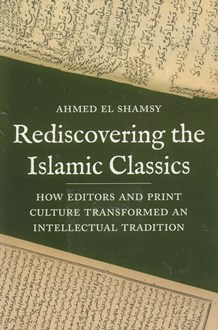
245 10|aRediscovering the Islamic classics :|bhow editors and print culture transformed an intellectual tradition /|cAhmed El Shamsy.
260 |aPrinceton, NJ :|bPrinceton University Press,|c2020.
300 |axiii, 295 sayfa :|bresim, portre, tıpkıbasım :|c24 cm
500 |aİndeks s. [285]-295.
504 |aBibliyografya s. [243]-283.
505 |tThe disappearing books --|tPostclassical book culture --|tThe beginnings of print --|tA new generation of book lovers --|tThe rise of the editor --|tReform through books --|tThe backlash against postclassicism --|tCritique and philology.
520 |a“Islamic book culture dates back to late antiquity, when Muslim scholars began to write down their doctrines on parchment, papyrus, and paper and then to compose increasingly elaborate analyses of, and commentaries on, these ideas. Movable type was adopted in the Middle East only in the early nineteenth century, and it wasn’t until the second half of the century that the first works of classical Islamic religious scholarship were printed there. But from that moment on, Ahmed El Shamsy reveals, the technology of print transformed Islamic scholarship and Arabic literature.
In the first wide-ranging account of the effects of print and the publishing industry on Islamic scholarship, El Shamsy tells the fascinating story of how a small group of editors and intellectuals brought forgotten works of Islamic literature into print and defined what became the classical canon of Islamic thought. Through the lens of the literary culture of nineteenth- and twentieth-century Arab cities—especially Cairo, a hot spot of the nascent publishing business—he explores the contributions of these individuals, who included some of the most important thinkers of the time. Through their efforts to find and publish classical literature, El Shamsy shows, many nearly lost works were recovered, disseminated, and harnessed for agendas of linguistic, ethical, and religious reform.
Bringing to light the agents and events of the Islamic print revolution, Rediscovering the Islamic Classics is an absorbing examination of the central role printing and its advocates played in the intellectual history of the modern Arab world“ --|cYayıncı.
600 0 |aAhmed Teymur Paşa, 1871-1930
600 0 |aAhmad Zaki.
600 0 |aAbd al-Hamīd Nāfi.
600 0 |aİbn Teymiyye.
600 0 |aMuhammed Abduh, 1849-1905.
600 0 |aTâhir el-Cezâirî, 1852-1920.
650 4|aYayıncılar ve yayıncılık|zMısır|zKahire|xTarih.
650 4|aArapça yayıncılık|zMısır|zKahire|xTarih.
650 4|aMatbaacılık, Arap|xTarih.
650 4|aKitap koleksiyonerleri|zMısır|zKahire|xTarih.