

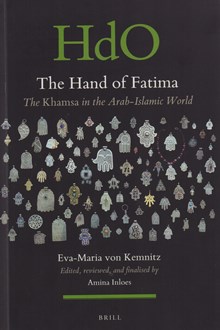
The hand of Fatima : the khamsa in the Arab-Islamic world / by Eva-Maria von Kemnitz ; edited, reviewed, and finalised by Amina Inloes.
Yer Numarası
A.IX/5716
ISBN
9789004526228 (hardback)
9789004526235 (e-book)
9789004526235 (e-book)
Dil Kodu
İngilizce
Kütüphane
Türk Tarih Kurumu Kütüphanesi
Eser Adının Farklı Biçimi
The khamsa in the Arab-Islamic world
Yayın Bilgisi
Leiden ; Boston : Brill, [2022]
Fiziksel Niteleme
xxix, [1], 219 sayfa : resim (renkli), portre (renkli) ; 24 cm
Dizi
Handbook of Oriental Studies = Handbuch der Orientalistik. Section one, Near and Middle East, 0169-9423 ; volume 165
Genel Not
İndeks s. [208]-219.
Bibliyografi, vb. Notu
Bibliyografya s. [191]-207.
Özet, vb.
“The Hand of Fatima traces the development and symbolism ascribed to the hand motif in the Arab and Islamic world, and beyond. Richly illustrated, it details the many types of khamsas produced historically and today - such as khamsas with swords, and khamsas with eagles - and the many objects on which khamsas appear, such as on amulets and flags. It traces the journey of the khamsa into the contemporary world of social and fine art, including museum highlights. Special sections are dedicated to the khamsa in Algeria; cultural crossover in Spain, Portugal, and Brazil; and the symbol of the hand in Shi'ism“-- Yayıncı.
Konu
Emeği Geçenler
Inloes, Amina, editör.
Dizi Ek Girişi- Tek Biçim Başlık
Handbook of Oriental studies. Section 1. The Near and Middle East ; volume 170.
Handbuch der Orientalistik. Section 1. The Near and Middle East ; volume 170.
HdO ; volume 170.
Handbuch der Orientalistik. Section 1. The Near and Middle East ; volume 170.
HdO ; volume 170.
