LEADER 02862naaaa2200349aa54500
001 604698
003 TR_AnAIT
005 20250627101601
006 aobede |||| 000 0d
007 ta
008 231130s2015 enkobede |||| 000 0deng c
020 |a9781784910648
020 |a9781784910655|q(e-Pdf)
040 |aTTK
041 |aeng
049 |aTürk Tarih Kurumu Kütüphanesi
090 |aB.I/9984
100 1 |aAbdelwahed, Youssri Ezzat Hussein.
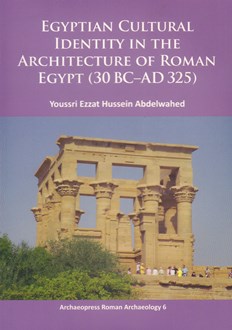
245 10|aEgyptian cultural identity in the architecture of Roman Egypt (30 BC-AD 325) /|cYoussri Ezzat Hussein Abdelwahed.
260 |aOxford :|bArchaeopress,|c©2015.
300 |ax, 222 sayfa :|bresim, harita, plan, tablo ;|c30 cm.
490 0 |aArchaeopress Roman archaeology ;|v6
504 |aBibliyografya s. 198-222.
505 |tIntroduction --|gChapter I.|tCity layout, urban space, and public buildings --|gChapter II.|tMonumentality of the Pylon and Egyptian cultural identity --|gChapter III.|tHouses and Egyptian cultural identity --|gChapter IV.|tTomb iconography and Egyptian cultural identity --|gChapter V.|tArchitectural ornament and Egyptian cultural identity --|tGeneral conclusion --|gAppendix 1.|tCatalogue of Roman-Period temple Pyla --|gAppendix 2.|tCatalogue of Roman-Period Houses --|gAppendix 3.|tCatalogue of Roman-Period Tombs --|gAppendix 4.|tTypology of Eyptian Composite Capitals --|tBibliography.
520 |a“This volume considers the relationship between architectural form and different layers of identity assertion in Roman Egypt. It stresses the sophistication of the concept of identity, and the complex yet close association between architecture and identity. Egyptian Cultural Identity in the Architecture of Roman Egypt (30 BC-AD 325) considers the relationship between architectural form and different layers of identity assertion in Roman Egypt. The Roman province of Aegyptus was a peculiar province such that many scholars have generally assumed that it was given a special status in the Roman Empire. The text covers the period from the Roman conquest of Egypt under Octavian in 30 BC to the official recognition of Christianity in AD 325. It stresses the sophistication of the concept of identity, and the complex yet close association between architecture and identity. This monograph is the outcome of four years of research at the Department of Classics and Ancient History, the University of Durham. The book will be of interest and value for both Classicists and Egyptologists working on the archaeology of Egypt under Roman rule and the concept of identity.” --|cYayıncı.
650 4|aMimarlık, Roma|zMısır.
650 4|aEtnik mimari|zMısır.
650 4|aEtnoarkeoloji|zMısır.
650 4|aMimarlık, Mısır|xKültürel kimlik.
651 4|aMısır|xEski eserler, Roma.
651 4|aMısır|xTarih|yMÖ 30-MS 640.