

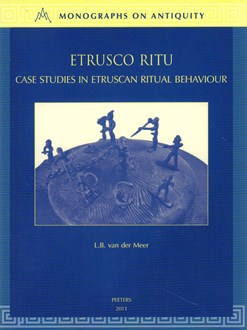
Etrusco ritu : case studies in Etruscan ritual behaviour / L. B. van der Meer.
Yer Numarası
B.II/0054
ISBN
9789042925380
Dil Kodu
İngilizce
Kütüphane
Türk Tarih Kurumu Kütüphanesi
Yayın Bilgisi
Louvain ; Walpole, MA : Peeters, 2011.
Fiziksel Niteleme
viii, 167 sayfa : resim (kimi renkli), çizim, şema ; 27 cm.
Dizi
Monographs on antiquity, 1781-9458 ; vol V
Genel Not
İndeks s. 157-165.
Bibliyografi, vb. Notu
Bibliyografya s. 144-156.
İçindekiler Notu
Acknowledgements -- General abbreviations -- Introduction -- Status quaestionis -- Theories and definitions -- Questions and method -- Family rituals -- Funerary rituals -- Public rituals -- Conclusive reflections -- Appendices -- Bibliography and abbreviations -- Indices -- List of illustrations.
Özet, vb.
“This book focuses on Etruscan private and public ritual behaviour in the last millennium BC. It is based on archaeological, epigraphical and historical sources. Topics are context, form, origins, agency, dynamics (homeostasis or change), meaning, function and the survival of rites in the Roman imperial and later periods. After an introduction to recent theories and definitions, first private rituals are traced, rites de passage like marriage, birth, perinatal burial, transition to adulthood, immersion, healing, adoption, divination and consecration. Mortuary rituals are dealt with separately in view of their private and public dimensions. Pre-burial, burial, and post-burial rites, are primarily analysed by paying attention to sets of grave-goods, and to artefacts and bones found in or near a tomb, as written sources are almost absent. Grave sets reflect, from c. 800 until c. 40 BC, the core activity first of the elite and later of the rich middle class, namely eating and wine drinking. Not only the deceased were supposed to continue this ritual in the netherworld, eating and drinking also took place in pre- and post-burial phases of funerals. This practice was important for reasons of self-repesentation, consolidation of power, and social reproduction. Finally, fragments of or quotations from sacred books, especially lost libri rituales, transmitted by Greek and Roman authors, are confronted with the evidence of recent archaeological excavations, especially in newly founded cities. Though ancient authors were biased, it will appear that their information, especially on cosmological orientation, orthogonality, mundus, sulcus primigenius, and pomerium, often has a core of truth. Most Etruscan rituals disappeared in the fourth century AD. A few, however, survived until the present day, be it in a changed way, and in different contexts.” -- Yayıncı.
Dizi Ek Girişi- Tek Biçim Başlık
Monographs on antiquity ; vol. 5.
