

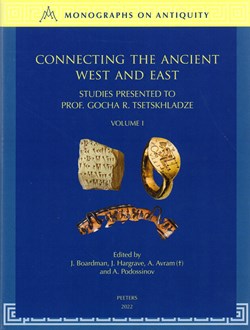
Connecting the Ancient West and East : studies presented to Prof. Gocha R. Tsetskhladze / edited by J. Boardman, J. Hargrave, A. Avram and A. Podossinov.
Yer Numarası
B.II/0030
ISBN
9789042944138
9789042944145 (eISBN)
9789042944145 (eISBN)
Dil Kodu
İngilizce
Kütüphane
Türk Tarih Kurumu Kütüphanesi
Yayın Bilgisi
Leuven ; Paris ; Bristol : Peeters, 2022.
Fiziksel Niteleme
2 cilt (1. c. xliv, 904 sayfa ; 2. c. x sayfa, sayfa [905]-1525) : resim (çoğu renkli), çizim, şekil, harita, plan ; 27 cm.
Dizi
Monographs on antiquity ; vol. VIII
Genel Not
İndeks s. [1507]-1525.
Bibliyografi, vb. Notu
Bibliyografya makale sonlarındadır.
İçindekiler Notu
1. Cilt. Life, Works and Reflexions. West and East : why a Festschrift? / Gocha Tsetskhladze -- Laudatio Domini -- Personal Recollections / John Boardman, Eka Avaliani, Alexandru Avram, Janet Buxton, Cecily Grace, James Hargrave, Paolo Maranzana, Alexander Podossinov, Simon Young -- The writings of Gocha Tsetskhladze, 1989-2022 -- The Black Sea, Anatolia and the Pontic Hinterland. Burial grounds at Tios / Sümer Atasoy -- The Roman cult of emperor worship : Was the Roman emperor revered as a god amongst Caucasian Iberians? / Eka Avaliani -- 519 BC : Persians occupy the North Pontic coast / Alexandru Avram -- ‘Timeo Danaos et dona ferentes’ : Biography of a collection of Pontic pottery in the National Museum, Belgrade / Staša Babić -- The land of the Sun and the Moon : An interpretation of the emblem on Pontic royal coins / Luis Ballesteros Pastor -- One forgotten Greek inscription from the Rostov region / Alexey Belousov -- Salt administration in Roman Dacia : An overview / Lucreţiu Mihailescu-Bîrliba -- A new stamped Roman amphora from Cioroiu Nou / Dorel Bondoc -- A gift for Dea Syria from Moukaporis, son of Ditoukenthos / Valentin Bottez, Peter Rothenhoefer -- Oueinia, bureau de douane romaine de la province d’Asie, et les routes du marbre de Dokimeion / Hadrien Bru -- A view from the Fringe : Heraclea Pontica in the age of Alexander / Stanley Burstein -- The Archaic necropolis of Myrmekion / Alexander Butyagin -- La période de début du Principat dans les villes grecques ouest-pontiques à la lumière des sources littéraires et épigraphiques / Livia Buzoianu, Maria Bǎrbulescu -- Greek urbanisation of the North Pontic region in the 6th-early 5th centuries BC / Dmitry Chistov -- Acampsis, Boas, Apsarus, Petra, Sebastopolis : Rivers and forts on the southern littoral of Colchis / Altay Coşkun -- An essay on the history of Apollonia Pontica to the Early Hellenistic period / Margarit Damyanov -- L’anneau du roi Skylès : Pouvoir et territoire au nord-ouest de la mer Noire / Madalina Dana, Dan Dana -- The coinage of Tios in Bithynia : Local history, religion and civic representation / Edward Dandrow -- Greek colonies, a middle ground and the hinterland in south-eastern Thrace / Jan de Boer -- Phrygian traces in Greek epigraphy of Roman Anatolia : Survival or identity revival? / María-Paz de Hoz -- Defining urban space : The archaeology and topography of Mtskheta / Irina Demetradze-Renz -- Achaemenid-period serpentine vessels from Oluz Höyük (Kritalia) and Harşena Fortress (Amasya), North-Central Anatolia / Şevket Dönmez, E. Emine Naza-Dönmez -- New finds of swords of Maeotian and Sarmatian types in the North Caucasus / Sergey Dudarev, Victoria Berezhnaya, Sveetlana Kolkova -- A fascinum representation from the Roman fort at Răcari, Dolj county, Roumania / Gabriela Filip -- Varkana : the country of wolves / Iulon Gagoshidze -- Greek-Sindian interactions in the territory of the Cimmerian Bosporus in the 6th-4th centuries BC / Vladimir Goroncharovsky -- Can Gordion roof tiles help date the Midas Monument? / Cecily Grace -- The earliest bronze metallurgy on the Georgian side of the south-eastern Black littoral / Amiran Kakhidze -- Tombes à bouclier au nord et à l'est de la mer Noire à l'époque romaine : origines / Michel Kazanski -- The mouth of the Tanais and its role in Colchian-Scythian trade in the 5th-first quarter of the 3rd century BC / Viktor Kopylov -- Some rare coins from the Vasilii Rozanov collection / Sergei Kovalenko -- Phanagoria in Archaic times / Vladimir Kuznetsov -- The main results of the archaeological excavations conducted at the fort of Gonio-Apsarus in 2015 / Shota Mamuladze and Emzar Kakhidze -- Paphlagonians and Phrygians / Manolis Manoledakis -- Cities in Roman Galatia and the emergence of urbanism / Paolo Maranzana -- Some remarks about Konsulovskoe, a lesser-known Late Scythian hillfort on the Lower Dnieper / Marcin Matera, Nadezhda Gavrylyuk, Dmytro Nykonenko, Paweł Lech -- The Sinop I shipwreck : a Black Sea merchant ship from the Roman Imperial era / Andrei Opaiţ, Dan Davis and Michael Brennan -- Musical instruments from the necropolis of Apollonia Pontica / Krastina Panayotova -- Dog not important, only staff important! / Richard Posamentir -- The main agonistic festivals in Tauric Chersonesus / Oksana Ruchynska -- The pre-Achaemenid kingdom of Cappadocia and the identification of Kerkenes Dağ / Zsolt Simon -- Gorgons on the Go : An Athenian Black-Figure Skyphos from Berezan / Tyler Jo Smith -- The Thracian tholos tombs at Ravnogor reconsidered / Nikola Theodossiev -- On the Archaic fortifications of Porthmion / Marina Vakhtina -- Bendis again / Maya Vassileva -- Forgotten monuments of the Cimmerian Bosporus / Yurii Vinogradov -- Route of the ‘Pilgrim’s Road’ in north-western Asia Minor : State of the art and new observations / Barbora Weissova -- Roman Colchis, Iberia and Alani : Some notes as apologia / Everett Wheeler -- Midas’ Gordion ud das übrige Kleinasien : Überlandrouten als Indikatoren für Konnektivität / Anne-Maria Wittke -- Results of recent archaeological investigations of Archaic Tieion / Şahin Yıldırım -- Greek pottery of the 7th-6th centuries BC on Bilsk fortified settlement / Stanislav Zadnikov, Iryna Shramko -- Stronghold on the isthmus of the Lighthouse Peninsula in the system of the polis of Chersonesus / Angelina Zedgenidze.
2. Cilt. East and West : Greece, Persia, Rome, Egypt, Central Asia. Revisiting a phalera from Mound 20 in Noin Ula in northern Mongolia : Some iconographic aspects of Bactrian art / Kazim Abdullaev -- Luxurious funerals and sumptuary laws / Larissa Bonfante -- Greek Helios or Indian Sūrya? The spread of the Sun God imagery from India to Gandhāra / Osmund Bopearachchi -- Greeks and their neighbors : From similar start to acculturation / Jan Bouzek -- Ritual pebbles : Pebbles between the living and the dead in the Mediterranean Iron Age / Mario Denti -- The Eretrian Late Geometric oinochoe Istanbul 1503 / Jean-Paul Descœudres -- Ethnic identities in conflict in ancient Epirus / Adolfo J. Domínguez -- Alexander Jannaeus’ defensive line against Antiochus XII Dionysus revisited once again / Alexander Fantalkin and Oren Tal -- Wandering Samians in the West / Flavia Frisone -- Ceraunus, Chrestus and others : ‘Double-layer’ epithets? / Oleg Gabelko -- The early phases of Cult Place 2 in Elea-Velia : An archaeological palimpsest / Verena Gassner -- Are two Great Kings too many? Some considerations on Parthian kingship in the Classical sources / Leonardo Gregoratti -- The Median empire and the highstand waters of the Caspian Sea / Yervand Grekyan -- Magical mysetery tour : The role of islands in connecting ancient West and East / Louis Hitchcock, Laura Pisanu and Aren Maeir -- Down in the dumps at Seleucid Jebel Khalid on the Euphrates / Heather Jackson -- Timbres amphoriques rhodiens d'Archangelos / Vasilica Lungu et Pierre Dupont -- Applying the Beazley method to mosaic artist attribution / Andrew Madden -- Seleucids as ‘Great Kings’? / Andreas Mehl -- Two Monophysite bishops between Roman West and Sasanian East / Fergus Millar -- L'hospitalité de Zeus, d'un côté à l'autre de la Méditerranée / Marta Oller Guzmán -- Crisis, divination and ‘killing’ pottery : Astragals and punctured vessels from a Classical-period well at Sicilian Naxos / Jari Pakkanen, Maria Costanza Lentini -- Heracles Celticus and Heracles Scythicus : The same narrative in the west and the east of Europe? / Alexander Podossinov -- How the Mediterranean became the Mediterranean : Some neglected pieces of evidence for the history of the mental mapping of an inland sea / Robert Rollinger -- About the Lollii of Byzantium / Ligia Ruscu -- Republican theatres of Rome / Frank Sear -- Herodotus and Amasis’ coup d’état / Květa Smoláriková -- Imported bronze hammered cauldrons from Asian Sarmatia / Milkail Treister -- Migration - not colonisation : What motivated people to leave their community according to the texts of Archaic Greece / Christoph Ulf -- The lost inscription of Argos (IG IV 556 = Syll3 182) : A case of Athenian propaganda in the 4th century BC? / José Vela Tejada.
2. Cilt. East and West : Greece, Persia, Rome, Egypt, Central Asia. Revisiting a phalera from Mound 20 in Noin Ula in northern Mongolia : Some iconographic aspects of Bactrian art / Kazim Abdullaev -- Luxurious funerals and sumptuary laws / Larissa Bonfante -- Greek Helios or Indian Sūrya? The spread of the Sun God imagery from India to Gandhāra / Osmund Bopearachchi -- Greeks and their neighbors : From similar start to acculturation / Jan Bouzek -- Ritual pebbles : Pebbles between the living and the dead in the Mediterranean Iron Age / Mario Denti -- The Eretrian Late Geometric oinochoe Istanbul 1503 / Jean-Paul Descœudres -- Ethnic identities in conflict in ancient Epirus / Adolfo J. Domínguez -- Alexander Jannaeus’ defensive line against Antiochus XII Dionysus revisited once again / Alexander Fantalkin and Oren Tal -- Wandering Samians in the West / Flavia Frisone -- Ceraunus, Chrestus and others : ‘Double-layer’ epithets? / Oleg Gabelko -- The early phases of Cult Place 2 in Elea-Velia : An archaeological palimpsest / Verena Gassner -- Are two Great Kings too many? Some considerations on Parthian kingship in the Classical sources / Leonardo Gregoratti -- The Median empire and the highstand waters of the Caspian Sea / Yervand Grekyan -- Magical mysetery tour : The role of islands in connecting ancient West and East / Louis Hitchcock, Laura Pisanu and Aren Maeir -- Down in the dumps at Seleucid Jebel Khalid on the Euphrates / Heather Jackson -- Timbres amphoriques rhodiens d'Archangelos / Vasilica Lungu et Pierre Dupont -- Applying the Beazley method to mosaic artist attribution / Andrew Madden -- Seleucids as ‘Great Kings’? / Andreas Mehl -- Two Monophysite bishops between Roman West and Sasanian East / Fergus Millar -- L'hospitalité de Zeus, d'un côté à l'autre de la Méditerranée / Marta Oller Guzmán -- Crisis, divination and ‘killing’ pottery : Astragals and punctured vessels from a Classical-period well at Sicilian Naxos / Jari Pakkanen, Maria Costanza Lentini -- Heracles Celticus and Heracles Scythicus : The same narrative in the west and the east of Europe? / Alexander Podossinov -- How the Mediterranean became the Mediterranean : Some neglected pieces of evidence for the history of the mental mapping of an inland sea / Robert Rollinger -- About the Lollii of Byzantium / Ligia Ruscu -- Republican theatres of Rome / Frank Sear -- Herodotus and Amasis’ coup d’état / Květa Smoláriková -- Imported bronze hammered cauldrons from Asian Sarmatia / Milkail Treister -- Migration - not colonisation : What motivated people to leave their community according to the texts of Archaic Greece / Christoph Ulf -- The lost inscription of Argos (IG IV 556 = Syll3 182) : A case of Athenian propaganda in the 4th century BC? / José Vela Tejada.
Özet, vb.
“Connecting the ancient West and East has been the life’s goal of the Georgian-born scholar Gocha Tsetskhladze since he stepped westward from the then Soviet Union in 1990 (his higher education took place in Kharkov and Moscow). This publication honours his not inconsiderable achievements, following in (and filling) the footsteps of Minns and Rostovtzeff, unremittingly for 30 years, first in Oxford, then London and Melbourne, now in Wales. Its publication occurs just short of his sixtieth birthday. Epithets applied to him have included ‘king of Pontus’ and ‘Mr Colonisation’, for his focus has been the Black Sea and Greek colonisation, unashamedly called that, of its coasts, and the exploration of Graeco-native contacts there and in the related hinterland, starting first from his native Colchis, where the Greeks learnt a thing or two from the locals : two-way exchange, not unidirectional Hellenisation. More recently, his attention turned to excavation of Pessinus in Central Anatolia. The work is divided into two volumes : the first focused primarily on the Black Sea ; the second spreading its wings to other regions. Over a hundred scholars, based predominantly in Europe, North America and Australia, have contributed 85 papers and several personal reminiscences.” -- Yayıncı.
Konu
Tsetskhladze, Gocha R., 1963-2022.
Arkeolojik kazılar__Avrasya.
Kültürlerarası iletişim__Avrasya.
Harşena Kalesi (Amasya, Türkiye)__Kaplar__Ahameniş Dönemi.
Pessinus (antik kent)__Türkiye.
Tios (antik kent)__Türkiye__Mezarlıklar.
Oluz Höyük (Amasya, Türkiye)__Kaplar__Ahameniş Dönemi.
Avrasya__Medeniyet.
Avrasya__Eski eserler.
Arkeolojik kazılar__Avrasya.
Kültürlerarası iletişim__Avrasya.
Harşena Kalesi (Amasya, Türkiye)__Kaplar__Ahameniş Dönemi.
Pessinus (antik kent)__Türkiye.
Tios (antik kent)__Türkiye__Mezarlıklar.
Oluz Höyük (Amasya, Türkiye)__Kaplar__Ahameniş Dönemi.
Avrasya__Medeniyet.
Avrasya__Eski eserler.
Emeği Geçenler
Boardman, John, 1927- editör.
Hargrave, James, editör.
Avram, Alexandru, 1956-2021, editör.
Podosinov, Aleksandr Vasileviç, 1950- editör.
Hargrave, James, editör.
Avram, Alexandru, 1956-2021, editör.
Podosinov, Aleksandr Vasileviç, 1950- editör.
Dizi Ek Girişi- Tek Biçim Başlık
Monographs on antiquity ; 8.
Eseri Alıntıla
Referansları kullanmadan önce gözden geçirmeniz ve varsa gerekli düzeltmeleri yapmanız önerilir.
Dijital Kaynak
MARC Görünümü
LEADER 11463naaaa2200457aa54500
001 604812
003 TR_AnAIT
005 20250627100823
006 aoabee |||| 001 0d
007 ta
008 240116s2022 be oabee |||| 001 0deng c
020 |a9789042944138
020 |a9789042944145|q(eISBN)
040 |aTTK
041 |aeng
049 |aTürk Tarih Kurumu Kütüphanesi
090 |aB.II/0030
245 00|aConnecting the Ancient West and East :|bstudies presented to Prof. Gocha R. Tsetskhladze /|cedited by J. Boardman, J. Hargrave, A. Avram and A. Podossinov.
260 |aLeuven ;|aParis ;|aBristol :|bPeeters,|c2022.
300 |a2 cilt (1. c. xliv, 904 sayfa ; 2. c. x sayfa, sayfa [905]-1525) :|bresim (çoğu renkli), çizim, şekil, harita, plan ;|c27 cm.
490 1 |aMonographs on antiquity ;|vvol. VIII
500 |aİndeks s. [1507]-1525.
504 |aBibliyografya makale sonlarındadır.
505 |g1. Cilt.|tLife, Works and Reflexions.|tWest and East : why a Festschrift? /|rGocha Tsetskhladze --|tLaudatio Domini --|tPersonal Recollections /|rJohn Boardman, Eka Avaliani, Alexandru Avram, Janet Buxton, Cecily Grace, James Hargrave, Paolo Maranzana, Alexander Podossinov, Simon Young --|tThe writings of Gocha Tsetskhladze, 1989-2022 --|tThe Black Sea, Anatolia and the Pontic Hinterland. Burial grounds at Tios /|rSümer Atasoy --|tThe Roman cult of emperor worship : Was the Roman emperor revered as a god amongst Caucasian Iberians? /|rEka Avaliani --|t519 BC : Persians occupy the North Pontic coast /|rAlexandru Avram --|t‘Timeo Danaos et dona ferentes’ : Biography of a collection of Pontic pottery in the National Museum, Belgrade /|rStaša Babić --|tThe land of the Sun and the Moon : An interpretation of the emblem on Pontic royal coins /|rLuis Ballesteros Pastor --|tOne forgotten Greek inscription from the Rostov region /|rAlexey Belousov --|tSalt administration in Roman Dacia : An overview /|rLucreţiu Mihailescu-Bîrliba --|tA new stamped Roman amphora from Cioroiu Nou /|rDorel Bondoc --|tA gift for Dea Syria from Moukaporis, son of Ditoukenthos /|rValentin Bottez, Peter Rothenhoefer --|tOueinia, bureau de douane romaine de la province d’Asie, et les routes du marbre de Dokimeion /|rHadrien Bru --|tA view from the Fringe : Heraclea Pontica in the age of Alexander /|rStanley Burstein --|tThe Archaic necropolis of Myrmekion /|rAlexander Butyagin --|tLa période de début du Principat dans les villes grecques ouest-pontiques à la lumière des sources littéraires et épigraphiques /|rLivia Buzoianu, Maria Bǎrbulescu --|tGreek urbanisation of the North Pontic region in the 6th-early 5th centuries BC /|rDmitry Chistov --|tAcampsis, Boas, Apsarus, Petra, Sebastopolis : Rivers and forts on the southern littoral of Colchis /|rAltay Coşkun --|tAn essay on the history of Apollonia Pontica to the Early Hellenistic period /|rMargarit Damyanov --|tL’anneau du roi Skylès : Pouvoir et territoire au nord-ouest de la mer Noire /|rMadalina Dana, Dan Dana --|tThe coinage of Tios in Bithynia : Local history, religion and civic representation /|rEdward Dandrow --|tGreek colonies, a middle ground and the hinterland in south-eastern Thrace /|rJan de Boer --|tPhrygian traces in Greek epigraphy of Roman Anatolia : Survival or identity revival? /|rMaría-Paz de Hoz --|tDefining urban space : The archaeology and topography of Mtskheta /|rIrina Demetradze-Renz --|tAchaemenid-period serpentine vessels from Oluz Höyük (Kritalia) and Harşena Fortress (Amasya), North-Central Anatolia /|rŞevket Dönmez, E. Emine Naza-Dönmez --|tNew finds of swords of Maeotian and Sarmatian types in the North Caucasus /|rSergey Dudarev, Victoria Berezhnaya, Sveetlana Kolkova --|tA fascinum representation from the Roman fort at Răcari, Dolj county, Roumania /|rGabriela Filip --|tVarkana : the country of wolves /|rIulon Gagoshidze --|tGreek-Sindian interactions in the territory of the Cimmerian Bosporus in the 6th-4th centuries BC /|rVladimir Goroncharovsky --|tCan Gordion roof tiles help date the Midas Monument? /|rCecily Grace --|tThe earliest bronze metallurgy on the Georgian side of the south-eastern Black littoral /|rAmiran Kakhidze --|tTombes à bouclier au nord et à l'est de la mer Noire à l'époque romaine : origines /|rMichel Kazanski --|tThe mouth of the Tanais and its role in Colchian-Scythian trade in the 5th-first quarter of the 3rd century BC /|rViktor Kopylov --|tSome rare coins from the Vasilii Rozanov collection /|rSergei Kovalenko --|tPhanagoria in Archaic times /|rVladimir Kuznetsov --|tThe main results of the archaeological excavations conducted at the fort of Gonio-Apsarus in 2015 /|rShota Mamuladze and Emzar Kakhidze --|tPaphlagonians and Phrygians /|rManolis Manoledakis --|tCities in Roman Galatia and the emergence of urbanism /|rPaolo Maranzana --|tSome remarks about Konsulovskoe, a lesser-known Late Scythian hillfort on the Lower Dnieper /|rMarcin Matera, Nadezhda Gavrylyuk, Dmytro Nykonenko, Paweł Lech --|tThe Sinop I shipwreck : a Black Sea merchant ship from the Roman Imperial era /|rAndrei Opaiţ, Dan Davis and Michael Brennan --|tMusical instruments from the necropolis of Apollonia Pontica /|rKrastina Panayotova --|tDog not important, only staff important! /|rRichard Posamentir --|tThe main agonistic festivals in Tauric Chersonesus /|rOksana Ruchynska --|tThe pre-Achaemenid kingdom of Cappadocia and the identification of Kerkenes Dağ /|rZsolt Simon --|tGorgons on the Go : An Athenian Black-Figure Skyphos from Berezan /|rTyler Jo Smith --|tThe Thracian tholos tombs at Ravnogor reconsidered /|rNikola Theodossiev --|tOn the Archaic fortifications of Porthmion /|rMarina Vakhtina --|tBendis again /|rMaya Vassileva --|tForgotten monuments of the Cimmerian Bosporus /|rYurii Vinogradov --|tRoute of the ‘Pilgrim’s Road’ in north-western Asia Minor : State of the art and new observations /|rBarbora Weissova --|tRoman Colchis, Iberia and Alani : Some notes as apologia /|rEverett Wheeler --|tMidas’ Gordion ud das übrige Kleinasien : Überlandrouten als Indikatoren für Konnektivität /|rAnne-Maria Wittke --|tResults of recent archaeological investigations of Archaic Tieion /|rŞahin Yıldırım --|tGreek pottery of the 7th-6th centuries BC on Bilsk fortified settlement /|rStanislav Zadnikov, Iryna Shramko --|tStronghold on the isthmus of the Lighthouse Peninsula in the system of the polis of Chersonesus /|rAngelina Zedgenidze.
505 |g2. Cilt.|tEast and West : Greece, Persia, Rome, Egypt, Central Asia.|tRevisiting a phalera from Mound 20 in Noin Ula in northern Mongolia : Some iconographic aspects of Bactrian art /|rKazim Abdullaev --|tLuxurious funerals and sumptuary laws /|rLarissa Bonfante --|tGreek Helios or Indian Sūrya? The spread of the Sun God imagery from India to Gandhāra /|rOsmund Bopearachchi --|tGreeks and their neighbors : From similar start to acculturation /|rJan Bouzek --|tRitual pebbles : Pebbles between the living and the dead in the Mediterranean Iron Age /|rMario Denti --|tThe Eretrian Late Geometric oinochoe Istanbul 1503 /|rJean-Paul Descœudres --|tEthnic identities in conflict in ancient Epirus /|rAdolfo J. Domínguez --|tAlexander Jannaeus’ defensive line against Antiochus XII Dionysus revisited once again /|rAlexander Fantalkin and Oren Tal --|tWandering Samians in the West /|rFlavia Frisone --|tCeraunus, Chrestus and others : ‘Double-layer’ epithets? /|rOleg Gabelko --|tThe early phases of Cult Place 2 in Elea-Velia : An archaeological palimpsest /|rVerena Gassner --|tAre two Great Kings too many? Some considerations on Parthian kingship in the Classical sources /|rLeonardo Gregoratti --|tThe Median empire and the highstand waters of the Caspian Sea /|rYervand Grekyan --|tMagical mysetery tour : The role of islands in connecting ancient West and East /|rLouis Hitchcock, Laura Pisanu and Aren Maeir --|tDown in the dumps at Seleucid Jebel Khalid on the Euphrates /|rHeather Jackson --|tTimbres amphoriques rhodiens d'Archangelos /|rVasilica Lungu et Pierre Dupont --|tApplying the Beazley method to mosaic artist attribution /|rAndrew Madden --|tSeleucids as ‘Great Kings’? /|rAndreas Mehl --|tTwo Monophysite bishops between Roman West and Sasanian East /|rFergus Millar --|tL'hospitalité de Zeus, d'un côté à l'autre de la Méditerranée /|rMarta Oller Guzmán --|tCrisis, divination and ‘killing’ pottery : Astragals and punctured vessels from a Classical-period well at Sicilian Naxos /|rJari Pakkanen, Maria Costanza Lentini --|tHeracles Celticus and Heracles Scythicus : The same narrative in the west and the east of Europe? /|rAlexander Podossinov --|tHow the Mediterranean became the Mediterranean : Some neglected pieces of evidence for the history of the mental mapping of an inland sea /|rRobert Rollinger --|tAbout the Lollii of Byzantium /|rLigia Ruscu --|tRepublican theatres of Rome /|rFrank Sear --|tHerodotus and Amasis’ coup d’état /|rKvěta Smoláriková --|tImported bronze hammered cauldrons from Asian Sarmatia /|rMilkail Treister --|tMigration - not colonisation : What motivated people to leave their community according to the texts of Archaic Greece /|rChristoph Ulf --|tThe lost inscription of Argos (IG IV 556 = Syll3 182) : A case of Athenian propaganda in the 4th century BC? /|rJosé Vela Tejada.
520 |a“Connecting the ancient West and East has been the life’s goal of the Georgian-born scholar Gocha Tsetskhladze since he stepped westward from the then Soviet Union in 1990 (his higher education took place in Kharkov and Moscow). This publication honours his not inconsiderable achievements, following in (and filling) the footsteps of Minns and Rostovtzeff, unremittingly for 30 years, first in Oxford, then London and Melbourne, now in Wales. Its publication occurs just short of his sixtieth birthday. Epithets applied to him have included ‘king of Pontus’ and ‘Mr Colonisation’, for his focus has been the Black Sea and Greek colonisation, unashamedly called that, of its coasts, and the exploration of Graeco-native contacts there and in the related hinterland, starting first from his native Colchis, where the Greeks learnt a thing or two from the locals : two-way exchange, not unidirectional Hellenisation. More recently, his attention turned to excavation of Pessinus in Central Anatolia. The work is divided into two volumes : the first focused primarily on the Black Sea ; the second spreading its wings to other regions. Over a hundred scholars, based predominantly in Europe, North America and Australia, have contributed 85 papers and several personal reminiscences.” --|cYayıncı.
600 14|aTsetskhladze, Gocha R., 1963-2022.
650 4|aArkeolojik kazılar|zAvrasya.
650 4|aKültürlerarası iletişim|zAvrasya.
650 4|aHarşena Kalesi (Amasya, Türkiye)|xKaplar|yAhameniş Dönemi.
651 4|aPessinus (antik kent)|zTürkiye.
651 4|aTios (antik kent)|zTürkiye|xMezarlıklar.
651 4|aOluz Höyük (Amasya, Türkiye)|xKaplar|yAhameniş Dönemi.
651 4|aAvrasya|xMedeniyet.
651 4|aAvrasya|xEski eserler.
700 1 |aBoardman, John,|d1927-|eeditör.
700 1 |aHargrave, James,|eeditör.
700 1 |aAvram, Alexandru,|d1956-2021,|eeditör.
700 1 |aPodosinov, Aleksandr Vasileviç,|d1950-|eeditör.
830 0|aMonographs on antiquity ;|v8.
001 604812
003 TR_AnAIT
005 20250627100823
006 aoabee |||| 001 0d
007 ta
008 240116s2022 be oabee |||| 001 0deng c
020 |a9789042944138
020 |a9789042944145|q(eISBN)
040 |aTTK
041 |aeng
049 |aTürk Tarih Kurumu Kütüphanesi
090 |aB.II/0030
245 00|aConnecting the Ancient West and East :|bstudies presented to Prof. Gocha R. Tsetskhladze /|cedited by J. Boardman, J. Hargrave, A. Avram and A. Podossinov.
260 |aLeuven ;|aParis ;|aBristol :|bPeeters,|c2022.
300 |a2 cilt (1. c. xliv, 904 sayfa ; 2. c. x sayfa, sayfa [905]-1525) :|bresim (çoğu renkli), çizim, şekil, harita, plan ;|c27 cm.
490 1 |aMonographs on antiquity ;|vvol. VIII
500 |aİndeks s. [1507]-1525.
504 |aBibliyografya makale sonlarındadır.
505 |g1. Cilt.|tLife, Works and Reflexions.|tWest and East : why a Festschrift? /|rGocha Tsetskhladze --|tLaudatio Domini --|tPersonal Recollections /|rJohn Boardman, Eka Avaliani, Alexandru Avram, Janet Buxton, Cecily Grace, James Hargrave, Paolo Maranzana, Alexander Podossinov, Simon Young --|tThe writings of Gocha Tsetskhladze, 1989-2022 --|tThe Black Sea, Anatolia and the Pontic Hinterland. Burial grounds at Tios /|rSümer Atasoy --|tThe Roman cult of emperor worship : Was the Roman emperor revered as a god amongst Caucasian Iberians? /|rEka Avaliani --|t519 BC : Persians occupy the North Pontic coast /|rAlexandru Avram --|t‘Timeo Danaos et dona ferentes’ : Biography of a collection of Pontic pottery in the National Museum, Belgrade /|rStaša Babić --|tThe land of the Sun and the Moon : An interpretation of the emblem on Pontic royal coins /|rLuis Ballesteros Pastor --|tOne forgotten Greek inscription from the Rostov region /|rAlexey Belousov --|tSalt administration in Roman Dacia : An overview /|rLucreţiu Mihailescu-Bîrliba --|tA new stamped Roman amphora from Cioroiu Nou /|rDorel Bondoc --|tA gift for Dea Syria from Moukaporis, son of Ditoukenthos /|rValentin Bottez, Peter Rothenhoefer --|tOueinia, bureau de douane romaine de la province d’Asie, et les routes du marbre de Dokimeion /|rHadrien Bru --|tA view from the Fringe : Heraclea Pontica in the age of Alexander /|rStanley Burstein --|tThe Archaic necropolis of Myrmekion /|rAlexander Butyagin --|tLa période de début du Principat dans les villes grecques ouest-pontiques à la lumière des sources littéraires et épigraphiques /|rLivia Buzoianu, Maria Bǎrbulescu --|tGreek urbanisation of the North Pontic region in the 6th-early 5th centuries BC /|rDmitry Chistov --|tAcampsis, Boas, Apsarus, Petra, Sebastopolis : Rivers and forts on the southern littoral of Colchis /|rAltay Coşkun --|tAn essay on the history of Apollonia Pontica to the Early Hellenistic period /|rMargarit Damyanov --|tL’anneau du roi Skylès : Pouvoir et territoire au nord-ouest de la mer Noire /|rMadalina Dana, Dan Dana --|tThe coinage of Tios in Bithynia : Local history, religion and civic representation /|rEdward Dandrow --|tGreek colonies, a middle ground and the hinterland in south-eastern Thrace /|rJan de Boer --|tPhrygian traces in Greek epigraphy of Roman Anatolia : Survival or identity revival? /|rMaría-Paz de Hoz --|tDefining urban space : The archaeology and topography of Mtskheta /|rIrina Demetradze-Renz --|tAchaemenid-period serpentine vessels from Oluz Höyük (Kritalia) and Harşena Fortress (Amasya), North-Central Anatolia /|rŞevket Dönmez, E. Emine Naza-Dönmez --|tNew finds of swords of Maeotian and Sarmatian types in the North Caucasus /|rSergey Dudarev, Victoria Berezhnaya, Sveetlana Kolkova --|tA fascinum representation from the Roman fort at Răcari, Dolj county, Roumania /|rGabriela Filip --|tVarkana : the country of wolves /|rIulon Gagoshidze --|tGreek-Sindian interactions in the territory of the Cimmerian Bosporus in the 6th-4th centuries BC /|rVladimir Goroncharovsky --|tCan Gordion roof tiles help date the Midas Monument? /|rCecily Grace --|tThe earliest bronze metallurgy on the Georgian side of the south-eastern Black littoral /|rAmiran Kakhidze --|tTombes à bouclier au nord et à l'est de la mer Noire à l'époque romaine : origines /|rMichel Kazanski --|tThe mouth of the Tanais and its role in Colchian-Scythian trade in the 5th-first quarter of the 3rd century BC /|rViktor Kopylov --|tSome rare coins from the Vasilii Rozanov collection /|rSergei Kovalenko --|tPhanagoria in Archaic times /|rVladimir Kuznetsov --|tThe main results of the archaeological excavations conducted at the fort of Gonio-Apsarus in 2015 /|rShota Mamuladze and Emzar Kakhidze --|tPaphlagonians and Phrygians /|rManolis Manoledakis --|tCities in Roman Galatia and the emergence of urbanism /|rPaolo Maranzana --|tSome remarks about Konsulovskoe, a lesser-known Late Scythian hillfort on the Lower Dnieper /|rMarcin Matera, Nadezhda Gavrylyuk, Dmytro Nykonenko, Paweł Lech --|tThe Sinop I shipwreck : a Black Sea merchant ship from the Roman Imperial era /|rAndrei Opaiţ, Dan Davis and Michael Brennan --|tMusical instruments from the necropolis of Apollonia Pontica /|rKrastina Panayotova --|tDog not important, only staff important! /|rRichard Posamentir --|tThe main agonistic festivals in Tauric Chersonesus /|rOksana Ruchynska --|tThe pre-Achaemenid kingdom of Cappadocia and the identification of Kerkenes Dağ /|rZsolt Simon --|tGorgons on the Go : An Athenian Black-Figure Skyphos from Berezan /|rTyler Jo Smith --|tThe Thracian tholos tombs at Ravnogor reconsidered /|rNikola Theodossiev --|tOn the Archaic fortifications of Porthmion /|rMarina Vakhtina --|tBendis again /|rMaya Vassileva --|tForgotten monuments of the Cimmerian Bosporus /|rYurii Vinogradov --|tRoute of the ‘Pilgrim’s Road’ in north-western Asia Minor : State of the art and new observations /|rBarbora Weissova --|tRoman Colchis, Iberia and Alani : Some notes as apologia /|rEverett Wheeler --|tMidas’ Gordion ud das übrige Kleinasien : Überlandrouten als Indikatoren für Konnektivität /|rAnne-Maria Wittke --|tResults of recent archaeological investigations of Archaic Tieion /|rŞahin Yıldırım --|tGreek pottery of the 7th-6th centuries BC on Bilsk fortified settlement /|rStanislav Zadnikov, Iryna Shramko --|tStronghold on the isthmus of the Lighthouse Peninsula in the system of the polis of Chersonesus /|rAngelina Zedgenidze.
505 |g2. Cilt.|tEast and West : Greece, Persia, Rome, Egypt, Central Asia.|tRevisiting a phalera from Mound 20 in Noin Ula in northern Mongolia : Some iconographic aspects of Bactrian art /|rKazim Abdullaev --|tLuxurious funerals and sumptuary laws /|rLarissa Bonfante --|tGreek Helios or Indian Sūrya? The spread of the Sun God imagery from India to Gandhāra /|rOsmund Bopearachchi --|tGreeks and their neighbors : From similar start to acculturation /|rJan Bouzek --|tRitual pebbles : Pebbles between the living and the dead in the Mediterranean Iron Age /|rMario Denti --|tThe Eretrian Late Geometric oinochoe Istanbul 1503 /|rJean-Paul Descœudres --|tEthnic identities in conflict in ancient Epirus /|rAdolfo J. Domínguez --|tAlexander Jannaeus’ defensive line against Antiochus XII Dionysus revisited once again /|rAlexander Fantalkin and Oren Tal --|tWandering Samians in the West /|rFlavia Frisone --|tCeraunus, Chrestus and others : ‘Double-layer’ epithets? /|rOleg Gabelko --|tThe early phases of Cult Place 2 in Elea-Velia : An archaeological palimpsest /|rVerena Gassner --|tAre two Great Kings too many? Some considerations on Parthian kingship in the Classical sources /|rLeonardo Gregoratti --|tThe Median empire and the highstand waters of the Caspian Sea /|rYervand Grekyan --|tMagical mysetery tour : The role of islands in connecting ancient West and East /|rLouis Hitchcock, Laura Pisanu and Aren Maeir --|tDown in the dumps at Seleucid Jebel Khalid on the Euphrates /|rHeather Jackson --|tTimbres amphoriques rhodiens d'Archangelos /|rVasilica Lungu et Pierre Dupont --|tApplying the Beazley method to mosaic artist attribution /|rAndrew Madden --|tSeleucids as ‘Great Kings’? /|rAndreas Mehl --|tTwo Monophysite bishops between Roman West and Sasanian East /|rFergus Millar --|tL'hospitalité de Zeus, d'un côté à l'autre de la Méditerranée /|rMarta Oller Guzmán --|tCrisis, divination and ‘killing’ pottery : Astragals and punctured vessels from a Classical-period well at Sicilian Naxos /|rJari Pakkanen, Maria Costanza Lentini --|tHeracles Celticus and Heracles Scythicus : The same narrative in the west and the east of Europe? /|rAlexander Podossinov --|tHow the Mediterranean became the Mediterranean : Some neglected pieces of evidence for the history of the mental mapping of an inland sea /|rRobert Rollinger --|tAbout the Lollii of Byzantium /|rLigia Ruscu --|tRepublican theatres of Rome /|rFrank Sear --|tHerodotus and Amasis’ coup d’état /|rKvěta Smoláriková --|tImported bronze hammered cauldrons from Asian Sarmatia /|rMilkail Treister --|tMigration - not colonisation : What motivated people to leave their community according to the texts of Archaic Greece /|rChristoph Ulf --|tThe lost inscription of Argos (IG IV 556 = Syll3 182) : A case of Athenian propaganda in the 4th century BC? /|rJosé Vela Tejada.
520 |a“Connecting the ancient West and East has been the life’s goal of the Georgian-born scholar Gocha Tsetskhladze since he stepped westward from the then Soviet Union in 1990 (his higher education took place in Kharkov and Moscow). This publication honours his not inconsiderable achievements, following in (and filling) the footsteps of Minns and Rostovtzeff, unremittingly for 30 years, first in Oxford, then London and Melbourne, now in Wales. Its publication occurs just short of his sixtieth birthday. Epithets applied to him have included ‘king of Pontus’ and ‘Mr Colonisation’, for his focus has been the Black Sea and Greek colonisation, unashamedly called that, of its coasts, and the exploration of Graeco-native contacts there and in the related hinterland, starting first from his native Colchis, where the Greeks learnt a thing or two from the locals : two-way exchange, not unidirectional Hellenisation. More recently, his attention turned to excavation of Pessinus in Central Anatolia. The work is divided into two volumes : the first focused primarily on the Black Sea ; the second spreading its wings to other regions. Over a hundred scholars, based predominantly in Europe, North America and Australia, have contributed 85 papers and several personal reminiscences.” --|cYayıncı.
600 14|aTsetskhladze, Gocha R., 1963-2022.
650 4|aArkeolojik kazılar|zAvrasya.
650 4|aKültürlerarası iletişim|zAvrasya.
650 4|aHarşena Kalesi (Amasya, Türkiye)|xKaplar|yAhameniş Dönemi.
651 4|aPessinus (antik kent)|zTürkiye.
651 4|aTios (antik kent)|zTürkiye|xMezarlıklar.
651 4|aOluz Höyük (Amasya, Türkiye)|xKaplar|yAhameniş Dönemi.
651 4|aAvrasya|xMedeniyet.
651 4|aAvrasya|xEski eserler.
700 1 |aBoardman, John,|d1927-|eeditör.
700 1 |aHargrave, James,|eeditör.
700 1 |aAvram, Alexandru,|d1956-2021,|eeditör.
700 1 |aPodosinov, Aleksandr Vasileviç,|d1950-|eeditör.
830 0|aMonographs on antiquity ;|v8.
Materyaller
Depodan talep edilen materyal sadece kütüphane içerisinde kullanılmaktadır.
Materyal dışarıya ödünç verilmemektedir.
Materyal dışarıya ödünç verilmemektedir.
