

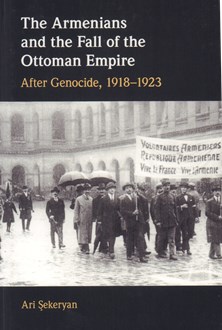
The Armenians and the fall of the Ottoman Empire : after genocide, 1918-1923 / Ari Şekeryan.
Yer Numarası
A.IX/7222
ISBN
9781108844017 (hardback)
9781108921817 (epub)
9781108921817 (epub)
Dil Kodu
İngilizce
Kütüphane
Türk Tarih Kurumu Kütüphanesi
Yazar
Basım Bildirimi
First published.
Yayın Bilgisi
Cambridge, UK ; New York, NY : Cambridge University Press, 2023.
Fiziksel Niteleme
xiv, 249 sayfa : resim, harita, tablo ; 24 cm
Genel Not
İndeks s. 236-249.
Bibliyografi, vb. Notu
Bibliyografya s. 219-235.
İçindekiler Notu
End of the Great War -- The Emergence of the Turkish National Movement in Anatolia and the Armenian community -- The French occupation in Cilicia and the Turkish-Armenian war in the Causcaus -- The transformation of the Armenian political position -- Conclusion : Fractured futures -- Appendix -- Selected bibliography -- Index.
Özet, vb.
“The Armistice of Mudros was signed on 30 October 1918 and on the morning of 13 November 1918, a mighty fleet of battleships from Britain, France, Italy and Greece sailed to Istanbul, and dropped anchor without encountering resistance. This day marked the beginning of the end of the Ottoman Empire, a dissolution that would bring great suffering and chaos, but also new opportunities for all Ottomans, Muslim and non-Muslim alike. Drawing upon a previously untouched collection of Armenian and Ottoman Turkish primary sources, Ari Şekeryan considers these understudied post-war years. Examining the Armenian community as they emerged from the aftermath of war and genocide, Şekeryan outlines their shifting political position and the strategies they used to survive this turbulent period. By focusing on the Ottoman Armistice (1918-1923), Şekeryan illuminates an oft-neglected period in history, and develops a new case study for understanding the political reactions of ethnic groups to the fall of empires and nation-states” -- Yayıncı.
