LEADER 02910naaaa2200421aa54500
001 604978
003 TR_AnAIT
005 20250627095801
006 aod||e |||| 001 0d
007 ta
008 231212s2023 enkod||e |||| 001 0deng c
020 |a9780755645473|q(HB)
020 |a9780755645510|q(paperback)
020 |a9780755645480|q(ePDF)
020 |a9780755645497|q(eBook)
040 |aTTK
041 |aeng
049 |aTürk Tarih Kurumu Kütüphanesi
090 |aA.IX/7205
100 1 |aBektaş, Erhan.
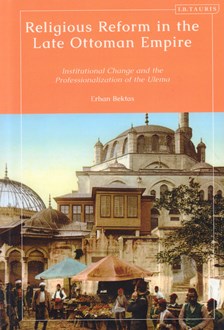
245 10|aReligious reform in the late Ottoman Empire :|binstitutional change and the professionalisation of the ulema /|cErhan Bektas.
250 |aFirst edition.
260 |aLondon :|bI.B. Tauris,|c2023.
300 |axvi, 215 sayfa :|bresim, grafik, şema, tıpkıbasım, tablo ;|c24 cm
500 |aİndeks s. [209]-215.
504 |aBibliyografya s. [199]-208.
504 |aBibliyografik notlar s. [165]-197.
505 |tPreface --|tAcknowledgments --|tList of abbreviations --|tIntroduction : The decline paradigm of the Ulema Reconsidered --|tThe re-organization of the Şeyhülislam Office, 1826-1914 --|tUlema’s Educational Career --|tUlema’s professional career, 1880-1920 --|tSocial profile of the Ulema : a prosopographical study --|tUlema in the context of everyday social life --|tConclusion --|tAppendices --|tNotes --|tBibliography --|tIndex.
520 |a“The influence of the ulema, the official Sunni Muslim religious scholars of the Ottoman Empire, is commonly understood to have waned in the empire's last century. Drawing upon Ottoman state archives and the institutional archives of the ulema, this study challenges this narrative, showing that the ulema underwent a process of professionalisation as part of the wider Tanzimat reforms and thereby continued to play an important role in Ottoman society. First outlining transformations in the office of the Sheikh ul-islam, the leading Ottoman Sunni Muslim cleric, the book goes on to use the archives to present a detailed portrait of the lives of individual ulema, charting their education and professional and social lives. It also includes a glossary of Turkish-Arabic vocabulary for increased clarity. Contrary to beliefs about their decline, the book shows they played a central role in the empire's efforts to centralise the state by acting as intermediaries between the government and social groups, particularly on the empire's peripheries.” --|cYayıncı.
650 4|aUlema|zOsmanlı imparatorluğu, 1299-1918.
650 4|aDin adamları|zOsmanlı imparatorluğu, 1299-1018.
650 4|aŞeyhülislam.
650 4|aDini kurumlar|zTürkiye|xTarih.
650 4|aDin adamları|zTürkiye|xTarih.
650 4|aİslam|zTürkiye|xTarih.
651 4|aTürkiye|xYönetim ve politikalar|xTarih|y19. yy.
651 4|aTürkiye|xYönetim ve politikalar|xTarih|y20. yy.