

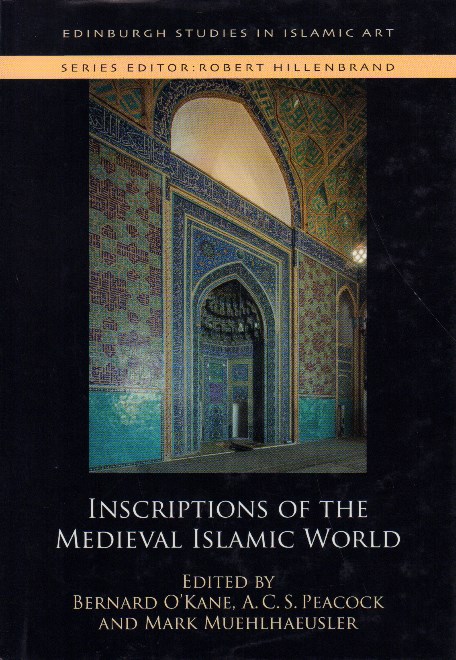
Inscriptions of the Medieval Islamic world / edited by Bernard O'Kane, A. C. S. Peacock and Mark Muehlhaeusler.
Yer Numarası
A.IX/7602
ISBN
9781474489447 (hardback)
9781474489461 (webready PDF)
9781474489478 (epub)
9781474489461 (webready PDF)
9781474489478 (epub)
Dil Kodu
İngilizce
Kütüphane
Türk Tarih Kurumu Kütüphanesi
Yayın Bilgisi
Edinburgh : Edinburgh University Press, ©2023.
Fiziksel Niteleme
xxvii, 723 sayfa : resim (çoğu renkli), minyatür, çizim, harita, tablo ; 25 cm.
Dizi
Edinburgh studies in Islamic art
Genel Not
İndeks s. [711]-723.
Bibliyografi, vb. Notu
Bibliyografya makale sonlarındadır.
İçindekiler Notu
Introduction / Bernard O’Kane, A. C. S. Peacock -- Part I. Inscriptions and royal power. The Fatimid public text revisited / Jonathan M. Bloom -- Micro and macro power projection in the Medieval Islamic world: the architectural and numismatic epigraphic evidence / Richard P. McClary -- The Monumental inscriptions of the Great Seljuqs Malikshåh and Tutush. Observations on texts, protocols and writing styles / Roberta Giunta -- New epigraphic data from a Ghurid monument at Chisht-i Sharif cc: expressing power and piety in Sixth/Twelfth-Century Afghanistan / Viola Allegranzi -- Part II. Inscriptions and piety. Stars and symmetry: the name of the Prophet Muhammad in architectural inscriptions / Bernard O’Kane -- Barakat Muhammad. Notes on square kufic epigraphy in the history of Morocco / Umberto Bongianino, Péter T. Nagy -- Islamic supplications of the funerary architecture of Medieval Castile / Razan Francis -- The Shaykh and the Amir: reflections on the non-Quranic epigraphic programme in the buildings of Shaykhi al-Umari al-Nasiri / Noha Abou-Khatwa -- Part III. Inscriptions, history and society. Tombstones from Aswan in the British Museum / Venetia Porter -- Marwanid inscriptions / Carole Hillenbrand -- The Rise of New Epigraphic Languages in the Medieval Islamic East. The Interplay of Persian, Turkish and Arabic on Inscriptions / A. C. S. Peacock -- Inscriptions from the Golden Horde Period and the Crimean Khanate in Crimea: a Body of Hitherto Neglected Material within the Study of the Inscriptions of Islamic Lands / Nicole Kançal-Ferrari, Fatma M. Şen -- Part IV. Inscribed objects. The epigraphic Samarra Horizon: blue-on-white ceramics / Rebecca Wrightson -- Art with poetry: inscriptions on Mamluk metalwork / Doris Behrens-Abouseif -- ‘The calligrapher is an Ape!’ Arabic epigrams on pen boxes (Sixth/Twelfth - Ninth/Fifteenth Centuries) / Frédéric Bauden -- Between the artist and the Patron: painted inscriptions of the Khamsa of Shah Tahmasb / Selin Ünlüönen -- Part V. Epigraphic style and function. The influence of aesthetics on orthographic decisions in the early islamic graffiti of Wadi al-Khirqa, Northern Hijaz / Risa Tokunaga -- The here and the hereafter: rounded and angularinscriptions in Medieval Syria, Anatolia and the Jazira / Scott Redford -- Luted letters: the relief inscriptions on Kashan Lustre mihrabs / Sheila Blair -- Carved letters, designs and ornaments: Ilkhanid stuccos and ‘signatures’ of their craftsmen / Ana Marija Grbanovic -- The qutb minar: epigraphic notes / Robert Hillenbrand -- Index.
Özet, vb.
“This volume offers an overview of the state of the field, and shows the importance of Islamic inscriptions for disciplines such as art history, history and literature. The chapters range from surveys to detailed exploration of individual topics, providing an insight to some of the most recent cutting-edge work on Islamic inscriptions. It focuses on the period from the rise of Islam to the fifteenth century, ranging across the Islamic world from the Maghreb to India and Central Asia, and inscriptions in Arabic, Persian and Turkish. The five sections of the book draw together some of the principal themes: ‘Royal Power’ investigates the role of sultanic patronage in epigraphy, and the use of inscriptions for projecting royal power. ‘Piety’ examines the relationship between epigraphy and religious practice. ‘Epigraphic Style and Function’ explores the relationship between the use of specific epigraphic styles and scripts and the function of a monument. ‘Inscribed Objects’ moves from monumental inscriptions to those on objects such as ceramics and pen-cases. The final section considers the interplay between inscriptions and historical sources as well as the utility of inscriptions as historical sources.” -- Arka kapak.
Konu
Emeği Geçenler
O'Kane, Bernard, editör.
Peacock, Andrew Charles Spencer, 1976- editör.
Muehlhaeusler, Mark, editör.
Peacock, Andrew Charles Spencer, 1976- editör.
Muehlhaeusler, Mark, editör.
Eseri Alıntıla
Referansları kullanmadan önce gözden geçirmeniz ve varsa gerekli düzeltmeleri yapmanız önerilir.
Dijital Kaynak
MARC Görünümü
LEADER 05217naaaa2200373aa54500
001 606180
003 TR_AnAIT
005 20250627090538
006 aoabde |||| 001 0d
007 ta
008 240522s2023 stkoabde |||| 001 0deng c
020 |a9781474489447|q(hardback)
020 |a9781474489461|q(webready PDF)
020 |a9781474489478|q(epub)
040 |aTTK
041 |aeng
049 |aTürk Tarih Kurumu Kütüphanesi
090 |aA.IX/7602
245 00|aInscriptions of the Medieval Islamic world / edited by Bernard O'Kane, A. C. S. Peacock and Mark Muehlhaeusler.
260 |aEdinburgh :|bEdinburgh University Press,|c©2023.
300 |axxvii, 723 sayfa :|bresim (çoğu renkli), minyatür, çizim, harita, tablo ;|c25 cm.
490 0 |aEdinburgh studies in Islamic art
500 |aİndeks s. [711]-723.
504 |aBibliyografya makale sonlarındadır.
505 |tIntroduction /|rBernard O’Kane, A. C. S. Peacock --|gPart I.|tInscriptions and royal power.|tThe Fatimid public text revisited /|rJonathan M. Bloom --|tMicro and macro power projection in the Medieval Islamic world: the architectural and numismatic epigraphic evidence /|rRichard P. McClary --|tThe Monumental inscriptions of the Great Seljuqs Malikshåh and Tutush. Observations on texts, protocols and writing styles /|rRoberta Giunta --|tNew epigraphic data from a Ghurid monument at Chisht-i Sharif cc: expressing power and piety in Sixth/Twelfth-Century Afghanistan /|rViola Allegranzi --|gPart II.|tInscriptions and piety.|tStars and symmetry: the name of the Prophet Muhammad in architectural inscriptions /|rBernard O’Kane --|tBarakat Muhammad. Notes on square kufic epigraphy in the history of Morocco /|rUmberto Bongianino, Péter T. Nagy --|tIslamic supplications of the funerary architecture of Medieval Castile /|rRazan Francis --|tThe Shaykh and the Amir: reflections on the non-Quranic epigraphic programme in the buildings of Shaykhi al-Umari al-Nasiri /|rNoha Abou-Khatwa --|gPart III.|tInscriptions, history and society.|tTombstones from Aswan in the British Museum /|rVenetia Porter --|tMarwanid inscriptions /|rCarole Hillenbrand --|tThe Rise of New Epigraphic Languages in the Medieval Islamic East. The Interplay of Persian, Turkish and Arabic on Inscriptions /|rA. C. S. Peacock --|tInscriptions from the Golden Horde Period and the Crimean Khanate in Crimea: a Body of Hitherto Neglected Material within the Study of the Inscriptions of Islamic Lands /|rNicole Kançal-Ferrari, Fatma M. Şen --|gPart IV.|tInscribed objects.|tThe epigraphic Samarra Horizon: blue-on-white ceramics /|rRebecca Wrightson --|tArt with poetry: inscriptions on Mamluk metalwork /|rDoris Behrens-Abouseif --|t‘The calligrapher is an Ape!’ Arabic epigrams on pen boxes (Sixth/Twelfth - Ninth/Fifteenth Centuries) /|rFrédéric Bauden --|tBetween the artist and the Patron: painted inscriptions of the Khamsa of Shah Tahmasb /|rSelin Ünlüönen --|gPart V.|tEpigraphic style and function.|tThe influence of aesthetics on orthographic decisions in the early islamic graffiti of Wadi al-Khirqa, Northern Hijaz /|rRisa Tokunaga --|tThe here and the hereafter: rounded and angularinscriptions in Medieval Syria, Anatolia and the Jazira /|rScott Redford --|tLuted letters: the relief inscriptions on Kashan Lustre mihrabs /|rSheila Blair --|tCarved letters, designs and ornaments: Ilkhanid stuccos and ‘signatures’ of their craftsmen /|rAna Marija Grbanovic --|tThe qutb minar: epigraphic notes /|rRobert Hillenbrand --|tIndex.
520 |a“This volume offers an overview of the state of the field, and shows the importance of Islamic inscriptions for disciplines such as art history, history and literature. The chapters range from surveys to detailed exploration of individual topics, providing an insight to some of the most recent cutting-edge work on Islamic inscriptions. It focuses on the period from the rise of Islam to the fifteenth century, ranging across the Islamic world from the Maghreb to India and Central Asia, and inscriptions in Arabic, Persian and Turkish. The five sections of the book draw together some of the principal themes: ‘Royal Power’ investigates the role of sultanic patronage in epigraphy, and the use of inscriptions for projecting royal power. ‘Piety’ examines the relationship between epigraphy and religious practice. ‘Epigraphic Style and Function’ explores the relationship between the use of specific epigraphic styles and scripts and the function of a monument. ‘Inscribed Objects’ moves from monumental inscriptions to those on objects such as ceramics and pen-cases. The final section considers the interplay between inscriptions and historical sources as well as the utility of inscriptions as historical sources.” --|cArka kapak.
650 4|aYazıtlar, Arapça|xİslam dünyası|yOrta Çağ.
650 4|aYazıtlar, Farsça|xİslam dünyası|yOrta Çağ.
650 4|aYazıtlar, Türkçe|xİslam dünyası|yOrta Çağ.
650 4|aMedeniyet, İslam|yOrta Çağ|vKaynaklar.
700 1 |aO'Kane, Bernard,|eeditör.
700 1 |aPeacock, Andrew Charles Spencer,|d1976-|eeditör.
700 1 |aMuehlhaeusler, Mark,|eeditör.
001 606180
003 TR_AnAIT
005 20250627090538
006 aoabde |||| 001 0d
007 ta
008 240522s2023 stkoabde |||| 001 0deng c
020 |a9781474489447|q(hardback)
020 |a9781474489461|q(webready PDF)
020 |a9781474489478|q(epub)
040 |aTTK
041 |aeng
049 |aTürk Tarih Kurumu Kütüphanesi
090 |aA.IX/7602
245 00|aInscriptions of the Medieval Islamic world / edited by Bernard O'Kane, A. C. S. Peacock and Mark Muehlhaeusler.
260 |aEdinburgh :|bEdinburgh University Press,|c©2023.
300 |axxvii, 723 sayfa :|bresim (çoğu renkli), minyatür, çizim, harita, tablo ;|c25 cm.
490 0 |aEdinburgh studies in Islamic art
500 |aİndeks s. [711]-723.
504 |aBibliyografya makale sonlarındadır.
505 |tIntroduction /|rBernard O’Kane, A. C. S. Peacock --|gPart I.|tInscriptions and royal power.|tThe Fatimid public text revisited /|rJonathan M. Bloom --|tMicro and macro power projection in the Medieval Islamic world: the architectural and numismatic epigraphic evidence /|rRichard P. McClary --|tThe Monumental inscriptions of the Great Seljuqs Malikshåh and Tutush. Observations on texts, protocols and writing styles /|rRoberta Giunta --|tNew epigraphic data from a Ghurid monument at Chisht-i Sharif cc: expressing power and piety in Sixth/Twelfth-Century Afghanistan /|rViola Allegranzi --|gPart II.|tInscriptions and piety.|tStars and symmetry: the name of the Prophet Muhammad in architectural inscriptions /|rBernard O’Kane --|tBarakat Muhammad. Notes on square kufic epigraphy in the history of Morocco /|rUmberto Bongianino, Péter T. Nagy --|tIslamic supplications of the funerary architecture of Medieval Castile /|rRazan Francis --|tThe Shaykh and the Amir: reflections on the non-Quranic epigraphic programme in the buildings of Shaykhi al-Umari al-Nasiri /|rNoha Abou-Khatwa --|gPart III.|tInscriptions, history and society.|tTombstones from Aswan in the British Museum /|rVenetia Porter --|tMarwanid inscriptions /|rCarole Hillenbrand --|tThe Rise of New Epigraphic Languages in the Medieval Islamic East. The Interplay of Persian, Turkish and Arabic on Inscriptions /|rA. C. S. Peacock --|tInscriptions from the Golden Horde Period and the Crimean Khanate in Crimea: a Body of Hitherto Neglected Material within the Study of the Inscriptions of Islamic Lands /|rNicole Kançal-Ferrari, Fatma M. Şen --|gPart IV.|tInscribed objects.|tThe epigraphic Samarra Horizon: blue-on-white ceramics /|rRebecca Wrightson --|tArt with poetry: inscriptions on Mamluk metalwork /|rDoris Behrens-Abouseif --|t‘The calligrapher is an Ape!’ Arabic epigrams on pen boxes (Sixth/Twelfth - Ninth/Fifteenth Centuries) /|rFrédéric Bauden --|tBetween the artist and the Patron: painted inscriptions of the Khamsa of Shah Tahmasb /|rSelin Ünlüönen --|gPart V.|tEpigraphic style and function.|tThe influence of aesthetics on orthographic decisions in the early islamic graffiti of Wadi al-Khirqa, Northern Hijaz /|rRisa Tokunaga --|tThe here and the hereafter: rounded and angularinscriptions in Medieval Syria, Anatolia and the Jazira /|rScott Redford --|tLuted letters: the relief inscriptions on Kashan Lustre mihrabs /|rSheila Blair --|tCarved letters, designs and ornaments: Ilkhanid stuccos and ‘signatures’ of their craftsmen /|rAna Marija Grbanovic --|tThe qutb minar: epigraphic notes /|rRobert Hillenbrand --|tIndex.
520 |a“This volume offers an overview of the state of the field, and shows the importance of Islamic inscriptions for disciplines such as art history, history and literature. The chapters range from surveys to detailed exploration of individual topics, providing an insight to some of the most recent cutting-edge work on Islamic inscriptions. It focuses on the period from the rise of Islam to the fifteenth century, ranging across the Islamic world from the Maghreb to India and Central Asia, and inscriptions in Arabic, Persian and Turkish. The five sections of the book draw together some of the principal themes: ‘Royal Power’ investigates the role of sultanic patronage in epigraphy, and the use of inscriptions for projecting royal power. ‘Piety’ examines the relationship between epigraphy and religious practice. ‘Epigraphic Style and Function’ explores the relationship between the use of specific epigraphic styles and scripts and the function of a monument. ‘Inscribed Objects’ moves from monumental inscriptions to those on objects such as ceramics and pen-cases. The final section considers the interplay between inscriptions and historical sources as well as the utility of inscriptions as historical sources.” --|cArka kapak.
650 4|aYazıtlar, Arapça|xİslam dünyası|yOrta Çağ.
650 4|aYazıtlar, Farsça|xİslam dünyası|yOrta Çağ.
650 4|aYazıtlar, Türkçe|xİslam dünyası|yOrta Çağ.
650 4|aMedeniyet, İslam|yOrta Çağ|vKaynaklar.
700 1 |aO'Kane, Bernard,|eeditör.
700 1 |aPeacock, Andrew Charles Spencer,|d1976-|eeditör.
700 1 |aMuehlhaeusler, Mark,|eeditör.
Materyaller
Depodan talep edilen materyal sadece kütüphane içerisinde kullanılmaktadır.
Materyal dışarıya ödünç verilmemektedir.
Materyal dışarıya ödünç verilmemektedir.
