

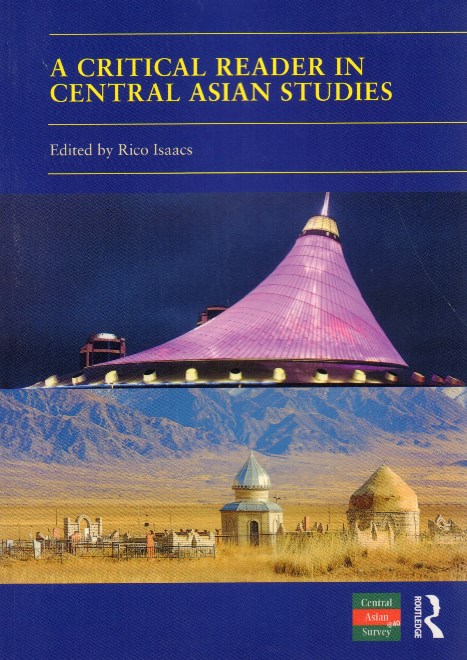
A critical reader in Central Asian studies : 40 years of Central Asian survey / edited by Rico Isaacs.
Yer Numarası
A.IX/8826
ISBN
9781032060217 (pbk)
9781032060194 (hbk)
9781003200338 (ebk)
9781032060194 (hbk)
9781003200338 (ebk)
Dil Kodu
İngilizce
Kütüphane
Türk Tarih Kurumu Kütüphanesi
Eser Adının Farklı Biçimi
A critical reader in Central Asian studies : forty years of Central Asian survey
Basım Bildirimi
First published [1. baskı].
Yayın Bilgisi
Abingdon, Oxon ; New York, NY : Routledge, 2022.
Fiziksel Niteleme
x, 210 sayfa ; 25 cm.
Dizi
Central Asian studies ; 42
Genel Not
İndeks s. [205]-210.
Bibliyografi, vb. Notu
Bibliyografya makale sonlarındadır.
İçindekiler Notu
SECTION ONE. HISTORY. The Russian conquest of Central Asia (1982) / Mehmet Saray -- The role of the pristavstvo institution in the context of Russian imperial policies in the Kazakh Steppe in the nineteenth century (2014) / Gulmira Sultangalieva -- The creation of Soviet Central Asia: The 1924 national delimitation (1995) / Steven Sabol -- Humans as territory: forced resettlement and the making of Soviet Tajikistan, 1920–38 (2011) / Botakoz Kassymbekova -- Marriage, modernity, and the ‘friendship of nations’: interethnic intimacy in post-war Central Asia in comparative perspective (2007) / Adrienne Lynn Edgar -- SECTION TWO. IDENTITY AND NATIONALISM. The politics of identity change in Soviet Central Asia (1984) / S. Enders Wimbush -- Creating national identity in socialist Mongolia (1998) / Christopher Kaplonski -- Imagined communities: Kazak nationalism and Kazakification in the 1990s (1999) / Azamat Sarsembayev -- Nationalism as a geopolitical phenomenon: The Central Asian case (2001) / Farkhod Tolipov -- Global Astana: nation branding as a legitimization tool for authoritarian regimes (2015) / Adrien Fauve -- SECTION THREE. ISLAM. Islam in Soviet central Asia, 1917–1930: Soviet policy and the struggle for control (1992) / Shoshana Keller -- Soviet Islam since the invasion of Afghanistan (1982) / Alexandre Bennigsen -- Islamic revival in the central Asian Republics (1994) / Mehrdad Haghayeghi -- The logic of Islamic practice: a religious conflict in Central Asia (2006) / Sergei Abashin -- Islamic discourses in Azerbaijan: the securitization of ‘non-traditional religious movements (2018) / Galib Bashirov -- SECTION FOUR. GOVERNING AND THE STATE. Sharaf Rashidov and the dilemmas of national leadership (1986) / Gregory Gleason -- Authoritarian political development in Central Asia: The case of Turkmenistan (1995) / John Anderson -- Tajikistan amidst globalization: state failure or state transformation? (2011) / John Heathershaw -- Disorder over the border: spinning the spectre of instability through time and space in Central Asia (2018) / Natalie Koch -- SECTION FIVE. INFORMAL INSTITUTIONS. ‘Tribalism’ and identity in contemporary circumstances: The case of Kazakstan (1998) / Saulesh Esenova -- Neopatrimonialism, interest groups and patronage networks: the impasses of the governance system in Uzbekistan (2007) / Alisher Ilkhamov -- Theories on Central Asian factionalism: the debate in political science and its wider implications (2007) / David Gullette -- Political and social networks in Tajikistan and Uzbekistan: ‘clan’, region and beyond (2009) / İdil Tunçer-Kılavuz -- SECTION SIX. CONTENTIOUS POLITICS. Central Asian riots and disturbances, 1989–1990: Causes and context (1991) / Yaacov Ro'i -- Networks, localism and mobilization in Aksy, Kyrgyzstan (2005) / Scott Radnitz -- Poetry of witness: Uzbek identity and the response to Andijon (2007) / Sarah Kendzior -- The dynamics of regime change: domestic and international factors in the ‘Tulip Revolution’ (2008) / David Lewis -- Post-violence regime survival and expansion in Kazakhstan and Tajikistan (2016) / Erica Marat -- SECTION SEVEN. GENDER. The politics of gender and the Soviet paradox: neither colonized, nor modern? (2007) / Deniz Kandiyoti -- Making the ‘empowered woman’: exploring contradictions in gender and development programming in Kyrgyzstan (2018) / Elena Kim, Asel Myrzabekova, Elena Molchanova, Olha Yarova -- Women of protest, men of applause: political activism, gender and tradition in Kyrgyzstan (2019) / Judith Beyer, Aijarkyn Kojobekova -- What's in a name? The personal and political meanings of ‘LGBT’ for non-heterosexual and transgender youth in Kyrgyzstan (2010) Cai Wilkinson, Anna Kirey -- SECTION EIGHT. EVERYDAY LIFE. Household networks and the security of mutual indebtedness in rural Kazakstan (1998) / Cynthia Werner -- Staying put? Towards a relational politics of mobility at a time of migration (2011) / Madeleine Reeves -- Wedding rituals and the struggle over national identities (2011) / Sophie Roche, Sophie Hohmann -- ‘How can I be post-Soviet if I was never Soviet?’ Rethinking categories of time and social change – a perspective from Kulob, southern Tajikistan (2015) / Diana Ibañez-Tirado -- SECTION NINE. REGIONAL AND GLOBAL PERSPECTIVES. Virtual regionalism, regional structures, and regime security in Central Asia. (2008) / Roy Allison -- Regime security, base politics, and rent-seeking: the local and global political economies of the American air base in Kyrgyzstan, 2001–2010 (2015) / Kemel Toktomushev -- Blurring the line between licit and illicit: transnational corruption networks in Central Asia and beyond (2015) Alexander Cooley, J.C. Sharman -- Thoroughly reforming them towards a healthy heart attitude’: China’s political re-education campaign in Xinjiang (2019) / Adrian Zenz.
Özet, vb.
“Central Asian Survey has remained as the premier world-leading peer-reviewed journal for Central Asian studies for four decades. To mark the 40th anniversary of the journal, this volume is intended to be a reader of selected essays from the journal over the last four decades. This book is not just a mere collection, but also a critical reflection on the field over that time. Each of the nine sections in the book feature a critical appraisal of the selected excerpts by young scholars who analyse the reproduced excerpts and the contribution they make to advancing our understanding of the field. The nine sections encapsulate prominent themes in Central Asian studies: history, identity and nationalism, Islam, governing and the state, informal institutions, contentious politics, gender, everyday life, and regional and global perspectives.
The book is not just intended to reflect on the role of Central Asian Survey in the development of Central Asian studies, but also the aim is for the volume to be used as a teaching resource where the different sections in the collection could correlate to specific teaching weeks in courses on the region. The different contributions cover many case studies from across a range of countries that have featured in the journal over the years, and thus is not just restricted to the Central Asian republics but also includes Mongolia, Azerbaijan, and Xinjiang. This book will serve as a great resource for researchers and students of Central Asian history, politics, culture, society, and international relations“ Yayıncı.
Konu
Emeği Geçenler
Isaacs, Rico, editör.
Eseri Alıntıla
Referansları kullanmadan önce gözden geçirmeniz ve varsa gerekli düzeltmeleri yapmanız önerilir.
Dijital Kaynak
MARC Görünümü
LEADER 07708namaa22003498a 4500
001 606836
003 TR_AnAIT
005 20250627083534
006 a||||e |||| 001 0
007 ta
008 241111s2022 xxk||||e |||| 00||0 eng c
020 |a9781032060217|q(pbk)
020 |a9781032060194|q(hbk)
020 |a9781003200338|q(ebk)
041 |aeng
049 |aTürk Tarih Kurumu Kütüphanesi
090 |aA.IX/8826
245 00|aA critical reader in Central Asian studies :|b40 years of Central Asian survey /|cedited by Rico Isaacs.
246 1 |aA critical reader in Central Asian studies :|bforty years of Central Asian survey
250 |aFirst published [1. baskı].
260 |aAbingdon, Oxon ;|aNew York, NY :|bRoutledge,|c2022.
300 |ax, 210 sayfa ;|c25 cm.
490 0 |aCentral Asian studies ;|v42
500 |aİndeks s. [205]-210.
504 |aBibliyografya makale sonlarındadır.
505 |gSECTION ONE.|tHISTORY.|tThe Russian conquest of Central Asia (1982) /|rMehmet Saray --|tThe role of the pristavstvo institution in the context of Russian imperial policies in the Kazakh Steppe in the nineteenth century (2014) /|rGulmira Sultangalieva --|tThe creation of Soviet Central Asia: The 1924 national delimitation (1995) /|rSteven Sabol --|tHumans as territory: forced resettlement and the making of Soviet Tajikistan, 1920–38 (2011) /|rBotakoz Kassymbekova --|tMarriage, modernity, and the ‘friendship of nations’: interethnic intimacy in post-war Central Asia in comparative perspective (2007) /|rAdrienne Lynn Edgar --|gSECTION TWO.|tIDENTITY AND NATIONALISM.|tThe politics of identity change in Soviet Central Asia (1984) /|rS. Enders Wimbush --|tCreating national identity in socialist Mongolia (1998) /|rChristopher Kaplonski --|tImagined communities: Kazak nationalism and Kazakification in the 1990s (1999) /|rAzamat Sarsembayev --|tNationalism as a geopolitical phenomenon: The Central Asian case (2001) /|rFarkhod Tolipov --|tGlobal Astana: nation branding as a legitimization tool for authoritarian regimes (2015) /|rAdrien Fauve --|gSECTION THREE.|tISLAM.|tIslam in Soviet central Asia, 1917–1930: Soviet policy and the struggle for control (1992) /|rShoshana Keller --|tSoviet Islam since the invasion of Afghanistan (1982) /|rAlexandre Bennigsen --|tIslamic revival in the central Asian Republics (1994) /|rMehrdad Haghayeghi --|tThe logic of Islamic practice: a religious conflict in Central Asia (2006) /|rSergei Abashin --|tIslamic discourses in Azerbaijan: the securitization of ‘non-traditional religious movements (2018) /|rGalib Bashirov --|gSECTION FOUR.|tGOVERNING AND THE STATE.|tSharaf Rashidov and the dilemmas of national leadership (1986) /|rGregory Gleason --|tAuthoritarian political development in Central Asia: The case of Turkmenistan (1995) /|rJohn Anderson --|tTajikistan amidst globalization: state failure or state transformation? (2011) /|rJohn Heathershaw --|tDisorder over the border: spinning the spectre of instability through time and space in Central Asia (2018) /|rNatalie Koch --|gSECTION FIVE.|tINFORMAL INSTITUTIONS.|t‘Tribalism’ and identity in contemporary circumstances: The case of Kazakstan (1998) /|rSaulesh Esenova --|tNeopatrimonialism, interest groups and patronage networks: the impasses of the governance system in Uzbekistan (2007) /|rAlisher Ilkhamov --|tTheories on Central Asian factionalism: the debate in political science and its wider implications (2007) /|rDavid Gullette --|tPolitical and social networks in Tajikistan and Uzbekistan: ‘clan’, region and beyond (2009) /|rİdil Tunçer-Kılavuz --|gSECTION SIX.|tCONTENTIOUS POLITICS.|tCentral Asian riots and disturbances, 1989–1990: Causes and context (1991) /|rYaacov Ro'i --|tNetworks, localism and mobilization in Aksy, Kyrgyzstan (2005) /|rScott Radnitz --|tPoetry of witness: Uzbek identity and the response to Andijon (2007) /|rSarah Kendzior --|tThe dynamics of regime change: domestic and international factors in the ‘Tulip Revolution’ (2008) /|rDavid Lewis --|tPost-violence regime survival and expansion in Kazakhstan and Tajikistan (2016) /|rErica Marat --|gSECTION SEVEN.|tGENDER.|tThe politics of gender and the Soviet paradox: neither colonized, nor modern? (2007) /|rDeniz Kandiyoti --|tMaking the ‘empowered woman’: exploring contradictions in gender and development programming in Kyrgyzstan (2018) /|rElena Kim, Asel Myrzabekova, Elena Molchanova, Olha Yarova --|tWomen of protest, men of applause: political activism, gender and tradition in Kyrgyzstan (2019) /|rJudith Beyer, Aijarkyn Kojobekova --|tWhat's in a name? The personal and political meanings of ‘LGBT’ for non-heterosexual and transgender youth in Kyrgyzstan (2010)|rCai Wilkinson, Anna Kirey --|gSECTION EIGHT.|tEVERYDAY LIFE.|tHousehold networks and the security of mutual indebtedness in rural Kazakstan (1998) /|rCynthia Werner --|tStaying put? Towards a relational politics of mobility at a time of migration (2011) /|rMadeleine Reeves --|tWedding rituals and the struggle over national identities (2011) /|rSophie Roche, Sophie Hohmann --|t‘How can I be post-Soviet if I was never Soviet?’ Rethinking categories of time and social change – a perspective from Kulob, southern Tajikistan (2015) /|rDiana Ibañez-Tirado --|gSECTION NINE.|tREGIONAL AND GLOBAL PERSPECTIVES.|tVirtual regionalism, regional structures, and regime security in Central Asia. (2008) /|rRoy Allison --|tRegime security, base politics, and rent-seeking: the local and global political economies of the American air base in Kyrgyzstan, 2001–2010 (2015) /|rKemel Toktomushev --|tBlurring the line between licit and illicit: transnational corruption networks in Central Asia and beyond (2015)|rAlexander Cooley, J.C. Sharman --|tThoroughly reforming them towards a healthy heart attitude’: China’s political re-education campaign in Xinjiang (2019) /|rAdrian Zenz.
520 |a“Central Asian Survey has remained as the premier world-leading peer-reviewed journal for Central Asian studies for four decades. To mark the 40th anniversary of the journal, this volume is intended to be a reader of selected essays from the journal over the last four decades. This book is not just a mere collection, but also a critical reflection on the field over that time. Each of the nine sections in the book feature a critical appraisal of the selected excerpts by young scholars who analyse the reproduced excerpts and the contribution they make to advancing our understanding of the field. The nine sections encapsulate prominent themes in Central Asian studies: history, identity and nationalism, Islam, governing and the state, informal institutions, contentious politics, gender, everyday life, and regional and global perspectives.
The book is not just intended to reflect on the role of Central Asian Survey in the development of Central Asian studies, but also the aim is for the volume to be used as a teaching resource where the different sections in the collection could correlate to specific teaching weeks in courses on the region. The different contributions cover many case studies from across a range of countries that have featured in the journal over the years, and thus is not just restricted to the Central Asian republics but also includes Mongolia, Azerbaijan, and Xinjiang. This book will serve as a great resource for researchers and students of Central Asian history, politics, culture, society, and international relations“|cYayıncı.
651 4|aOrta Asya|xTarih.
651 4|aOrta Asya|xYönetim ve politikalar.
651 4|aOrta Asya|xMedeniyet.
651 4|aOrta Asya|xSosyal koşullar.
700 1 |aIsaacs, Rico,|eeditör.
001 606836
003 TR_AnAIT
005 20250627083534
006 a||||e |||| 001 0
007 ta
008 241111s2022 xxk||||e |||| 00||0 eng c
020 |a9781032060217|q(pbk)
020 |a9781032060194|q(hbk)
020 |a9781003200338|q(ebk)
041 |aeng
049 |aTürk Tarih Kurumu Kütüphanesi
090 |aA.IX/8826
245 00|aA critical reader in Central Asian studies :|b40 years of Central Asian survey /|cedited by Rico Isaacs.
246 1 |aA critical reader in Central Asian studies :|bforty years of Central Asian survey
250 |aFirst published [1. baskı].
260 |aAbingdon, Oxon ;|aNew York, NY :|bRoutledge,|c2022.
300 |ax, 210 sayfa ;|c25 cm.
490 0 |aCentral Asian studies ;|v42
500 |aİndeks s. [205]-210.
504 |aBibliyografya makale sonlarındadır.
505 |gSECTION ONE.|tHISTORY.|tThe Russian conquest of Central Asia (1982) /|rMehmet Saray --|tThe role of the pristavstvo institution in the context of Russian imperial policies in the Kazakh Steppe in the nineteenth century (2014) /|rGulmira Sultangalieva --|tThe creation of Soviet Central Asia: The 1924 national delimitation (1995) /|rSteven Sabol --|tHumans as territory: forced resettlement and the making of Soviet Tajikistan, 1920–38 (2011) /|rBotakoz Kassymbekova --|tMarriage, modernity, and the ‘friendship of nations’: interethnic intimacy in post-war Central Asia in comparative perspective (2007) /|rAdrienne Lynn Edgar --|gSECTION TWO.|tIDENTITY AND NATIONALISM.|tThe politics of identity change in Soviet Central Asia (1984) /|rS. Enders Wimbush --|tCreating national identity in socialist Mongolia (1998) /|rChristopher Kaplonski --|tImagined communities: Kazak nationalism and Kazakification in the 1990s (1999) /|rAzamat Sarsembayev --|tNationalism as a geopolitical phenomenon: The Central Asian case (2001) /|rFarkhod Tolipov --|tGlobal Astana: nation branding as a legitimization tool for authoritarian regimes (2015) /|rAdrien Fauve --|gSECTION THREE.|tISLAM.|tIslam in Soviet central Asia, 1917–1930: Soviet policy and the struggle for control (1992) /|rShoshana Keller --|tSoviet Islam since the invasion of Afghanistan (1982) /|rAlexandre Bennigsen --|tIslamic revival in the central Asian Republics (1994) /|rMehrdad Haghayeghi --|tThe logic of Islamic practice: a religious conflict in Central Asia (2006) /|rSergei Abashin --|tIslamic discourses in Azerbaijan: the securitization of ‘non-traditional religious movements (2018) /|rGalib Bashirov --|gSECTION FOUR.|tGOVERNING AND THE STATE.|tSharaf Rashidov and the dilemmas of national leadership (1986) /|rGregory Gleason --|tAuthoritarian political development in Central Asia: The case of Turkmenistan (1995) /|rJohn Anderson --|tTajikistan amidst globalization: state failure or state transformation? (2011) /|rJohn Heathershaw --|tDisorder over the border: spinning the spectre of instability through time and space in Central Asia (2018) /|rNatalie Koch --|gSECTION FIVE.|tINFORMAL INSTITUTIONS.|t‘Tribalism’ and identity in contemporary circumstances: The case of Kazakstan (1998) /|rSaulesh Esenova --|tNeopatrimonialism, interest groups and patronage networks: the impasses of the governance system in Uzbekistan (2007) /|rAlisher Ilkhamov --|tTheories on Central Asian factionalism: the debate in political science and its wider implications (2007) /|rDavid Gullette --|tPolitical and social networks in Tajikistan and Uzbekistan: ‘clan’, region and beyond (2009) /|rİdil Tunçer-Kılavuz --|gSECTION SIX.|tCONTENTIOUS POLITICS.|tCentral Asian riots and disturbances, 1989–1990: Causes and context (1991) /|rYaacov Ro'i --|tNetworks, localism and mobilization in Aksy, Kyrgyzstan (2005) /|rScott Radnitz --|tPoetry of witness: Uzbek identity and the response to Andijon (2007) /|rSarah Kendzior --|tThe dynamics of regime change: domestic and international factors in the ‘Tulip Revolution’ (2008) /|rDavid Lewis --|tPost-violence regime survival and expansion in Kazakhstan and Tajikistan (2016) /|rErica Marat --|gSECTION SEVEN.|tGENDER.|tThe politics of gender and the Soviet paradox: neither colonized, nor modern? (2007) /|rDeniz Kandiyoti --|tMaking the ‘empowered woman’: exploring contradictions in gender and development programming in Kyrgyzstan (2018) /|rElena Kim, Asel Myrzabekova, Elena Molchanova, Olha Yarova --|tWomen of protest, men of applause: political activism, gender and tradition in Kyrgyzstan (2019) /|rJudith Beyer, Aijarkyn Kojobekova --|tWhat's in a name? The personal and political meanings of ‘LGBT’ for non-heterosexual and transgender youth in Kyrgyzstan (2010)|rCai Wilkinson, Anna Kirey --|gSECTION EIGHT.|tEVERYDAY LIFE.|tHousehold networks and the security of mutual indebtedness in rural Kazakstan (1998) /|rCynthia Werner --|tStaying put? Towards a relational politics of mobility at a time of migration (2011) /|rMadeleine Reeves --|tWedding rituals and the struggle over national identities (2011) /|rSophie Roche, Sophie Hohmann --|t‘How can I be post-Soviet if I was never Soviet?’ Rethinking categories of time and social change – a perspective from Kulob, southern Tajikistan (2015) /|rDiana Ibañez-Tirado --|gSECTION NINE.|tREGIONAL AND GLOBAL PERSPECTIVES.|tVirtual regionalism, regional structures, and regime security in Central Asia. (2008) /|rRoy Allison --|tRegime security, base politics, and rent-seeking: the local and global political economies of the American air base in Kyrgyzstan, 2001–2010 (2015) /|rKemel Toktomushev --|tBlurring the line between licit and illicit: transnational corruption networks in Central Asia and beyond (2015)|rAlexander Cooley, J.C. Sharman --|tThoroughly reforming them towards a healthy heart attitude’: China’s political re-education campaign in Xinjiang (2019) /|rAdrian Zenz.
520 |a“Central Asian Survey has remained as the premier world-leading peer-reviewed journal for Central Asian studies for four decades. To mark the 40th anniversary of the journal, this volume is intended to be a reader of selected essays from the journal over the last four decades. This book is not just a mere collection, but also a critical reflection on the field over that time. Each of the nine sections in the book feature a critical appraisal of the selected excerpts by young scholars who analyse the reproduced excerpts and the contribution they make to advancing our understanding of the field. The nine sections encapsulate prominent themes in Central Asian studies: history, identity and nationalism, Islam, governing and the state, informal institutions, contentious politics, gender, everyday life, and regional and global perspectives.
The book is not just intended to reflect on the role of Central Asian Survey in the development of Central Asian studies, but also the aim is for the volume to be used as a teaching resource where the different sections in the collection could correlate to specific teaching weeks in courses on the region. The different contributions cover many case studies from across a range of countries that have featured in the journal over the years, and thus is not just restricted to the Central Asian republics but also includes Mongolia, Azerbaijan, and Xinjiang. This book will serve as a great resource for researchers and students of Central Asian history, politics, culture, society, and international relations“|cYayıncı.
651 4|aOrta Asya|xTarih.
651 4|aOrta Asya|xYönetim ve politikalar.
651 4|aOrta Asya|xMedeniyet.
651 4|aOrta Asya|xSosyal koşullar.
700 1 |aIsaacs, Rico,|eeditör.
Materyaller
Depodan talep edilen materyal sadece kütüphane içerisinde kullanılmaktadır.
Materyal dışarıya ödünç verilmemektedir.
Materyal dışarıya ödünç verilmemektedir.
