LEADER 03183naaaa2200349aa54500
001 606855
003 TR_AnAIT
005 20250627083426
006 ao|||e |||| 001 0d
007 ta
008 241115s2023 enko|||e |||| 001 0deng c
020 |a9781788312769|q(HB)
020 |a9780755649693|q(ePDF)
020 |a9780755649709|q(eBook)
040 |aTTK
041 |aeng
049 |aTürk Tarih Kurumu Kütüphanesi
090 |aA.IX/8813
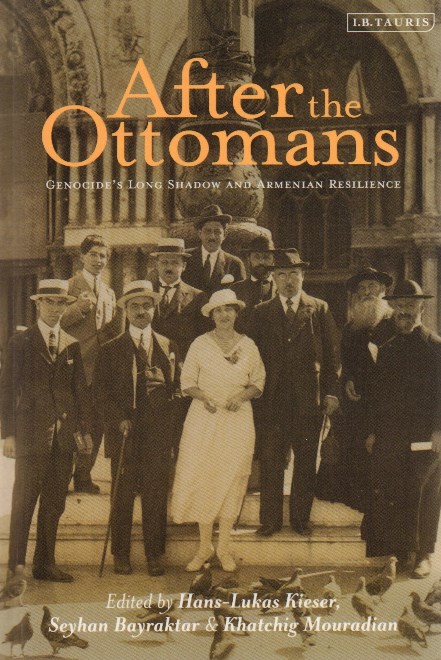
245 00|aAfter the Ottomans :|bgenocide's long shadow and Armenian resilience /|cedited by Hans-Lukas Kieser, Seyhan Bayraktar, Khatchig Mouradian.
250 |aFirst published.
260 |aLondon ;|aNew York :|bI.B. Tauris,|c2023.
300 |avi, 295 sayfa :|bresim, tıpkıbasım ;|c24 cm
500 |aİndeks s. [289]-295.
504 |aBibliyografya bölüm sonlarındadır.
505 |gPART I.|tDISMANTLING SILENCES AND DOCTRINES, TELLING TRUTHS.|tDismantling Silence: Remembrance and Action under the Genocide's Long Shadow /|rKhatchig Mouradian --|tReturn of the Suppressed : Atatürk's History Doctrine, Islam and the Armenian Genocide /|rHans-Lukas Kieser --|tThe past, the present and the politics of memory /|rSeyhan Bayraktar --|gPART II.|tARMENIAN WRITING AS AGENCY.|tThe Armenian Writers Faced with Writing about the Medz Yeghern, 1917-24 /|rValentina Calzolari --|tRoupen Der Minasian : Three Kinds of Agency /|rElke Hartmann --|tHrant Dink and Turkey's Armenian Problem /|rToros Korkmaz --|gPART III.|tBEING ARMENIAN IN TURKEY.|tAuto-da-fe in Istanbul : Nationalist Turkey's first denialist crisis, 1935 /|rEmmanuel Szurek, translated by Adrian Morfee --|tBeing Armenian in Turkey : The Story of the Papazyan Family /|rÖykü Gürpinar --|tA repatriation that never took place : The Soviet Armenian call for immigration of 1946 and its impact in Turkey /|rTalin Suciyan --|tGenocide Commemorations in Turkey : A Social Identity Perspective /|rNanore Barsoumian --|tAfterword /|rRaymond H. Kévorkian.
520 |a“This book deals with the lasting impact and the formative legacy of removal, dispossession and the politics of genocide in the last decade of the Ottoman Empire. For understanding contemporary Turkey and the neighboring region, it is important to revisit the massive transformation of the late-Ottoman world caused by persistent warfare between 1912 and 1922. This fourth volume of a series focusing on the Ottoman Cataclysm looks at the century-long consequences and persistent implications of the Armenian genocide. It deals with the actions and words of the Armenians as they grappled with total destruction and tried to emerge from under it. Eleven scholars of history, anthropology, literature and political science explore the Ottoman Armenians not only as the major victims of the First World War and the post-war treaties, but also as agents striving for survival, writing history, transmitting the memory and searching for justice.” --|cArka kapak.
600 14|aDink, Hrant, 1954-2007.
650 4|aErmeniler|zTürkiye|xTarih.
700 1 |aKieser, Hans-Lukas,|d1957-|eeditör.
700 1 |aBayraktar, Seyhan,|eeditör.
700 1 |aMouradian, Khatchig,|eeditör.