LEADER 03884nam a22005535i 4500
001 608340
003 TR_AnAIT
005 20250627073549
007 cr nn 008mamaa
008 201029s2020 sz | s |||| 0|eng d
020 |a9783030554125|9978-3-030-55412-5
024 7 |a10.1007/978-3-030-55412-5|2doi
041 |aeng
049 |aTürk Tarih Kurumu Kütüphanesi
050 4|aDAW1001-1051
072 7|aHBJD|2bicssc
072 7|a1DF|2bicssc
072 7|aHIS010000|2bisacsh
072 7|aNHD|x1DF|2thema
082 04|a943|223
090 |aDK/1013
100 1 |aRamet, Sabrina P.|eauthor.|4aut|4http://id.loc.gov/vocabulary/relators/aut
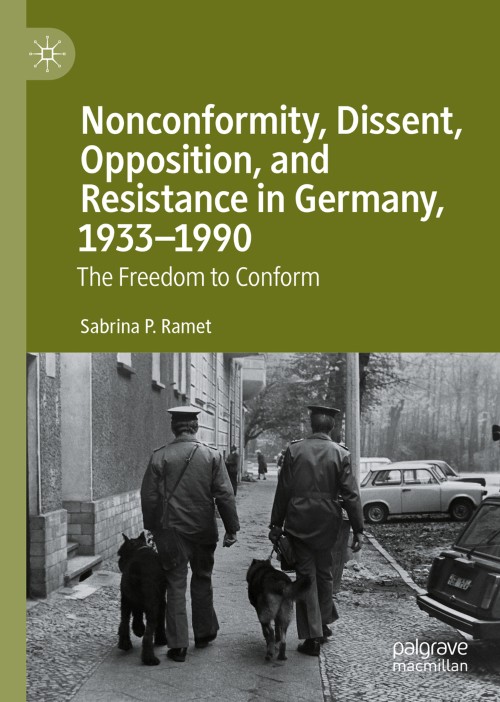
245 10|aNonconformity, Dissent, Opposition, and Resistance in Germany, 1933-1990|h[electronic resource] :|bThe Freedom to Conform /|cby Sabrina P. Ramet.
250 |a1st ed. 2020.
264 1|aCham :|bSpringer International Publishing :|bImprint: Palgrave Macmillan,|c2020.
300 |aXXIII, 279 p. 3 illus.|bonline resource.
336 |atext|btxt|2rdacontent
337 |acomputer|bc|2rdamedia
338 |aonline resource|bcr|2rdacarrier
347 |atext file|bPDF|2rda
505 0 |a1. Introduction: The freedom to conform -- 2. Nazi Germany, 1933-1945: Nonconformity as “degeneration” -- 3. Democratic Reconstruction under Allied Occupation, 1945-1949: Neither tradition nor “degeneration” -- 4. The Soviet Occupation Zone, 1945-1949: Building new structures of conformity -- 5. The German Democratic Republic, 1949-1990: Conformity as alienation -- 6. West Germany, 1949-1990: Nonconformity as alienation -- 7. Conclusion.
520 |a“This book brings fresh light to previously marginalized subject in German history. It is an original approach, up-to-date written without scholarly jargon, easily accessible to students, both at undergraduate and graduate. It is highly focused departing from the usual “histories” of a single country arguing for the “two German states”, and the three political systems.” - Prof. Dr. László Kürti, Institute of Applied Social Sciences, University of Miskolc, Hungary This books argues that nation-building and identity (re)construction in Germany from the Wilhelmine period until the present day has involved debates about and struggles over religion, education, sexuality and the arts, as well as the country's past. Contrasting three very different incarnations of Germany – the totalitarian Third Reich, the communist German Democratic Republic, and the democratic Federal Republic of Germany up to 1990 – this book examines their experiences with and responses to nonconformity, dissent, opposition, and resistance, and the role played by those factors in each case. It is worth stressing that what qualifies as nonconformity and dissent depends on the social and political context and, thus, changes over time. Like those in active dissent, opposition, or resistance, nonconformists are rebels (whether they are conscious of it or not), and have repeatedly played a role in pushing for change, whether through reform of legislation, transformation of the public’s attitudes, or even regime change.
650 0|aEurope, Central|xHistory.
650 0|aHistory, Modern.
650 0|aCollective memory.
650 0|aCivilization|xHistory.
650 0|aEurope|xHistory|x1492-.
650 14|aHistory of Germany and Central Europe.
650 24|aModern History.
650 24|aMemory Studies.
650 24|aCultural History.
650 24|aHistory of Modern Europe.
773 0 |tSpringer Nature eBook
776 08|iPrinted edition:|z9783030554118
776 08|iPrinted edition:|z9783030554132
776 08|iPrinted edition:|z9783030554149
856 40|uhttps://doi.org/10.1007/978-3-030-55412-5
912 |aZDB-2-HTY
912 |aZDB-2-SXH
950 |aHistory (SpringerNature-41172)
950 |aHistory (R0) (SpringerNature-43722)