

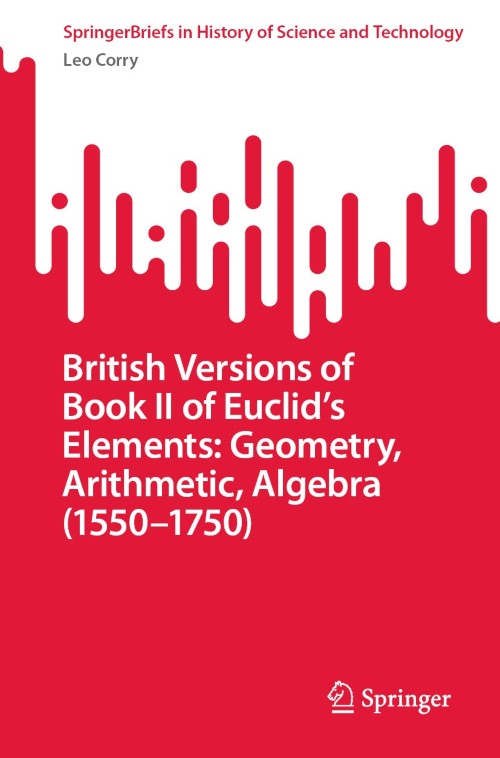
British Versions of Book II of Euclid’s Elements: Geometry, Arithmetic, Algebra (1550–1750) [electronic resource] / by Leo Corry.
Erişim Adresi
ISBN
9783031115387
Dil Kodu
İngilizce
Yer Numarası
DK/1019
Yazar
Basım Bildirimi
1st ed. 2022.
Yayın Bilgisi
Cham : Springer International Publishing : Imprint: Springer, 2022.
Fiziksel Niteleme
VII, 74 p. 56 illus. online resource.
Dizi
SpringerBriefs in History of Science and Technology, 2211-4572
İçindekiler Notu
1. Introduction: Euclidean Background -- 2. The Main Figures: From Recorde to Wallis and Barrow -- 3. Some Lesser-known Figures -- 4. Summary and Concluding Remarks -- 5. References.
Özet, vb.
This book discusses the changing conceptions about the relationship between geometry and arithmetic within the Euclidean tradition that developed in the British context of the sixteenth and seventeenth century. Its focus is on Book II of the Elements and the ways in which algebraic symbolism and methods, especially as recently introduced by François Viète and his followers, took center stage as mediators between the two realms, and thus offered new avenues to work out that relationship in idiosyncratic ways not found in earlier editions of the Euclidean text. Texts examined include Robert Recorde's Pathway to Knowledge (1551), Henry Billingsley’s first English translation of the Elements (1570), Clavis Mathematicae by William Oughtred and Artis Analyticae Praxis by Thomas Harriot (both published in 1631), Isaac Barrow’s versions of the Elements (1660), and John Wallis Treatise of Algebra (1685), and the English translations of Claude Dechales’ French Euclidean Elements (1685). This book offers a completely new perspective of the topic and analyzes mostly unexplored material. It will be of interest to historians of mathematics, mathematicians with an interest in history and historians of renaissance science in general.
Konu
Science __ History.
Logic.
Algebraic geometry.
Computer arithmetic and logic units.
Historiography.
History __ Methodology.
History of Science.
Logic.
Algebraic Geometry.
Arithmetic and Logic Structures.
Historiography and Method.
Logic.
Algebraic geometry.
Computer arithmetic and logic units.
Historiography.
History __ Methodology.
History of Science.
Logic.
Algebraic Geometry.
Arithmetic and Logic Structures.
Historiography and Method.
