

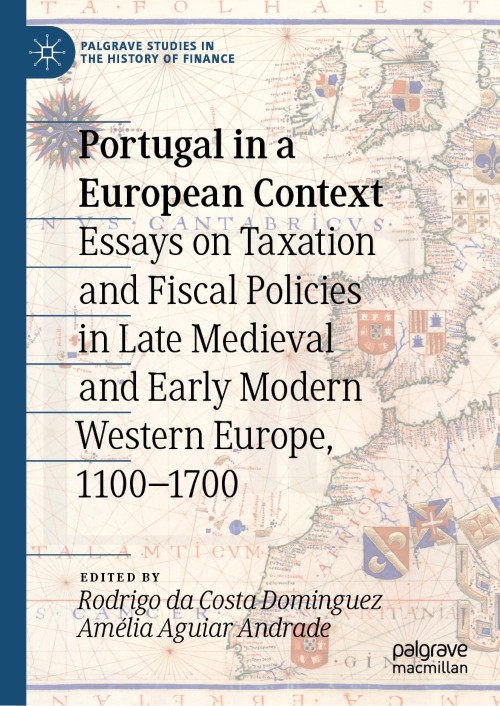
Portugal in a European Context [electronic resource] : Essays on Taxation and Fiscal Policies in Late Medieval and Early Modern Western Europe, 1100-1700 / edited by Rodrigo da Costa Dominguez, Amélia Aguiar Andrade.
Erişim Adresi
ISBN
9783031062278
Dil Kodu
İngilizce
Yer Numarası
DK/1029
Basım Bildirimi
1st ed. 2023.
Yayın Bilgisi
Cham : Springer International Publishing : Imprint: Palgrave Macmillan, 2023.
Fiziksel Niteleme
XXII, 331 p. 5 illus., 3 illus. in color. online resource.
Dizi
Palgrave Studies in the History of Finance, 2662-5172
İçindekiler Notu
Introduction -- Part I: Medieval and Early Modern Portuguese State Finances: sources and evidence -- Chapter 1:“The study of Medieval Fiscal History in Portugal: results and problems (1951-2020)” -- Chapter 2: “The collection of annates in Portugal during the Papacy of Avignon, c. 1316-1378: just another case of apostolic tax-collecting in a realm at the back of beyond?” -- Chapter 3: “Was the economy an Issue? Kings and economic legislation in Medieval Portugal, c. 1200-1400” -- Chapter 4:“A difficult transition: Portuguese State finances between later medieval and early modern times, c. 1430-1530” -- Chapter 5:“Taxes and fiscal institutions in a maritime empire: a comparative view of overseas’ territories under the Portuguese Crown” -- Part I afterword -- Part II: The development of state finance: Portugal in European context -- Introduction -- Chapter 1:“The “resource curse” of medieval English state finances, c. 1155-1453” -- Chapter 2:“Tax histories in the Kingdom of France (12th to 15th centuries): policies, rules and practices” -- Chapter 3:“Tradition and innovation in late medieval and early modern (Northern) Italy” -- Chapter 4:“A Treasury in transition: changes and continuity in the management of Castilian State income and expenditure during the reign of Isabella I, c. 1474-1504 -- Chapter 5:“The Public debt in the Crown of Aragon at the end of the Middle Ages: A particular case?” -- Chapter 6:Low Countries) – “Why Holland had a financial revolution, but Flanders and Brabant did not” -- Chapter 7:“Financial policy and fiscal control of the Papal States territory in Early Modern Age” -- Part II afterword.
Özet, vb.
Although Portugal was one of the first European states with stable borders, the process of the making of a Portuguese fiscal state still remains to be studied in detail. This volume brings together studies on the development of the Portuguese fiscal state within a comparative perspective in relation to other kingdoms across Europe, such as Castile and Aragon, England, Tuscany, the Papal States, Holland and France, in order to bring Portugal into the broader and comparative international debate about the development of the fiscal state. As a very distinctive case, Portugal remains understudied and underrepresented in the broader literature on the development of fiscal states. There are relatively few studies on the building of a fiscal state in Portugal that are accessible to an international audience. This book will make a fundamental contribution to this field, which is still full of untapped potential. It will combine the latest theory and comparative context with a detailed reconstruction of Portuguese state finance, taking a longer chronological frame that follows its development from the medieval through to the early modern period. It will also make the latest research from Portuguese scholars available to a wider, international audience, and will be of particular interest to researchers and students of financial and economic history. Rodrigo da Costa Dominguez is currently a Junior Research Associate and Director of the Interdisciplinary Center of Social Sciences (CICS.NOVA) at the University of Minho, in Braga, Portugal. His expertise relies on the Fiscal History of Portugal in the long-run (14th-20th century). He is also a member of international economic, fiscal, and social history associations in Portugal, Spain, Brazil, Latin America and United States, being a member of the Arca Comunis Group (a network of research projects on the History of Hispanic Finance and Taxation, 13th-18th centuries) and also President-elect of the Economic and Business History Society (EBHS – USA) for the mandates 2020-2021 and 2022-2023. Amélia Aguiar Andrade is a Full Professor of Medieval History at the Faculty of Social and Human Sciences, New University of Lisbon (NOVA FCSH), Portugal. She has held numerous scientific and university positions, in Portugal and abroad, being recently accepted in the College of Expert Reviewers of the European Science Foundation (ESF). From 2009 to 2012, she was Vice-Dean of the Faculty of Social and Human Sciences, for which she received a public praise and headed the Institute of Medieval Studies of the same faculty between 2011 and 2016. She is also a member of the Scientific Council of NOVA FCSH, including the vice-presidency from 2006 to 2008 and 2021-22. Among her international curriculum, it's to highlight that she chaired Scientific Committee of the European Association for Urban History (2012-2014) which he served from 2008-2016. She is also the PI of ROSSIO - Infrastructure for Social Sciences, Arts and Humanities and national representative in the European infrastructure DARIAH.
Konu
Finance.
History.
Economic history.
Europe __ History.
Financial History.
Economic History.
European History.
History.
Economic history.
Europe __ History.
Financial History.
Economic History.
European History.
Diğer Yazarlar
Eseri Alıntıla
Referansları kullanmadan önce gözden geçirmeniz ve varsa gerekli düzeltmeleri yapmanız önerilir.
Dijital Kaynak
MARC Görünümü
LEADER 06874nam a22005655i 4500
001 608356
003 TR_AnAIT
005 20250627073519
007 cr nn 008mamaa
008 221221s2023 sz | s |||| 0|eng d
020 |a9783031062278|9978-3-031-06227-8
024 7 |a10.1007/978-3-031-06227-8|2doi
041 |aeng
049 |aTürk Tarih Kurumu Kütüphanesi
050 4|aHG171
072 7|aKFF|2bicssc
072 7|aKCZ|2bicssc
072 7|aBUS023000|2bisacsh
072 7|aKFF|2thema
072 7|aKCZ|2thema
082 04|a332.09|223
090 |aDK/1029
245 10|aPortugal in a European Context|h[electronic resource] :|bEssays on Taxation and Fiscal Policies in Late Medieval and Early Modern Western Europe, 1100-1700 /|cedited by Rodrigo da Costa Dominguez, Amélia Aguiar Andrade.
250 |a1st ed. 2023.
264 1|aCham :|bSpringer International Publishing :|bImprint: Palgrave Macmillan,|c2023.
300 |aXXII, 331 p. 5 illus., 3 illus. in color.|bonline resource.
336 |atext|btxt|2rdacontent
337 |acomputer|bc|2rdamedia
338 |aonline resource|bcr|2rdacarrier
347 |atext file|bPDF|2rda
490 1 |aPalgrave Studies in the History of Finance,|x2662-5172
505 0 |aIntroduction -- Part I: Medieval and Early Modern Portuguese State Finances: sources and evidence -- Chapter 1:“The study of Medieval Fiscal History in Portugal: results and problems (1951-2020)” -- Chapter 2: “The collection of annates in Portugal during the Papacy of Avignon, c. 1316-1378: just another case of apostolic tax-collecting in a realm at the back of beyond?” -- Chapter 3: “Was the economy an Issue? Kings and economic legislation in Medieval Portugal, c. 1200-1400” -- Chapter 4:“A difficult transition: Portuguese State finances between later medieval and early modern times, c. 1430-1530” -- Chapter 5:“Taxes and fiscal institutions in a maritime empire: a comparative view of overseas’ territories under the Portuguese Crown” -- Part I afterword -- Part II: The development of state finance: Portugal in European context -- Introduction -- Chapter 1:“The “resource curse” of medieval English state finances, c. 1155-1453” -- Chapter 2:“Tax histories in the Kingdom of France (12th to 15th centuries): policies, rules and practices” -- Chapter 3:“Tradition and innovation in late medieval and early modern (Northern) Italy” -- Chapter 4:“A Treasury in transition: changes and continuity in the management of Castilian State income and expenditure during the reign of Isabella I, c. 1474-1504 -- Chapter 5:“The Public debt in the Crown of Aragon at the end of the Middle Ages: A particular case?” -- Chapter 6:Low Countries) – “Why Holland had a financial revolution, but Flanders and Brabant did not” -- Chapter 7:“Financial policy and fiscal control of the Papal States territory in Early Modern Age” -- Part II afterword.
520 |aAlthough Portugal was one of the first European states with stable borders, the process of the making of a Portuguese fiscal state still remains to be studied in detail. This volume brings together studies on the development of the Portuguese fiscal state within a comparative perspective in relation to other kingdoms across Europe, such as Castile and Aragon, England, Tuscany, the Papal States, Holland and France, in order to bring Portugal into the broader and comparative international debate about the development of the fiscal state. As a very distinctive case, Portugal remains understudied and underrepresented in the broader literature on the development of fiscal states. There are relatively few studies on the building of a fiscal state in Portugal that are accessible to an international audience. This book will make a fundamental contribution to this field, which is still full of untapped potential. It will combine the latest theory and comparative context with a detailed reconstruction of Portuguese state finance, taking a longer chronological frame that follows its development from the medieval through to the early modern period. It will also make the latest research from Portuguese scholars available to a wider, international audience, and will be of particular interest to researchers and students of financial and economic history. Rodrigo da Costa Dominguez is currently a Junior Research Associate and Director of the Interdisciplinary Center of Social Sciences (CICS.NOVA) at the University of Minho, in Braga, Portugal. His expertise relies on the Fiscal History of Portugal in the long-run (14th-20th century). He is also a member of international economic, fiscal, and social history associations in Portugal, Spain, Brazil, Latin America and United States, being a member of the Arca Comunis Group (a network of research projects on the History of Hispanic Finance and Taxation, 13th-18th centuries) and also President-elect of the Economic and Business History Society (EBHS – USA) for the mandates 2020-2021 and 2022-2023. Amélia Aguiar Andrade is a Full Professor of Medieval History at the Faculty of Social and Human Sciences, New University of Lisbon (NOVA FCSH), Portugal. She has held numerous scientific and university positions, in Portugal and abroad, being recently accepted in the College of Expert Reviewers of the European Science Foundation (ESF). From 2009 to 2012, she was Vice-Dean of the Faculty of Social and Human Sciences, for which she received a public praise and headed the Institute of Medieval Studies of the same faculty between 2011 and 2016. She is also a member of the Scientific Council of NOVA FCSH, including the vice-presidency from 2006 to 2008 and 2021-22. Among her international curriculum, it's to highlight that she chaired Scientific Committee of the European Association for Urban History (2012-2014) which he served from 2008-2016. She is also the PI of ROSSIO - Infrastructure for Social Sciences, Arts and Humanities and national representative in the European infrastructure DARIAH.
650 0|aFinance.
650 0|aHistory.
650 0|aEconomic history.
650 0|aEurope|xHistory.
650 14|aFinancial History.
650 24|aEconomic History.
650 24|aEuropean History.
700 1 |aDominguez, Rodrigo da Costa.|eeditor.|4edt|4http://id.loc.gov/vocabulary/relators/edt
700 1 |aAndrade, Amélia Aguiar.|eeditor.|4edt|4http://id.loc.gov/vocabulary/relators/edt
773 0 |tSpringer Nature eBook
776 08|iPrinted edition:|z9783031062261
776 08|iPrinted edition:|z9783031062285
776 08|iPrinted edition:|z9783031062292
830 0|aPalgrave Studies in the History of Finance,|x2662-5172
856 40|uhttps://doi.org/10.1007/978-3-031-06227-8
912 |aZDB-2-HTY
912 |aZDB-2-SXH
950 |aHistory (SpringerNature-41172)
950 |aHistory (R0) (SpringerNature-43722)
001 608356
003 TR_AnAIT
005 20250627073519
007 cr nn 008mamaa
008 221221s2023 sz | s |||| 0|eng d
020 |a9783031062278|9978-3-031-06227-8
024 7 |a10.1007/978-3-031-06227-8|2doi
041 |aeng
049 |aTürk Tarih Kurumu Kütüphanesi
050 4|aHG171
072 7|aKFF|2bicssc
072 7|aKCZ|2bicssc
072 7|aBUS023000|2bisacsh
072 7|aKFF|2thema
072 7|aKCZ|2thema
082 04|a332.09|223
090 |aDK/1029
245 10|aPortugal in a European Context|h[electronic resource] :|bEssays on Taxation and Fiscal Policies in Late Medieval and Early Modern Western Europe, 1100-1700 /|cedited by Rodrigo da Costa Dominguez, Amélia Aguiar Andrade.
250 |a1st ed. 2023.
264 1|aCham :|bSpringer International Publishing :|bImprint: Palgrave Macmillan,|c2023.
300 |aXXII, 331 p. 5 illus., 3 illus. in color.|bonline resource.
336 |atext|btxt|2rdacontent
337 |acomputer|bc|2rdamedia
338 |aonline resource|bcr|2rdacarrier
347 |atext file|bPDF|2rda
490 1 |aPalgrave Studies in the History of Finance,|x2662-5172
505 0 |aIntroduction -- Part I: Medieval and Early Modern Portuguese State Finances: sources and evidence -- Chapter 1:“The study of Medieval Fiscal History in Portugal: results and problems (1951-2020)” -- Chapter 2: “The collection of annates in Portugal during the Papacy of Avignon, c. 1316-1378: just another case of apostolic tax-collecting in a realm at the back of beyond?” -- Chapter 3: “Was the economy an Issue? Kings and economic legislation in Medieval Portugal, c. 1200-1400” -- Chapter 4:“A difficult transition: Portuguese State finances between later medieval and early modern times, c. 1430-1530” -- Chapter 5:“Taxes and fiscal institutions in a maritime empire: a comparative view of overseas’ territories under the Portuguese Crown” -- Part I afterword -- Part II: The development of state finance: Portugal in European context -- Introduction -- Chapter 1:“The “resource curse” of medieval English state finances, c. 1155-1453” -- Chapter 2:“Tax histories in the Kingdom of France (12th to 15th centuries): policies, rules and practices” -- Chapter 3:“Tradition and innovation in late medieval and early modern (Northern) Italy” -- Chapter 4:“A Treasury in transition: changes and continuity in the management of Castilian State income and expenditure during the reign of Isabella I, c. 1474-1504 -- Chapter 5:“The Public debt in the Crown of Aragon at the end of the Middle Ages: A particular case?” -- Chapter 6:Low Countries) – “Why Holland had a financial revolution, but Flanders and Brabant did not” -- Chapter 7:“Financial policy and fiscal control of the Papal States territory in Early Modern Age” -- Part II afterword.
520 |aAlthough Portugal was one of the first European states with stable borders, the process of the making of a Portuguese fiscal state still remains to be studied in detail. This volume brings together studies on the development of the Portuguese fiscal state within a comparative perspective in relation to other kingdoms across Europe, such as Castile and Aragon, England, Tuscany, the Papal States, Holland and France, in order to bring Portugal into the broader and comparative international debate about the development of the fiscal state. As a very distinctive case, Portugal remains understudied and underrepresented in the broader literature on the development of fiscal states. There are relatively few studies on the building of a fiscal state in Portugal that are accessible to an international audience. This book will make a fundamental contribution to this field, which is still full of untapped potential. It will combine the latest theory and comparative context with a detailed reconstruction of Portuguese state finance, taking a longer chronological frame that follows its development from the medieval through to the early modern period. It will also make the latest research from Portuguese scholars available to a wider, international audience, and will be of particular interest to researchers and students of financial and economic history. Rodrigo da Costa Dominguez is currently a Junior Research Associate and Director of the Interdisciplinary Center of Social Sciences (CICS.NOVA) at the University of Minho, in Braga, Portugal. His expertise relies on the Fiscal History of Portugal in the long-run (14th-20th century). He is also a member of international economic, fiscal, and social history associations in Portugal, Spain, Brazil, Latin America and United States, being a member of the Arca Comunis Group (a network of research projects on the History of Hispanic Finance and Taxation, 13th-18th centuries) and also President-elect of the Economic and Business History Society (EBHS – USA) for the mandates 2020-2021 and 2022-2023. Amélia Aguiar Andrade is a Full Professor of Medieval History at the Faculty of Social and Human Sciences, New University of Lisbon (NOVA FCSH), Portugal. She has held numerous scientific and university positions, in Portugal and abroad, being recently accepted in the College of Expert Reviewers of the European Science Foundation (ESF). From 2009 to 2012, she was Vice-Dean of the Faculty of Social and Human Sciences, for which she received a public praise and headed the Institute of Medieval Studies of the same faculty between 2011 and 2016. She is also a member of the Scientific Council of NOVA FCSH, including the vice-presidency from 2006 to 2008 and 2021-22. Among her international curriculum, it's to highlight that she chaired Scientific Committee of the European Association for Urban History (2012-2014) which he served from 2008-2016. She is also the PI of ROSSIO - Infrastructure for Social Sciences, Arts and Humanities and national representative in the European infrastructure DARIAH.
650 0|aFinance.
650 0|aHistory.
650 0|aEconomic history.
650 0|aEurope|xHistory.
650 14|aFinancial History.
650 24|aEconomic History.
650 24|aEuropean History.
700 1 |aDominguez, Rodrigo da Costa.|eeditor.|4edt|4http://id.loc.gov/vocabulary/relators/edt
700 1 |aAndrade, Amélia Aguiar.|eeditor.|4edt|4http://id.loc.gov/vocabulary/relators/edt
773 0 |tSpringer Nature eBook
776 08|iPrinted edition:|z9783031062261
776 08|iPrinted edition:|z9783031062285
776 08|iPrinted edition:|z9783031062292
830 0|aPalgrave Studies in the History of Finance,|x2662-5172
856 40|uhttps://doi.org/10.1007/978-3-031-06227-8
912 |aZDB-2-HTY
912 |aZDB-2-SXH
950 |aHistory (SpringerNature-41172)
950 |aHistory (R0) (SpringerNature-43722)
Materyaller
Depodan talep edilen materyal sadece kütüphane içerisinde kullanılmaktadır.
Materyal dışarıya ödünç verilmemektedir.
Materyal dışarıya ödünç verilmemektedir.
