LEADER 03092nam a22005295i 4500
001 608767
003 TR_AnAIT
005 20250627072209
007 cr nn 008mamaa
008 181206s2018 sz | s |||| 0|eng d
020 |a9783319932361|9978-3-319-93236-1
024 7 |a10.1007/978-3-319-93236-1|2doi
041 |aeng
049 |aTürk Tarih Kurumu Kütüphanesi
050 4|aD203.2-475
072 7|aHBJD|2bicssc
072 7|aHBLH|2bicssc
072 7|aHIS010000|2bisacsh
072 7|aNHD|x3M|2thema
082 04|a940.903|223
090 |aDK/1440
100 1 |aIngram, Kevin.|eauthor.|4aut|4http://id.loc.gov/vocabulary/relators/aut
245 10|aConverso Non-Conformism in Early Modern Spain|h[electronic resource] :|bBad Blood and Faith from Alonso de Cartagena to Diego Velázquez /|cby Kevin Ingram.
250 |a1st ed. 2018.
264 1|aCham :|bSpringer International Publishing :|bImprint: Palgrave Macmillan,|c2018.
300 |aXX, 370 p. 12 illus. in color.|bonline resource.
336 |atext|btxt|2rdacontent
337 |acomputer|bc|2rdamedia
338 |aonline resource|bcr|2rdacarrier
347 |atext file|bPDF|2rda
505 0 |a1 Introduction -- 2 From Toledo to Alcalá -- 3 From Alcalá to Seville and Beyond -- 4 The Way Out of Trent -- 5 Four Humanists -- 6 Diego Velázquez and the Subtle Art of Protest -- 7 The Converso Returns.
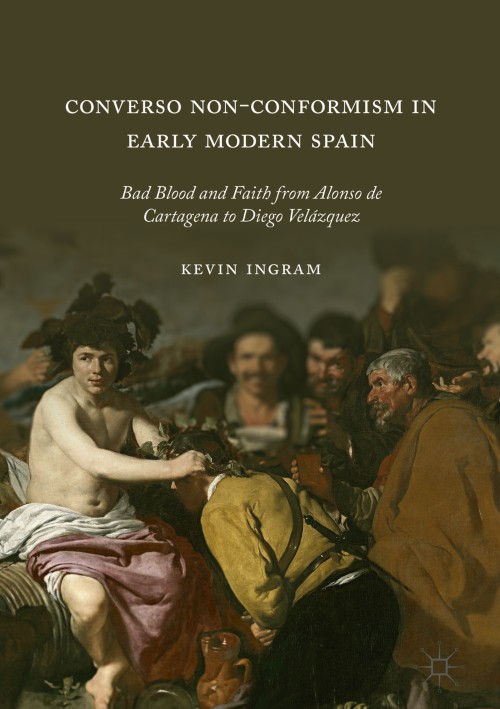
520 |aThis book examines the effects of Jewish conversions to Christianity in late medieval Spanish society. Ingram focuses on these converts and their descendants (known as conversos) not as Judaizers, but as Christian humanists, mystics and evangelists, who attempt to create a new society based on quietist religious practice, merit, and toleration. His narrative takes the reader on a journey from the late fourteenth-century conversions and the first blood purity laws (designed to marginalize conversos), through the early sixteenth-century Erasmian and radical mystical movements, to a Counter-Reformation environment in which conversos become the advocates for pacifism and concordance. His account ends at the court of Philip IV, where growing intolerance towards Madrid’s converso courtiers is subtly attacked by Spain’s greatest painter, Diego Velázquez, in his work, Los Borrachos. Finally, Ingram examines the historiography of early modern Spain, in which he argues the converso reform phenomenon continues to be underexplored.
650 0|aEurope|xHistory|x1492-.
650 0|aReligion|xHistory.
650 0|aCivilization|xHistory.
650 0|aWorld politics.
650 14|aHistory of Early Modern Europe.
650 24|aHistory of Religion.
650 24|aCultural History.
650 24|aPolitical History.
773 0 |tSpringer Nature eBook
776 08|iPrinted edition:|z9783319932354
776 08|iPrinted edition:|z9783319932378
776 08|iPrinted edition:|z9783030404307
856 40|uhttps://doi.org/10.1007/978-3-319-93236-1
912 |aZDB-2-HTY
912 |aZDB-2-SXH
950 |aHistory (SpringerNature-41172)
950 |aHistory (R0) (SpringerNature-43722)