LEADER 04002nam a22005775i 4500
001 608800
003 TR_AnAIT
005 20250627072109
007 cr nn 008mamaa
008 200701s2020 sz | s |||| 0|eng d
020 |a9783030478711|9978-3-030-47871-1
024 7 |a10.1007/978-3-030-47871-1|2doi
041 |aeng
049 |aTürk Tarih Kurumu Kütüphanesi
050 4|aF1409.6-1414.2
072 7|aHBJK|2bicssc
072 7|aHIS024000|2bisacsh
072 7|aNHK|2thema
082 04|a980|223
090 |aDK/1473
100 1 |aStuessy, Tod F.|eauthor.|4aut|4http://id.loc.gov/vocabulary/relators/aut
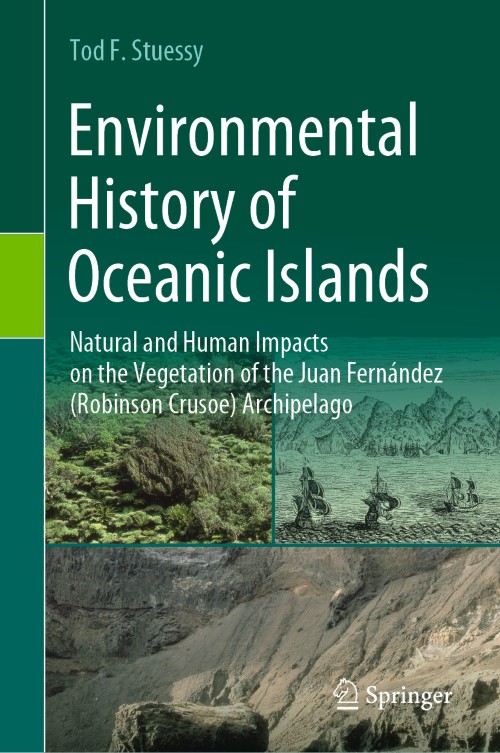
245 10|aEnvironmental History of Oceanic Islands|h[electronic resource] :|bNatural and Human Impacts on the Vegetation of the Juan Fernández (Robinson Crusoe) Archipelago /|cby Tod F. Stuessy.
250 |a1st ed. 2020.
264 1|aCham :|bSpringer International Publishing :|bImprint: Springer,|c2020.
300 |aXX, 341 p. 106 illus., 39 illus. in color.|bonline resource.
336 |atext|btxt|2rdacontent
337 |acomputer|bc|2rdamedia
338 |aonline resource|bcr|2rdacarrier
347 |atext file|bPDF|2rda
505 0 |aChapter 1. Introduction -- Part I. The Archipelago -- Chapter 2. The importance of the islands -- Part II. Modern flora and vegetation -- Chapter 3. Native and endemic flora -- Chapter 4. Introduced species -- Chapter 5. Vegetational patterns -- PART III. Three historial documentation of human activities -- Chapter 6. Discovery and early exploration (1574-1749) -- Chapter 7. Colonial period (1750-1819) -- Chapter 8. Early botanical period (1820-1875) -- Chapter 9. Floristic period (1876-1906) -- Chapter 10. Skottsberg (1907-1917) -- Chapter 11. Touristic period (1918-1959) -- Chapter 12. Modern period (1960-present) -- Part IV. Summaries of impacts on vegetation -- Chapter 13. Natural factors -- Chapter 14. Human influences -- Part V. Conservation -- Chapter 15. Existing conservation efforts -- Chapter 16. Recommendations for the future -- Index.
520 |aThe Juan Fernández Archipelago is located in the Pacific Ocean west of Chile at 33° S latitude. Robinson Crusoe Island is 667 km from the continent and approximately four million years old; Alejandro Selkirk Island is an additional 181 km west and only one million years old. The natural impacts of subsidence and erosion have shaped the landscapes of these islands, resulting in progressive changes to their subtropical vegetation. The older island has undergone more substantial changes, due to both natural causes and human impacts. After the discovery of Robinson Crusoe Island in 1574, people began cutting down forests for lumber to construct boats and homes, for firewood, and to make room for pastures. Domesticated plants and animals were introduced, some of which have since become feral or invasive, causing damage to the local vegetation. The wealth of historical records on these activities provides a detailed chronicle of how human beings use their environment for survival in a new ecosystem. This book offers an excellent case study on the impacts that people can have on the resources of an oceanic island. .
650 0|aLatin America|xHistory.
650 0|aHuman geography.
650 0|aConservation biology.
650 0|aEcology .
650 0|aHuman ecology|xStudy and teaching.
650 0|aEthnology.
650 0|aOceanography.
650 14|aLatin American History.
650 24|aHuman Geography.
650 24|aConservation Biology.
650 24|aEnvironmental Studies.
650 24|aSociocultural Anthropology.
650 24|aOcean Sciences.
773 0 |tSpringer Nature eBook
776 08|iPrinted edition:|z9783030478704
776 08|iPrinted edition:|z9783030478728
776 08|iPrinted edition:|z9783030478735
856 40|uhttps://doi.org/10.1007/978-3-030-47871-1
912 |aZDB-2-HTY
912 |aZDB-2-SXH
950 |aHistory (SpringerNature-41172)
950 |aHistory (R0) (SpringerNature-43722)