LEADER 03796nam a22005415i 4500
001 608908
003 TR_AnAIT
005 20250627071738
007 cr nn 008mamaa
008 200520s2020 sz | s |||| 0|eng d
020 |a9783030444327|9978-3-030-44432-7
024 7 |a10.1007/978-3-030-44432-7|2doi
041 |aeng
049 |aTürk Tarih Kurumu Kütüphanesi
050 4|aHN
072 7|aHBTB|2bicssc
072 7|aHIS054000|2bisacsh
072 7|aNHTB|2thema
082 04|a306.09|223
090 |aDK/1581
100 1 |aEllis, Robert.|eauthor.|4aut|4http://id.loc.gov/vocabulary/relators/aut
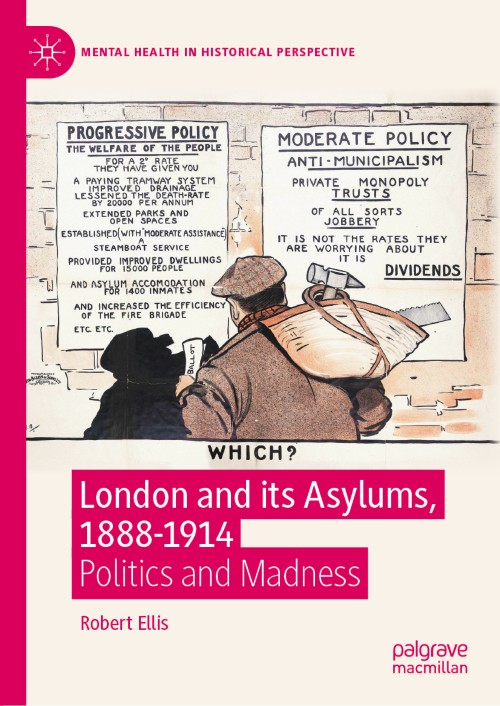
245 10|aLondon and its Asylums, 1888-1914|h[electronic resource] :|bPolitics and Madness /|cby Robert Ellis.
250 |a1st ed. 2020.
264 1|aCham :|bSpringer International Publishing :|bImprint: Palgrave Macmillan,|c2020.
300 |aXV, 296 p. 13 illus., 6 illus. in color.|bonline resource.
336 |atext|btxt|2rdacontent
337 |acomputer|bc|2rdamedia
338 |aonline resource|bcr|2rdacarrier
347 |atext file|bPDF|2rda
490 1 |aMental Health in Historical Perspective,|x2634-6044
505 0 |aChapter 1: ‘The Mere Scope of it is Immense’. London and its Asylums in Context -- Chapter 2: The Politics of Administration -- Chapter 3: The Politics of Finance -- Chapter 4: The Politics of Innovation -- Chapter 5: The Politics of Architecture -- Chapter 6: The Politics of Difference -- Chapter 7: Conclusions.
520 |a'This is an important and timely contribution to the politics of mental health. Ellis’s forensic dissection of the politics and finance of asylums in late nineteenth- and early twentieth-century London demonstrates the evolution of asylum and mental health care but also provides a nuanced account of local government and welfare activism in this period. This book is highly recommended for those interested not only in the history of mental health care, but also the sometimes internecine conflicts which underpinned urban government in the Victorian and Edwardian eras.' –Professor Heather Shore, Director of MCPHH, Department of History, Politics and Philosophy, Manchester Metropolitan University, UK This book explores the impact that politics had on the management of mental health care at the turn of the nineteenth and twentieth centuries. 1888 and the introduction of the Local Government Act marked a turning point in which democratically elected bodies became responsible for the management of madness for the first time. With its focus on London in the period leading up to the First World War, it offers a new way to look at institutions and to consider their connections to wider issues that were facing the capital and the nation. The chapters that follow place London at the heart of international networks and debates relating to finance, welfare, architecture, scientific and medical initiatives, and the developing responses to immigrant populations. Overall, it shines a light on the relationships between mental health policies and other ideological priorities.
650 0|aSocial history.
650 0|aCities and towns|xHistory.
650 0|aMedicine|xHistory.
650 0|aGreat Britain|xHistory.
650 14|aSocial History.
650 24|aUrban History.
650 24|aHistory of Medicine.
650 24|aHistory of Britain and Ireland.
773 0 |tSpringer Nature eBook
776 08|iPrinted edition:|z9783030444310
776 08|iPrinted edition:|z9783030444334
776 08|iPrinted edition:|z9783030444341
830 0|aMental Health in Historical Perspective,|x2634-6044
856 40|uhttps://doi.org/10.1007/978-3-030-44432-7
912 |aZDB-2-HTY
912 |aZDB-2-SXH
950 |aHistory (SpringerNature-41172)
950 |aHistory (R0) (SpringerNature-43722)