

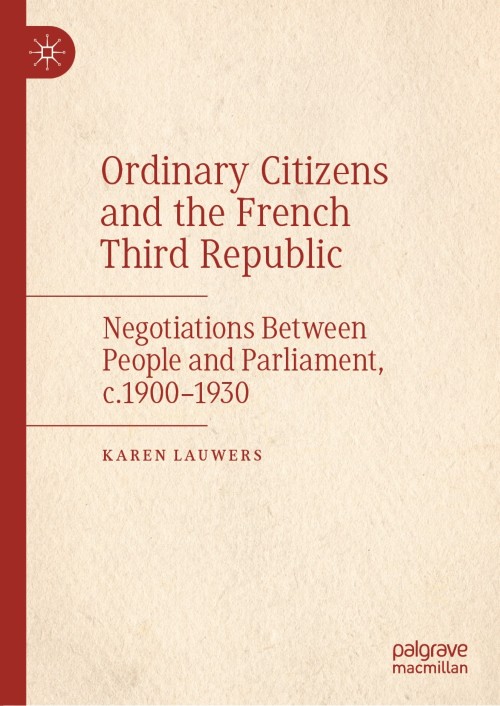
Ordinary Citizens and the French Third Republic [electronic resource] : Negotiations Between People and Parliament, c.1900–1930 / by Karen Lauwers.
Erişim Adresi
ISBN
9783030893040
Dil Kodu
İngilizce
Yer Numarası
DK/1602
Yazar
Basım Bildirimi
1st ed. 2022.
Yayın Bilgisi
Cham : Springer International Publishing : Imprint: Palgrave Macmillan, 2022.
Fiziksel Niteleme
XVI, 352 p. 14 illus., 10 illus. in color. online resource.
İçindekiler Notu
1. Introduction: Searching for the 'Citizen' in the Web of Political Concepts -- Part I. Materiality of the Negotiation Process -- 2. The Physical Presence of Citizens in the Chamber and the Deputy in his Constituency -- 3. Private Written Communications and their Material Characteristics -- 4. A Deputy's Accessibility in War-time: 14-18 Correspondence -- Part II. Typology of the MPs' Roles -- 5. The Impartial Deputy -- 6. The Deputy-Protector and Friend -- 7. The Deputy-Cult -- 8. The Deputy-Lawyer or Legal Advisor -- Part III. Construction of the 'Citizen' and its Relation to the MP -- 9. Citizens' Rights and Duties -- 10. The Fusion of 'Republican' and 'Apolitical' Frameworks -- Part IV. Conclusion -- 11. Conclusion.
Özet, vb.
This book analyzes the negotiation of socio-political concepts, such as citizenship, republicanism, and representation, between “ordinary” French citizens and their representatives in parliament during the early twentieth century. By examining the letters written to French Deputies of the Chamber (députés) at a tumultuous time in French political history, the author sheds light on the role that politically unorganized citizens played in the process of democratization. Central to the investigation are the aspirations, wishes and demands of individuals acting on their own or as spokespersons for informal communities. The way that they formulated personal requests in their letters to députés reveals their expectations of political representatives, the regime, and their own place in society. By taking a closer look at the epistolary relations between voters and non voters on the one hand and their deputies on the other during a time of rapidly succeeding governments, economic crises and changes in electoral laws, this book demonstrates how the Third Republic’s existence was co-determined by ordinary citizens’ perceptions of the regime. Helping readers to reflect on the nuances of the politicization process, this innovative book offers unique insights for those researching French political history and modern European political culture. Karen Lauwers is a Postdoctoral Researcher at the University of Helsinki, Finland, where she works on the French-Algerian axis of the ERC-funded CALLIOPE project: Vocal Articulations of Parliamentary Identity and Empire. Previously, she studied at the Center for Political History at the University of Antwerp in Belgium, where she conducted her research for this book .
Konu
France __ History.
World politics.
History, Modern.
Social history.
Europe __ History.
History of France.
Political History.
Modern History.
Social History.
European History.
World politics.
History, Modern.
Social history.
Europe __ History.
History of France.
Political History.
Modern History.
Social History.
European History.
