

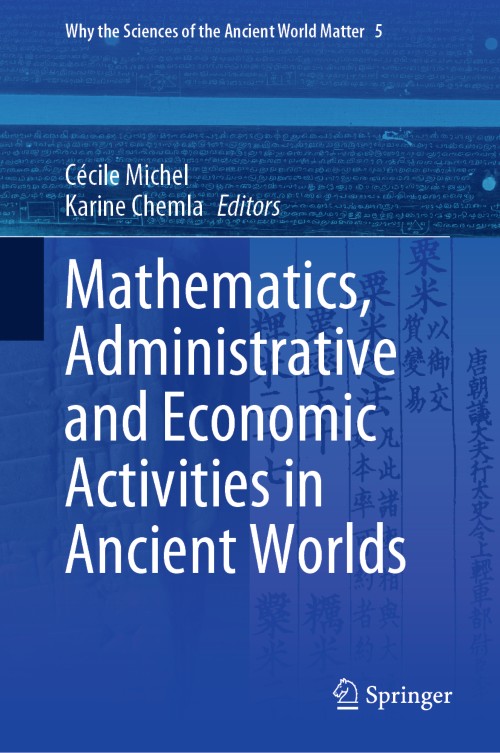
Mathematics, Administrative and Economic Activities in Ancient Worlds [electronic resource] / edited by Cécile Michel, Karine Chemla.
Erişim Adresi
ISBN
9783030483890
Dil Kodu
İngilizce
Yer Numarası
DK/1734
Basım Bildirimi
1st ed. 2020.
Yayın Bilgisi
Cham : Springer International Publishing : Imprint: Springer, 2020.
Fiziksel Niteleme
VI, 568 p. 162 illus., 35 illus. in color. online resource.
Dizi
Why the Sciences of the Ancient World Matter, 2662-9941 ; 5
İçindekiler Notu
Chapter 1. Mathematics, Administrative and Economic Activities in the Ancient Worlds: An introduction (Cécile Michel and Karine Chemla) -- Chapter 2. A Comparative Study of Prices and Wages in Royal Inscriptions, Administrative Texts and Mathematical Texts in the Old Babylonian Kingdom of Larsa (Cécile Michel, with contributions by Robert Middeke-Conlin and Christine Proust) -- Chapter 3. Computation in the Arthaśāstra (Mark McClish) -- Chapter 4. Official Salaries and State Taxes as Seen in Qin-Han Manuscripts, with a Focus on Mathematical Texts (Peng Hao) -- Chapter 5. Insights into the Administration of Ancient Irrigation Systems in Third Millennium BCE Mesopotamia (Stephanie Rost) -- Chapter 6. Mathematical Computations in the Management of Public Construction Work in Mesopotamia (End of the Third and Beginning of the Second Millennium BCE) (Martin Sauvage) -- Chapter 7. The use of volume in the measurement of grain in early imperial China (Karine Chemla and Ma Biao) -- Chapter 8. TheMeasurement of Fields During the Pre-Sargonic Period (Camille Lecompte) -- Chapter 9. Early-Dynastic Tables from Southern Mesopotamia, or the Multiple Facets of the Quantification of Surfaces (Christine Proust) -- Chapter 10. Computation Practices of the Assyrian Merchants during the Nineteenth Century BCE (Cécile Michel) -- Chapter 11. Connecting a Disconnect. Can Evidence for a Scribal Education be Found in a Professional Setting During the Old Babylonian Period? (Robert Middeke-Conlin) -- Chapter 12. Loans and Interest in Sanskrit Legal and Mathematical Texts (Sreeramula Rajeswara Sarma and Takanori Kusuba) -- Chapter 13. Computational Practices Around Coins and Coinage: John of Murs’ Quadripartitum Numerorum and French Money Changers’ Books (Marc Bompaire and Matthieu Husson).
Özet, vb.
This book focuses on the ancient Near East, early imperial China, South-East Asia, and medieval Europe, shedding light on mathematical knowledge and practices documented by sources relating to the administrative and economic activities of officials, merchants and other actors. It compares these to mathematical texts produced in related school contexts or reflecting the pursuit of mathematics for its own sake to reveal the diversity of mathematical practices in each of these geographical areas of the ancient world. Based on case studies from various periods and political, economic and social contexts, it explores how, in each part of the world discussed, it is possible to identify and describe the different cultures of quantification and computation as well as their points of contact. The thirteen chapters draw on a wide variety of texts from ancient Near East, China, South-East Asia and medieval Europe, which are analyzed by researchers from various fields, including mathematics, history, philology, archaeology and economics. The book will appeal to historians of science, economists and institutional historians of the ancient and medieval world, and also to Assyriologists, Indologists, Sinologists and experts on medieval Europe.
Konu
Mathematics.
History.
Science __ History.
Economics __ History.
Knowledge, Theory of.
History of Mathematical Sciences.
History of Science.
History of Economic Thought and Methodology.
Epistemology.
History.
Science __ History.
Economics __ History.
Knowledge, Theory of.
History of Mathematical Sciences.
History of Science.
History of Economic Thought and Methodology.
Epistemology.
Diğer Yazarlar
Eseri Alıntıla
Referansları kullanmadan önce gözden geçirmeniz ve varsa gerekli düzeltmeleri yapmanız önerilir.
Dijital Kaynak
MARC Görünümü
LEADER 05125nam a22005655i 4500
001 609061
003 TR_AnAIT
005 20250627071221
007 cr nn 008mamaa
008 200929s2020 sz | s |||| 0|eng d
020 |a9783030483890|9978-3-030-48389-0
024 7 |a10.1007/978-3-030-48389-0|2doi
041 |aeng
049 |aTürk Tarih Kurumu Kütüphanesi
050 4|aQA21-27
072 7|aPBX|2bicssc
072 7|aMAT015000|2bisacsh
072 7|aPBX|2thema
082 04|a510.9|223
090 |aDK/1734
245 10|aMathematics, Administrative and Economic Activities in Ancient Worlds|h[electronic resource] /|cedited by Cécile Michel, Karine Chemla.
250 |a1st ed. 2020.
264 1|aCham :|bSpringer International Publishing :|bImprint: Springer,|c2020.
300 |aVI, 568 p. 162 illus., 35 illus. in color.|bonline resource.
336 |atext|btxt|2rdacontent
337 |acomputer|bc|2rdamedia
338 |aonline resource|bcr|2rdacarrier
347 |atext file|bPDF|2rda
490 1 |aWhy the Sciences of the Ancient World Matter,|x2662-9941 ;|v5
505 0 |aChapter 1. Mathematics, Administrative and Economic Activities in the Ancient Worlds: An introduction (Cécile Michel and Karine Chemla) -- Chapter 2. A Comparative Study of Prices and Wages in Royal Inscriptions, Administrative Texts and Mathematical Texts in the Old Babylonian Kingdom of Larsa (Cécile Michel, with contributions by Robert Middeke-Conlin and Christine Proust) -- Chapter 3. Computation in the Arthaśāstra (Mark McClish) -- Chapter 4. Official Salaries and State Taxes as Seen in Qin-Han Manuscripts, with a Focus on Mathematical Texts (Peng Hao) -- Chapter 5. Insights into the Administration of Ancient Irrigation Systems in Third Millennium BCE Mesopotamia (Stephanie Rost) -- Chapter 6. Mathematical Computations in the Management of Public Construction Work in Mesopotamia (End of the Third and Beginning of the Second Millennium BCE) (Martin Sauvage) -- Chapter 7. The use of volume in the measurement of grain in early imperial China (Karine Chemla and Ma Biao) -- Chapter 8. TheMeasurement of Fields During the Pre-Sargonic Period (Camille Lecompte) -- Chapter 9. Early-Dynastic Tables from Southern Mesopotamia, or the Multiple Facets of the Quantification of Surfaces (Christine Proust) -- Chapter 10. Computation Practices of the Assyrian Merchants during the Nineteenth Century BCE (Cécile Michel) -- Chapter 11. Connecting a Disconnect. Can Evidence for a Scribal Education be Found in a Professional Setting During the Old Babylonian Period? (Robert Middeke-Conlin) -- Chapter 12. Loans and Interest in Sanskrit Legal and Mathematical Texts (Sreeramula Rajeswara Sarma and Takanori Kusuba) -- Chapter 13. Computational Practices Around Coins and Coinage: John of Murs’ Quadripartitum Numerorum and French Money Changers’ Books (Marc Bompaire and Matthieu Husson).
520 |aThis book focuses on the ancient Near East, early imperial China, South-East Asia, and medieval Europe, shedding light on mathematical knowledge and practices documented by sources relating to the administrative and economic activities of officials, merchants and other actors. It compares these to mathematical texts produced in related school contexts or reflecting the pursuit of mathematics for its own sake to reveal the diversity of mathematical practices in each of these geographical areas of the ancient world. Based on case studies from various periods and political, economic and social contexts, it explores how, in each part of the world discussed, it is possible to identify and describe the different cultures of quantification and computation as well as their points of contact. The thirteen chapters draw on a wide variety of texts from ancient Near East, China, South-East Asia and medieval Europe, which are analyzed by researchers from various fields, including mathematics, history, philology, archaeology and economics. The book will appeal to historians of science, economists and institutional historians of the ancient and medieval world, and also to Assyriologists, Indologists, Sinologists and experts on medieval Europe.
650 0|aMathematics.
650 0|aHistory.
650 0|aScience|xHistory.
650 0|aEconomics|xHistory.
650 0|aKnowledge, Theory of.
650 14|aHistory of Mathematical Sciences.
650 24|aHistory of Science.
650 24|aHistory of Economic Thought and Methodology.
650 24|aEpistemology.
700 1 |aMichel, Cécile.|eeditor.|4edt|4http://id.loc.gov/vocabulary/relators/edt
700 1 |aChemla, Karine.|eeditor.|4edt|4http://id.loc.gov/vocabulary/relators/edt
773 0 |tSpringer Nature eBook
776 08|iPrinted edition:|z9783030483883
776 08|iPrinted edition:|z9783030483906
776 08|iPrinted edition:|z9783030483913
830 0|aWhy the Sciences of the Ancient World Matter,|x2662-9941 ;|v5
856 40|uhttps://doi.org/10.1007/978-3-030-48389-0
912 |aZDB-2-HTY
912 |aZDB-2-SXH
950 |aHistory (SpringerNature-41172)
950 |aHistory (R0) (SpringerNature-43722)
001 609061
003 TR_AnAIT
005 20250627071221
007 cr nn 008mamaa
008 200929s2020 sz | s |||| 0|eng d
020 |a9783030483890|9978-3-030-48389-0
024 7 |a10.1007/978-3-030-48389-0|2doi
041 |aeng
049 |aTürk Tarih Kurumu Kütüphanesi
050 4|aQA21-27
072 7|aPBX|2bicssc
072 7|aMAT015000|2bisacsh
072 7|aPBX|2thema
082 04|a510.9|223
090 |aDK/1734
245 10|aMathematics, Administrative and Economic Activities in Ancient Worlds|h[electronic resource] /|cedited by Cécile Michel, Karine Chemla.
250 |a1st ed. 2020.
264 1|aCham :|bSpringer International Publishing :|bImprint: Springer,|c2020.
300 |aVI, 568 p. 162 illus., 35 illus. in color.|bonline resource.
336 |atext|btxt|2rdacontent
337 |acomputer|bc|2rdamedia
338 |aonline resource|bcr|2rdacarrier
347 |atext file|bPDF|2rda
490 1 |aWhy the Sciences of the Ancient World Matter,|x2662-9941 ;|v5
505 0 |aChapter 1. Mathematics, Administrative and Economic Activities in the Ancient Worlds: An introduction (Cécile Michel and Karine Chemla) -- Chapter 2. A Comparative Study of Prices and Wages in Royal Inscriptions, Administrative Texts and Mathematical Texts in the Old Babylonian Kingdom of Larsa (Cécile Michel, with contributions by Robert Middeke-Conlin and Christine Proust) -- Chapter 3. Computation in the Arthaśāstra (Mark McClish) -- Chapter 4. Official Salaries and State Taxes as Seen in Qin-Han Manuscripts, with a Focus on Mathematical Texts (Peng Hao) -- Chapter 5. Insights into the Administration of Ancient Irrigation Systems in Third Millennium BCE Mesopotamia (Stephanie Rost) -- Chapter 6. Mathematical Computations in the Management of Public Construction Work in Mesopotamia (End of the Third and Beginning of the Second Millennium BCE) (Martin Sauvage) -- Chapter 7. The use of volume in the measurement of grain in early imperial China (Karine Chemla and Ma Biao) -- Chapter 8. TheMeasurement of Fields During the Pre-Sargonic Period (Camille Lecompte) -- Chapter 9. Early-Dynastic Tables from Southern Mesopotamia, or the Multiple Facets of the Quantification of Surfaces (Christine Proust) -- Chapter 10. Computation Practices of the Assyrian Merchants during the Nineteenth Century BCE (Cécile Michel) -- Chapter 11. Connecting a Disconnect. Can Evidence for a Scribal Education be Found in a Professional Setting During the Old Babylonian Period? (Robert Middeke-Conlin) -- Chapter 12. Loans and Interest in Sanskrit Legal and Mathematical Texts (Sreeramula Rajeswara Sarma and Takanori Kusuba) -- Chapter 13. Computational Practices Around Coins and Coinage: John of Murs’ Quadripartitum Numerorum and French Money Changers’ Books (Marc Bompaire and Matthieu Husson).
520 |aThis book focuses on the ancient Near East, early imperial China, South-East Asia, and medieval Europe, shedding light on mathematical knowledge and practices documented by sources relating to the administrative and economic activities of officials, merchants and other actors. It compares these to mathematical texts produced in related school contexts or reflecting the pursuit of mathematics for its own sake to reveal the diversity of mathematical practices in each of these geographical areas of the ancient world. Based on case studies from various periods and political, economic and social contexts, it explores how, in each part of the world discussed, it is possible to identify and describe the different cultures of quantification and computation as well as their points of contact. The thirteen chapters draw on a wide variety of texts from ancient Near East, China, South-East Asia and medieval Europe, which are analyzed by researchers from various fields, including mathematics, history, philology, archaeology and economics. The book will appeal to historians of science, economists and institutional historians of the ancient and medieval world, and also to Assyriologists, Indologists, Sinologists and experts on medieval Europe.
650 0|aMathematics.
650 0|aHistory.
650 0|aScience|xHistory.
650 0|aEconomics|xHistory.
650 0|aKnowledge, Theory of.
650 14|aHistory of Mathematical Sciences.
650 24|aHistory of Science.
650 24|aHistory of Economic Thought and Methodology.
650 24|aEpistemology.
700 1 |aMichel, Cécile.|eeditor.|4edt|4http://id.loc.gov/vocabulary/relators/edt
700 1 |aChemla, Karine.|eeditor.|4edt|4http://id.loc.gov/vocabulary/relators/edt
773 0 |tSpringer Nature eBook
776 08|iPrinted edition:|z9783030483883
776 08|iPrinted edition:|z9783030483906
776 08|iPrinted edition:|z9783030483913
830 0|aWhy the Sciences of the Ancient World Matter,|x2662-9941 ;|v5
856 40|uhttps://doi.org/10.1007/978-3-030-48389-0
912 |aZDB-2-HTY
912 |aZDB-2-SXH
950 |aHistory (SpringerNature-41172)
950 |aHistory (R0) (SpringerNature-43722)
Materyaller
Depodan talep edilen materyal sadece kütüphane içerisinde kullanılmaktadır.
Materyal dışarıya ödünç verilmemektedir.
Materyal dışarıya ödünç verilmemektedir.
