

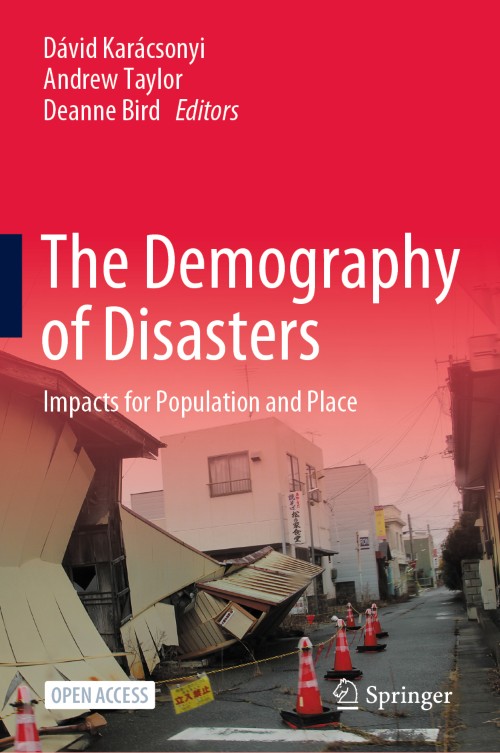
The Demography of Disasters [electronic resource] : Impacts for Population and Place / edited by Dávid Karácsonyi, Andrew Taylor, Deanne Bird.
Erişim Adresi
ISBN
9783030499204
Dil Kodu
İngilizce
Yer Numarası
DK/1828
Basım Bildirimi
1st ed. 2021.
Yayın Bilgisi
Cham : Springer International Publishing : Imprint: Springer, 2021.
Fiziksel Niteleme
XVII, 268 p. 42 illus., 36 illus. in color. online resource.
İçindekiler Notu
Part 1 People, Vulnerability and Resilience -- Demographic approaches to understanding impacts from disasters -- The four periods of natural and technological disasters -- Demographic and vulnerability aspects of affected populations and regionalization of natural hazards related with extreme rainfall events in Brazil -- Natural Disaster and Social Capital Nexus for Resilience: A study of Jeddah City, Kingdom of Saudi Arabia -- Part 2 – Migration & Relocation, Climate Change and Spatial Impacts -- Relocation of Communities after Natural Disasters in Taiwan and Japan -- Long-term mass displacements after nuclear disasters – Are they the largest emergency displacements of human history?- The demography of Climate change -- Indigenous demographic change and climate change -- Part 3 – Community Life and Recovery -- Communities in Fukushima and Chernobyl – enabling and inhibiting factors for recovery in nuclear disaster areas -- Community Life in the Aftermath of Catastrophe-Caused Demographic Change -- More than time? How Gallivare coped with the 1868 Deprivation and Katherine conceded to the 1998 Cyclone Les -- Indigenous cultural and demographic assets for managing disasters -- Part 4 – Planning for Future -- Planning for population loss -- Lifeline networks: Disruption from disasters or disasters from disruption? OR Reliance, vulnerability and disruption -- Exploring indigenous knowledge for assessing volcanic hazards and improving emergency communication -- Population urbanisation and disaster risks -- Conclusion.
Özet, vb.
This open access book provides worldwide examples demonstrating the importance of the interplay between demography and disasters in regions and spatially. It marks an advance in practical and theoretical insights for understanding the role of demography in planning for and mitigating impacts from disasters in developed nations. Both slow onset (like the of loss polar ice from climate change) and sudden disasters (such as cyclones and man-made disasters) have the capacity to fundamentally change the profiles of populations at local and regional levels. Impacts vary according to the type, rapidity and magnitude of the disaster, but also according to the pre-existing population profile and its relationships to the economy and society. In all cases, the key to understanding impacts and avoiding them in the future is to understand the relationships between disasters and population change. In most chapters in this book we compare and contrast studies from at least two cases and summarize their practical and theoretical lessons.
Konu
Demography.
Population.
Human geography.
Environment.
Social sciences __ Statistical methods.
Population __ Economic aspects.
Natural disasters.
Population and Demography.
Human Geography.
Environmental Sciences.
Statistics in Social Sciences, Humanities, Law, Education, Behavorial Sciences, Public Policy.
Population Economics.
Natural Hazards.
Population.
Human geography.
Environment.
Social sciences __ Statistical methods.
Population __ Economic aspects.
Natural disasters.
Population and Demography.
Human Geography.
Environmental Sciences.
Statistics in Social Sciences, Humanities, Law, Education, Behavorial Sciences, Public Policy.
Population Economics.
Natural Hazards.
Diğer Yazarlar
Eseri Alıntıla
Referansları kullanmadan önce gözden geçirmeniz ve varsa gerekli düzeltmeleri yapmanız önerilir.
Dijital Kaynak
MARC Görünümü
LEADER 04878nam a22006255i 4500
001 609156
003 TR_AnAIT
005 20250627070910
007 cr nn 008mamaa
008 200917s2021 sz | s |||| 0|eng d
020 |a9783030499204|9978-3-030-49920-4
024 7 |a10.1007/978-3-030-49920-4|2doi
041 |aeng
049 |aTürk Tarih Kurumu Kütüphanesi
050 4|aHB848-3697
072 7|aJHBD|2bicssc
072 7|aSOC006000|2bisacsh
072 7|aJHBD|2thema
082 04|a304.6|223
090 |aDK/1828
245 14|aThe Demography of Disasters|h[electronic resource] :|bImpacts for Population and Place /|cedited by Dávid Karácsonyi, Andrew Taylor, Deanne Bird.
250 |a1st ed. 2021.
264 1|aCham :|bSpringer International Publishing :|bImprint: Springer,|c2021.
300 |aXVII, 268 p. 42 illus., 36 illus. in color.|bonline resource.
336 |atext|btxt|2rdacontent
337 |acomputer|bc|2rdamedia
338 |aonline resource|bcr|2rdacarrier
347 |atext file|bPDF|2rda
505 0 |aPart 1 People, Vulnerability and Resilience -- Demographic approaches to understanding impacts from disasters -- The four periods of natural and technological disasters -- Demographic and vulnerability aspects of affected populations and regionalization of natural hazards related with extreme rainfall events in Brazil -- Natural Disaster and Social Capital Nexus for Resilience: A study of Jeddah City, Kingdom of Saudi Arabia -- Part 2 – Migration & Relocation, Climate Change and Spatial Impacts -- Relocation of Communities after Natural Disasters in Taiwan and Japan -- Long-term mass displacements after nuclear disasters – Are they the largest emergency displacements of human history?- The demography of Climate change -- Indigenous demographic change and climate change -- Part 3 – Community Life and Recovery -- Communities in Fukushima and Chernobyl – enabling and inhibiting factors for recovery in nuclear disaster areas -- Community Life in the Aftermath of Catastrophe-Caused Demographic Change -- More than time? How Gallivare coped with the 1868 Deprivation and Katherine conceded to the 1998 Cyclone Les -- Indigenous cultural and demographic assets for managing disasters -- Part 4 – Planning for Future -- Planning for population loss -- Lifeline networks: Disruption from disasters or disasters from disruption? OR Reliance, vulnerability and disruption -- Exploring indigenous knowledge for assessing volcanic hazards and improving emergency communication -- Population urbanisation and disaster risks -- Conclusion.
506 0 |aOpen Access
520 |aThis open access book provides worldwide examples demonstrating the importance of the interplay between demography and disasters in regions and spatially. It marks an advance in practical and theoretical insights for understanding the role of demography in planning for and mitigating impacts from disasters in developed nations. Both slow onset (like the of loss polar ice from climate change) and sudden disasters (such as cyclones and man-made disasters) have the capacity to fundamentally change the profiles of populations at local and regional levels. Impacts vary according to the type, rapidity and magnitude of the disaster, but also according to the pre-existing population profile and its relationships to the economy and society. In all cases, the key to understanding impacts and avoiding them in the future is to understand the relationships between disasters and population change. In most chapters in this book we compare and contrast studies from at least two cases and summarize their practical and theoretical lessons.
650 0|aDemography.
650 0|aPopulation.
650 0|aHuman geography.
650 0|aEnvironment.
650 0|aSocial sciences|xStatistical methods.
650 0|aPopulation|xEconomic aspects.
650 0|aNatural disasters.
650 14|aPopulation and Demography.
650 24|aHuman Geography.
650 24|aEnvironmental Sciences.
650 24|aStatistics in Social Sciences, Humanities, Law, Education, Behavorial Sciences, Public Policy.
650 24|aPopulation Economics.
650 24|aNatural Hazards.
700 1 |aKarácsonyi, Dávid.|eeditor.|4edt|4http://id.loc.gov/vocabulary/relators/edt
700 1 |aTaylor, Andrew.|eeditor.|4edt|4http://id.loc.gov/vocabulary/relators/edt
700 1 |aBird, Deanne.|eeditor.|4edt|4http://id.loc.gov/vocabulary/relators/edt
773 0 |tSpringer Nature eBook
776 08|iPrinted edition:|z9783030499198
776 08|iPrinted edition:|z9783030499211
776 08|iPrinted edition:|z9783030499228
856 40|uhttps://doi.org/10.1007/978-3-030-49920-4
912 |aZDB-2-HTY
912 |aZDB-2-SXH
912 |aZDB-2-SOB
950 |aHistory (SpringerNature-41172)
950 |aHistory (R0) (SpringerNature-43722)
001 609156
003 TR_AnAIT
005 20250627070910
007 cr nn 008mamaa
008 200917s2021 sz | s |||| 0|eng d
020 |a9783030499204|9978-3-030-49920-4
024 7 |a10.1007/978-3-030-49920-4|2doi
041 |aeng
049 |aTürk Tarih Kurumu Kütüphanesi
050 4|aHB848-3697
072 7|aJHBD|2bicssc
072 7|aSOC006000|2bisacsh
072 7|aJHBD|2thema
082 04|a304.6|223
090 |aDK/1828
245 14|aThe Demography of Disasters|h[electronic resource] :|bImpacts for Population and Place /|cedited by Dávid Karácsonyi, Andrew Taylor, Deanne Bird.
250 |a1st ed. 2021.
264 1|aCham :|bSpringer International Publishing :|bImprint: Springer,|c2021.
300 |aXVII, 268 p. 42 illus., 36 illus. in color.|bonline resource.
336 |atext|btxt|2rdacontent
337 |acomputer|bc|2rdamedia
338 |aonline resource|bcr|2rdacarrier
347 |atext file|bPDF|2rda
505 0 |aPart 1 People, Vulnerability and Resilience -- Demographic approaches to understanding impacts from disasters -- The four periods of natural and technological disasters -- Demographic and vulnerability aspects of affected populations and regionalization of natural hazards related with extreme rainfall events in Brazil -- Natural Disaster and Social Capital Nexus for Resilience: A study of Jeddah City, Kingdom of Saudi Arabia -- Part 2 – Migration & Relocation, Climate Change and Spatial Impacts -- Relocation of Communities after Natural Disasters in Taiwan and Japan -- Long-term mass displacements after nuclear disasters – Are they the largest emergency displacements of human history?- The demography of Climate change -- Indigenous demographic change and climate change -- Part 3 – Community Life and Recovery -- Communities in Fukushima and Chernobyl – enabling and inhibiting factors for recovery in nuclear disaster areas -- Community Life in the Aftermath of Catastrophe-Caused Demographic Change -- More than time? How Gallivare coped with the 1868 Deprivation and Katherine conceded to the 1998 Cyclone Les -- Indigenous cultural and demographic assets for managing disasters -- Part 4 – Planning for Future -- Planning for population loss -- Lifeline networks: Disruption from disasters or disasters from disruption? OR Reliance, vulnerability and disruption -- Exploring indigenous knowledge for assessing volcanic hazards and improving emergency communication -- Population urbanisation and disaster risks -- Conclusion.
506 0 |aOpen Access
520 |aThis open access book provides worldwide examples demonstrating the importance of the interplay between demography and disasters in regions and spatially. It marks an advance in practical and theoretical insights for understanding the role of demography in planning for and mitigating impacts from disasters in developed nations. Both slow onset (like the of loss polar ice from climate change) and sudden disasters (such as cyclones and man-made disasters) have the capacity to fundamentally change the profiles of populations at local and regional levels. Impacts vary according to the type, rapidity and magnitude of the disaster, but also according to the pre-existing population profile and its relationships to the economy and society. In all cases, the key to understanding impacts and avoiding them in the future is to understand the relationships between disasters and population change. In most chapters in this book we compare and contrast studies from at least two cases and summarize their practical and theoretical lessons.
650 0|aDemography.
650 0|aPopulation.
650 0|aHuman geography.
650 0|aEnvironment.
650 0|aSocial sciences|xStatistical methods.
650 0|aPopulation|xEconomic aspects.
650 0|aNatural disasters.
650 14|aPopulation and Demography.
650 24|aHuman Geography.
650 24|aEnvironmental Sciences.
650 24|aStatistics in Social Sciences, Humanities, Law, Education, Behavorial Sciences, Public Policy.
650 24|aPopulation Economics.
650 24|aNatural Hazards.
700 1 |aKarácsonyi, Dávid.|eeditor.|4edt|4http://id.loc.gov/vocabulary/relators/edt
700 1 |aTaylor, Andrew.|eeditor.|4edt|4http://id.loc.gov/vocabulary/relators/edt
700 1 |aBird, Deanne.|eeditor.|4edt|4http://id.loc.gov/vocabulary/relators/edt
773 0 |tSpringer Nature eBook
776 08|iPrinted edition:|z9783030499198
776 08|iPrinted edition:|z9783030499211
776 08|iPrinted edition:|z9783030499228
856 40|uhttps://doi.org/10.1007/978-3-030-49920-4
912 |aZDB-2-HTY
912 |aZDB-2-SXH
912 |aZDB-2-SOB
950 |aHistory (SpringerNature-41172)
950 |aHistory (R0) (SpringerNature-43722)
Materyaller
Depodan talep edilen materyal sadece kütüphane içerisinde kullanılmaktadır.
Materyal dışarıya ödünç verilmemektedir.
Materyal dışarıya ödünç verilmemektedir.
