LEADER 03946nam a22005655i 4500
001 609182
003 TR_AnAIT
005 20250627070820
007 cr nn 008mamaa
008 210424s2021 sz | s |||| 0|eng d
020 |a9783030517847|9978-3-030-51784-7
024 7 |a10.1007/978-3-030-51784-7|2doi
041 |aeng
049 |aTürk Tarih Kurumu Kütüphanesi
050 4|aHD72-88
072 7|aKCM|2bicssc
072 7|aBUS068000|2bisacsh
072 7|aKCM|2thema
082 04|a338.9|223
090 |aDK/1854
100 1 |aDomjan, Paul.|eauthor.|4aut|4http://id.loc.gov/vocabulary/relators/aut
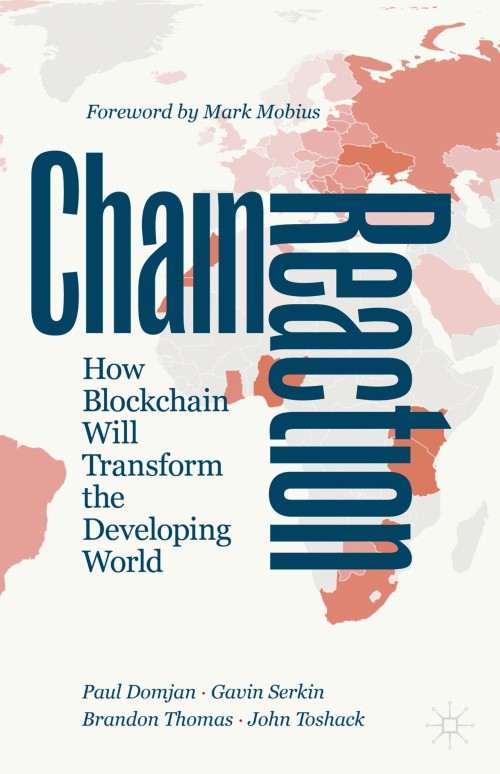
245 10|aChain Reaction|h[electronic resource] :|bHow Blockchain Will Transform the Developing World /|cby Paul Domjan, Gavin Serkin, Brandon Thomas, John Toshack.
250 |a1st ed. 2021.
264 1|aCham :|bSpringer International Publishing :|bImprint: Palgrave Macmillan,|c2021.
300 |aXIII, 110 p. 17 illus., 1 illus. in color.|bonline resource.
336 |atext|btxt|2rdacontent
337 |acomputer|bc|2rdamedia
338 |aonline resource|bcr|2rdacarrier
347 |atext file|bPDF|2rda
505 0 |aChapter 1: Introducing blockchain: Tomorrow's Railroads -- Chapter 2: Trust Matters -- Chapter 3: What Does Blockchain Solve? -- Chapter 4: Who Really Controls Blockchain? -- Chapter 5: Making money -- Chapter 6: More than money -- Chapter 7: Opening Up Trade -- Chapter 8: The Big Bet Vs. Devil You Know.
520 |aAmidst the constant stream of overly technical and excitable books heralding a blockchain revolution that’s destined to be more disruptive than the Internet, this book stands apart for its more nuanced take, focusing on the potential for these new technologies to change developing countries for the better. Chain Reaction divides the world into two: for some, blockchain seems a poor substitute for an efficient banking and regulatory system in which transactions are settled instantly and contracts are underpinned by solid institutions. For others, it will be truly life-changing – namely those living in countries where rule of law is weak, concepts of ownership are vague and, consequently, trust in institutions is in scarce supply. With blockchain, we are about to witness a leapfrogging – one that will bring the next billion emerging consumers into the formal economy by creating reliable institutions of contract, ownership and trust among people previously denied such luxuries. The authors humanize the technology by taking the reader on a global journey through a multitude of applications – from registering property to voting and delivering aid. In place of the usual abstract lessons in complex technology, this book is instead filled with lively anecdotes of places where trust is so weak that a crisp dollar bill sells at a premium to a better-used version. The book’s goal is to create the first truly approachable, entirely comprehensible and enjoyable read on the wonders to come from blockchain.
650 0|aDevelopment economics.
650 0|aBusiness enterprises|xFinance.
650 0|aInternational finance.
650 0|aFinancial services industry.
650 0|aFinance.
650 14|aDevelopment Economics.
650 24|aCorporate Finance.
650 24|aInternational Finance.
650 24|aFinancial Services.
650 24|aFinancial Economics.
700 1 |aSerkin, Gavin.|eauthor.|4aut|4http://id.loc.gov/vocabulary/relators/aut
700 1 |aThomas, Brandon.|eauthor.|4aut|4http://id.loc.gov/vocabulary/relators/aut
700 1 |aToshack, John.|eauthor.|4aut|4http://id.loc.gov/vocabulary/relators/aut
773 0 |tSpringer Nature eBook
776 08|iPrinted edition:|z9783030517830
776 08|iPrinted edition:|z9783030517854
856 40|uhttps://doi.org/10.1007/978-3-030-51784-7
912 |aZDB-2-HTY
912 |aZDB-2-SXH
950 |aHistory (SpringerNature-41172)
950 |aHistory (R0) (SpringerNature-43722)