

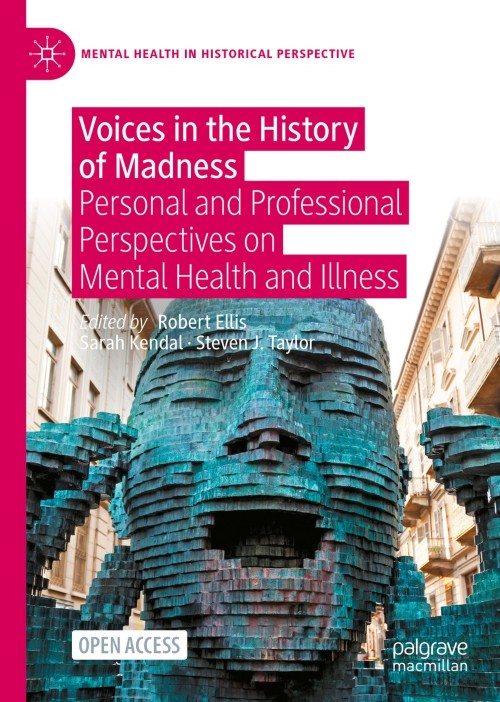
Voices in the History of Madness [electronic resource] : Personal and Professional Perspectives on Mental Health and Illness / edited by Robert Ellis, Sarah Kendal, Steven J. Taylor.
Erişim Adresi
ISBN
9783030695590
Dil Kodu
İngilizce
Yer Numarası
DK/1867
Basım Bildirimi
1st ed. 2021.
Yayın Bilgisi
Cham : Springer International Publishing : Imprint: Palgrave Macmillan, 2021.
Fiziksel Niteleme
XXII, 430 p. 20 illus., 16 illus. in color. online resource.
Dizi
Mental Health in Historical Perspective, 2634-6044
İçindekiler Notu
1. Voices in the History of Madness: An Introduction to Patient and Practitioner Perspectives- Rob Ellis, Sarah Kendal and Steven J. Taylor -- Part I: Shifting Perspectives in The Industry of Madness -- 2. Accepted and Rejected: Late nineteenth-century application for admission to the Scottish National Institution for the Education of Imbecile Children- Iain Hutchison -- 3. Mental health in the Vernacular: Print and Counter-hegemonic Approaches to Madness in Colonial Bengal- Pradipto Roy -- 4. “The root of all evil is inactivity”: The response of French psychiatrists to new approaches to patient work and occupation, 1918-1939- Jane Freebody -- 5. Distant voices – treatment of mentally ill children at the Copenhagen University Hospital in Denmark, c. 1935-1976- Jennie Sejr Junghans -- Part II Reconstructing Patient Perspectives -- 6. Experiences of the Madhouse in England, 1650-1810- Leonard Smith -- 7. “Tells his story quite rationally and collectedly”: Examining the casebooks of the Grahamstown Lunatic Asylum, 1890–1910, for cases of delusion where patients voiced their life stories- Rory du Plessis -- 8. Dehumanizing Experience, Rehumanizing Self-Awareness: Perception Of Violence In Psychiatric Hospitals Of Soviet Lithuania- Tomas Vaiseta -- 9. “I Like My Job because It Will Get Me Out Quicker”: Work, Independence, and Disability at Indiana’s Central State Hospital (1986-1993)- Emily Beckman, Elizabeth Nelson and Modupe Labode -- 10. “More than Bricks and Mortar:” Meaningful Care Practices in the Old State Mental Hospitals- Verusca Calabria, Di Bailey, Graham Bowpitt -- 11. Patient Photographs, Patient Voices: Recovering Patient Experience in the Nineteenth Century Asylum- Katherine Rawling -- Part III The Visual and The Material -- 12. Tracking Traces of the Art Extraordinary Collection- Cheryl McGeachan -- 13. A boundary between two worlds? Community perceptions of former asylums in Lancashire, England- Carolyn Gibbeson and Katie Beattie -- Part IV: Mad Studies And Activism -- 14. Brutal sanity and mad compassion. Tracing the voice of Dorothea Buck- Elena Demke -- 15. Mad Activists and the Left in Ontario, 1970s to 2000- Geoffrey Reaume -- 16. Knowing our own minds: transforming the knowledge base of madness and distress- Alison Faulkner -- 17. Making Public Their Use of History: Reflections on the History of Collective Action by Psychiatric Patients, the Oor Mad History Project and Survivors History Group- Mark Gallagher -- 18. Often, when I am using my voice… it does not go well. Perspectives on the service user experience- Megan Alikhanizadeh, Corey Hartley, Sarah Kendal, Liz Neill, Gemma Trainor -- 19. Coda - Speaking Madness: Word, Image, Action- Catharine Coleborne -- 20 Correction to: Mental Health in the Vernacular: Print and Counter-Hegemonic Approaches to Madness in Colonial Bengal.
Özet, vb.
This book presents new perspectives on the multiplicity of voices in the histories of mental ill-health. In the thirty years since Roy Porter called on historians to lower their gaze so that they might better understand patient-doctor roles in the past, historians have sought to place the voices of previously silent, marginalised and disenfranchised individuals at the heart of their analyses. Today, the development of service-user groups and patient consultations have become an important feature of the debates and planning related to current approaches to prevention, care and treatment. This edited collection of interdisciplinary chapters offers new and innovative perspectives on mental health and illness in the past and covers a breadth of opinions, views, and interpretations from patients, practitioners, policy makers, family members and wider communities. Its chronology runs from the early modern period to the 21st century and includes international and transnational analyses from Europe, North America, Asia and Africa, drawing on a range of sources and methodologies including oral histories, material culture, and the built environment. Chapter 4 is available open access under a Creative Commons Attribution 4.0 International License via link.springer.com.
Konu
Social history.
Medicine __ History.
Oral history.
Psychiatry.
Social History.
History of Medicine.
Oral History.
Psychiatry.
Medicine __ History.
Oral history.
Psychiatry.
Social History.
History of Medicine.
Oral History.
Psychiatry.
Diğer Yazarlar
Eseri Alıntıla
Referansları kullanmadan önce gözden geçirmeniz ve varsa gerekli düzeltmeleri yapmanız önerilir.
Dijital Kaynak
MARC Görünümü
LEADER 06262nam a22005655i 4500
001 609195
003 TR_AnAIT
005 20250627070757
007 cr nn 008mamaa
008 210512s2021 sz | s |||| 0|eng d
020 |a9783030695590|9978-3-030-69559-0
024 7 |a10.1007/978-3-030-69559-0|2doi
041 |aeng
049 |aTürk Tarih Kurumu Kütüphanesi
050 4|aHN
072 7|aHBTB|2bicssc
072 7|aHIS054000|2bisacsh
072 7|aNHTB|2thema
082 04|a306.09|223
090 |aDK/1867
245 10|aVoices in the History of Madness|h[electronic resource] :|bPersonal and Professional Perspectives on Mental Health and Illness /|cedited by Robert Ellis, Sarah Kendal, Steven J. Taylor.
250 |a1st ed. 2021.
264 1|aCham :|bSpringer International Publishing :|bImprint: Palgrave Macmillan,|c2021.
300 |aXXII, 430 p. 20 illus., 16 illus. in color.|bonline resource.
336 |atext|btxt|2rdacontent
337 |acomputer|bc|2rdamedia
338 |aonline resource|bcr|2rdacarrier
347 |atext file|bPDF|2rda
490 1 |aMental Health in Historical Perspective,|x2634-6044
505 0 |a1. Voices in the History of Madness: An Introduction to Patient and Practitioner Perspectives- Rob Ellis, Sarah Kendal and Steven J. Taylor -- Part I: Shifting Perspectives in The Industry of Madness -- 2. Accepted and Rejected: Late nineteenth-century application for admission to the Scottish National Institution for the Education of Imbecile Children- Iain Hutchison -- 3. Mental health in the Vernacular: Print and Counter-hegemonic Approaches to Madness in Colonial Bengal- Pradipto Roy -- 4. “The root of all evil is inactivity”: The response of French psychiatrists to new approaches to patient work and occupation, 1918-1939- Jane Freebody -- 5. Distant voices – treatment of mentally ill children at the Copenhagen University Hospital in Denmark, c. 1935-1976- Jennie Sejr Junghans -- Part II Reconstructing Patient Perspectives -- 6. Experiences of the Madhouse in England, 1650-1810- Leonard Smith -- 7. “Tells his story quite rationally and collectedly”: Examining the casebooks of the Grahamstown Lunatic Asylum, 1890–1910, for cases of delusion where patients voiced their life stories- Rory du Plessis -- 8. Dehumanizing Experience, Rehumanizing Self-Awareness: Perception Of Violence In Psychiatric Hospitals Of Soviet Lithuania- Tomas Vaiseta -- 9. “I Like My Job because It Will Get Me Out Quicker”: Work, Independence, and Disability at Indiana’s Central State Hospital (1986-1993)- Emily Beckman, Elizabeth Nelson and Modupe Labode -- 10. “More than Bricks and Mortar:” Meaningful Care Practices in the Old State Mental Hospitals- Verusca Calabria, Di Bailey, Graham Bowpitt -- 11. Patient Photographs, Patient Voices: Recovering Patient Experience in the Nineteenth Century Asylum- Katherine Rawling -- Part III The Visual and The Material -- 12. Tracking Traces of the Art Extraordinary Collection- Cheryl McGeachan -- 13. A boundary between two worlds? Community perceptions of former asylums in Lancashire, England- Carolyn Gibbeson and Katie Beattie -- Part IV: Mad Studies And Activism -- 14. Brutal sanity and mad compassion. Tracing the voice of Dorothea Buck- Elena Demke -- 15. Mad Activists and the Left in Ontario, 1970s to 2000- Geoffrey Reaume -- 16. Knowing our own minds: transforming the knowledge base of madness and distress- Alison Faulkner -- 17. Making Public Their Use of History: Reflections on the History of Collective Action by Psychiatric Patients, the Oor Mad History Project and Survivors History Group- Mark Gallagher -- 18. Often, when I am using my voice… it does not go well. Perspectives on the service user experience- Megan Alikhanizadeh, Corey Hartley, Sarah Kendal, Liz Neill, Gemma Trainor -- 19. Coda - Speaking Madness: Word, Image, Action- Catharine Coleborne -- 20 Correction to: Mental Health in the Vernacular: Print and Counter-Hegemonic Approaches to Madness in Colonial Bengal.
520 |aThis book presents new perspectives on the multiplicity of voices in the histories of mental ill-health. In the thirty years since Roy Porter called on historians to lower their gaze so that they might better understand patient-doctor roles in the past, historians have sought to place the voices of previously silent, marginalised and disenfranchised individuals at the heart of their analyses. Today, the development of service-user groups and patient consultations have become an important feature of the debates and planning related to current approaches to prevention, care and treatment. This edited collection of interdisciplinary chapters offers new and innovative perspectives on mental health and illness in the past and covers a breadth of opinions, views, and interpretations from patients, practitioners, policy makers, family members and wider communities. Its chronology runs from the early modern period to the 21st century and includes international and transnational analyses from Europe, North America, Asia and Africa, drawing on a range of sources and methodologies including oral histories, material culture, and the built environment. Chapter 4 is available open access under a Creative Commons Attribution 4.0 International License via link.springer.com.
650 0|aSocial history.
650 0|aMedicine|xHistory.
650 0|aOral history.
650 0|aPsychiatry.
650 14|aSocial History.
650 24|aHistory of Medicine.
650 24|aOral History.
650 24|aPsychiatry.
700 1 |aEllis, Robert.|eeditor.|4edt|4http://id.loc.gov/vocabulary/relators/edt
700 1 |aKendal, Sarah.|eeditor.|4edt|4http://id.loc.gov/vocabulary/relators/edt
700 1 |aTaylor, Steven J.|eeditor.|4edt|4http://id.loc.gov/vocabulary/relators/edt
773 0 |tSpringer Nature eBook
776 08|iPrinted edition:|z9783030695583
776 08|iPrinted edition:|z9783030695606
776 08|iPrinted edition:|z9783030695613
830 0|aMental Health in Historical Perspective,|x2634-6044
856 40|uhttps://doi.org/10.1007/978-3-030-69559-0
912 |aZDB-2-HTY
912 |aZDB-2-SXH
950 |aHistory (SpringerNature-41172)
950 |aHistory (R0) (SpringerNature-43722)
001 609195
003 TR_AnAIT
005 20250627070757
007 cr nn 008mamaa
008 210512s2021 sz | s |||| 0|eng d
020 |a9783030695590|9978-3-030-69559-0
024 7 |a10.1007/978-3-030-69559-0|2doi
041 |aeng
049 |aTürk Tarih Kurumu Kütüphanesi
050 4|aHN
072 7|aHBTB|2bicssc
072 7|aHIS054000|2bisacsh
072 7|aNHTB|2thema
082 04|a306.09|223
090 |aDK/1867
245 10|aVoices in the History of Madness|h[electronic resource] :|bPersonal and Professional Perspectives on Mental Health and Illness /|cedited by Robert Ellis, Sarah Kendal, Steven J. Taylor.
250 |a1st ed. 2021.
264 1|aCham :|bSpringer International Publishing :|bImprint: Palgrave Macmillan,|c2021.
300 |aXXII, 430 p. 20 illus., 16 illus. in color.|bonline resource.
336 |atext|btxt|2rdacontent
337 |acomputer|bc|2rdamedia
338 |aonline resource|bcr|2rdacarrier
347 |atext file|bPDF|2rda
490 1 |aMental Health in Historical Perspective,|x2634-6044
505 0 |a1. Voices in the History of Madness: An Introduction to Patient and Practitioner Perspectives- Rob Ellis, Sarah Kendal and Steven J. Taylor -- Part I: Shifting Perspectives in The Industry of Madness -- 2. Accepted and Rejected: Late nineteenth-century application for admission to the Scottish National Institution for the Education of Imbecile Children- Iain Hutchison -- 3. Mental health in the Vernacular: Print and Counter-hegemonic Approaches to Madness in Colonial Bengal- Pradipto Roy -- 4. “The root of all evil is inactivity”: The response of French psychiatrists to new approaches to patient work and occupation, 1918-1939- Jane Freebody -- 5. Distant voices – treatment of mentally ill children at the Copenhagen University Hospital in Denmark, c. 1935-1976- Jennie Sejr Junghans -- Part II Reconstructing Patient Perspectives -- 6. Experiences of the Madhouse in England, 1650-1810- Leonard Smith -- 7. “Tells his story quite rationally and collectedly”: Examining the casebooks of the Grahamstown Lunatic Asylum, 1890–1910, for cases of delusion where patients voiced their life stories- Rory du Plessis -- 8. Dehumanizing Experience, Rehumanizing Self-Awareness: Perception Of Violence In Psychiatric Hospitals Of Soviet Lithuania- Tomas Vaiseta -- 9. “I Like My Job because It Will Get Me Out Quicker”: Work, Independence, and Disability at Indiana’s Central State Hospital (1986-1993)- Emily Beckman, Elizabeth Nelson and Modupe Labode -- 10. “More than Bricks and Mortar:” Meaningful Care Practices in the Old State Mental Hospitals- Verusca Calabria, Di Bailey, Graham Bowpitt -- 11. Patient Photographs, Patient Voices: Recovering Patient Experience in the Nineteenth Century Asylum- Katherine Rawling -- Part III The Visual and The Material -- 12. Tracking Traces of the Art Extraordinary Collection- Cheryl McGeachan -- 13. A boundary between two worlds? Community perceptions of former asylums in Lancashire, England- Carolyn Gibbeson and Katie Beattie -- Part IV: Mad Studies And Activism -- 14. Brutal sanity and mad compassion. Tracing the voice of Dorothea Buck- Elena Demke -- 15. Mad Activists and the Left in Ontario, 1970s to 2000- Geoffrey Reaume -- 16. Knowing our own minds: transforming the knowledge base of madness and distress- Alison Faulkner -- 17. Making Public Their Use of History: Reflections on the History of Collective Action by Psychiatric Patients, the Oor Mad History Project and Survivors History Group- Mark Gallagher -- 18. Often, when I am using my voice… it does not go well. Perspectives on the service user experience- Megan Alikhanizadeh, Corey Hartley, Sarah Kendal, Liz Neill, Gemma Trainor -- 19. Coda - Speaking Madness: Word, Image, Action- Catharine Coleborne -- 20 Correction to: Mental Health in the Vernacular: Print and Counter-Hegemonic Approaches to Madness in Colonial Bengal.
520 |aThis book presents new perspectives on the multiplicity of voices in the histories of mental ill-health. In the thirty years since Roy Porter called on historians to lower their gaze so that they might better understand patient-doctor roles in the past, historians have sought to place the voices of previously silent, marginalised and disenfranchised individuals at the heart of their analyses. Today, the development of service-user groups and patient consultations have become an important feature of the debates and planning related to current approaches to prevention, care and treatment. This edited collection of interdisciplinary chapters offers new and innovative perspectives on mental health and illness in the past and covers a breadth of opinions, views, and interpretations from patients, practitioners, policy makers, family members and wider communities. Its chronology runs from the early modern period to the 21st century and includes international and transnational analyses from Europe, North America, Asia and Africa, drawing on a range of sources and methodologies including oral histories, material culture, and the built environment. Chapter 4 is available open access under a Creative Commons Attribution 4.0 International License via link.springer.com.
650 0|aSocial history.
650 0|aMedicine|xHistory.
650 0|aOral history.
650 0|aPsychiatry.
650 14|aSocial History.
650 24|aHistory of Medicine.
650 24|aOral History.
650 24|aPsychiatry.
700 1 |aEllis, Robert.|eeditor.|4edt|4http://id.loc.gov/vocabulary/relators/edt
700 1 |aKendal, Sarah.|eeditor.|4edt|4http://id.loc.gov/vocabulary/relators/edt
700 1 |aTaylor, Steven J.|eeditor.|4edt|4http://id.loc.gov/vocabulary/relators/edt
773 0 |tSpringer Nature eBook
776 08|iPrinted edition:|z9783030695583
776 08|iPrinted edition:|z9783030695606
776 08|iPrinted edition:|z9783030695613
830 0|aMental Health in Historical Perspective,|x2634-6044
856 40|uhttps://doi.org/10.1007/978-3-030-69559-0
912 |aZDB-2-HTY
912 |aZDB-2-SXH
950 |aHistory (SpringerNature-41172)
950 |aHistory (R0) (SpringerNature-43722)
Materyaller
Depodan talep edilen materyal sadece kütüphane içerisinde kullanılmaktadır.
Materyal dışarıya ödünç verilmemektedir.
Materyal dışarıya ödünç verilmemektedir.
