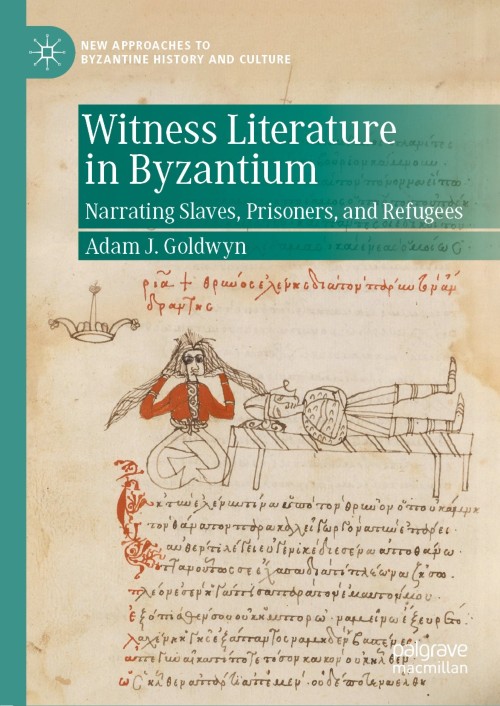
LEADER 03226nam a22005295i 4500
001 609206
003 TR_AnAIT
005 20250627070736
007 cr nn 008mamaa
008 210806s2021 sz | s |||| 0|eng d
020 |a9783030788575|9978-3-030-78857-5
024 7 |a10.1007/978-3-030-78857-5|2doi
041 |aeng
049 |aTürk Tarih Kurumu Kütüphanesi
050 4|aD111-203
072 7|aHBJD|2bicssc
072 7|aHBLC1|2bicssc
072 7|aHIS037010|2bisacsh
072 7|aNHDJ|2thema
082 04|a940.902|223
090 |aDK/1878
100 1 |aGoldwyn, Adam J.|eauthor.|4aut|4http://id.loc.gov/vocabulary/relators/aut
245 10|aWitness Literature in Byzantium|h[electronic resource] :|bNarrating Slaves, Prisoners, and Refugees /|cby Adam J. Goldwyn.
250 |a1st ed. 2021.
264 1|aCham :|bSpringer International Publishing :|bImprint: Palgrave Macmillan,|c2021.
300 |aXVI, 299 p. 1 illus.|bonline resource.
336 |atext|btxt|2rdacontent
337 |acomputer|bc|2rdamedia
338 |aonline resource|bcr|2rdacarrier
347 |atext file|bPDF|2rda
490 1 |aNew Approaches to Byzantine History and Culture,|x2730-9371
505 0 |a1. Bearing Witness in Eustathios of Thessaloniki’s Capture of Thessaloniki: Holocaust Literature and the Narration of Trauma in Byzantium -- 2. Prison Literature and Slave Narratives in Byzantium: John Kaminiates’ Capture of Thessaloniki -- 3. The Carceral Imaginary in Byzantium: The Komnenian Novels as Holocaust Fiction -- 4. The Refugee as Historian: Niketas Choniates and the Capture of Constantinople.
520 |a“By turns reflexive and daring, Goldwyn's book is riskful thinking at its best. For medievalists, it opens up new possibilities for reading and teaching the works that matter to us most -- those that somehow place us face-to-face with human Others and leave us feeling more than we can express. In Goldwyn's book, the face of the human Other presents itself, even if only briefly and in a moment of mortal danger.” — Vincent Barletta, Stanford University, USA “Innovative, illuminating and daring. This theoretically sophisticated book revolutionizes the study of Byzantine literature and enriches our understanding of angst, anxiety and trauma in the middle ages. This book provides an insightful discussion of captivity in the Byzantine era and a new interdisciplinary, trans-historical understanding of narratives which will captivate scholars for years to come.” —Elena N. Boeck, DePaul University, USA.
650 0|aEurope|xHistory|x476-1492.
650 0|aCivilization|xHistory.
650 0|aLiterature|xHistory and criticism.
650 14|aHistory of Medieval Europe.
650 24|aCultural History.
650 24|aLiterary History.
773 0 |tSpringer Nature eBook
776 08|iPrinted edition:|z9783030788568
776 08|iPrinted edition:|z9783030788582
776 08|iPrinted edition:|z9783030788599
830 0|aNew Approaches to Byzantine History and Culture,|x2730-9371
856 40|uhttps://doi.org/10.1007/978-3-030-78857-5
912 |aZDB-2-HTY
912 |aZDB-2-SXH
950 |aHistory (SpringerNature-41172)
950 |aHistory (R0) (SpringerNature-43722)