

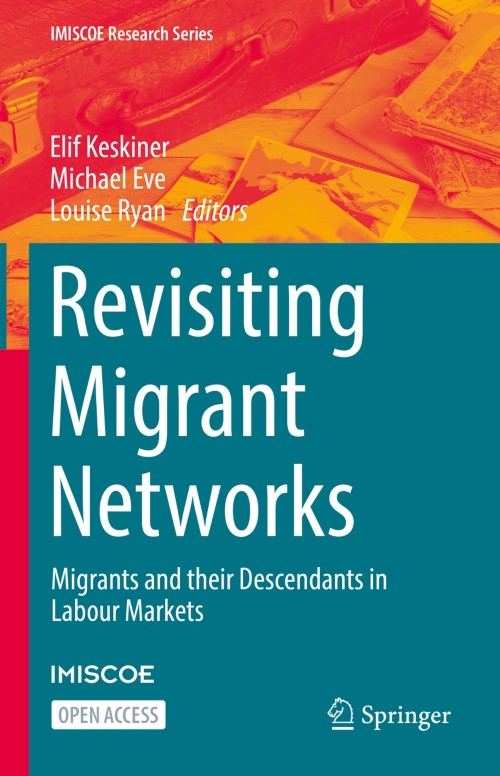
Revisiting Migrant Networks [electronic resource] : Migrants and their Descendants in Labour Markets / edited by Elif Keskiner, Michael Eve, Louise Ryan.
Erişim Adresi
ISBN
9783030949723
Dil Kodu
İngilizce
Yer Numarası
DK/1986
Basım Bildirimi
1st ed. 2022.
Yayın Bilgisi
Cham : Springer International Publishing : Imprint: Springer, 2022.
Fiziksel Niteleme
VIII, 236 p. 1 illus. online resource.
Dizi
IMISCOE Research Series, 2364-4095
İçindekiler Notu
Chapter 1. Introduction: Revisiting Networks: setting the conceptual and methodological scene -- Chapter 2. The direct and indirect role of migrants’ networks in accessing diverse labour market sectors: an analysis of the weak/ strong ties continuum -- Chapter 3. Are “weak ties” really weak? Social capital reliance among second generation Turkish lawyers in Paris -- Chapter 4. Context matters: the varying roles of social ties for professional careers of immigrants’ descendants -- Chapter 5. Access to employment of the second generations in France: unequal role of family and personal networks by Origins and Gender -- Chapter 6. Social capital, immigrants and their descendants - the case of Sweden -- Chapter 7.Activating Social Capital: Steep mobility of descendants of immigrants at the top of the corporate business sector -- Chapter 8. Reciprocity within Migrant Networks: The Role of Social Support for Employment -- Chapter 9. Networks in Migration Processes -- Chapter 10. Early-career academics’ transnational moves: The gendered role of vertical social ties in obtaining academic positions abroad -- Chapter 11: Epilogue. Where Did Weak and Strong Ties Go Wrong?.
Özet, vb.
This open access book provides new conceptualisations on the networks of migrants and their descendants in accessing the labour market. Although references to social networks are common in discussions of migration, simplified ideas of co-ethnic networks often obscure the reality, for example confounding ties with co-ethnics and ‘strong ties’. This open access book addresses key questions about the role of networks in migration contexts, particularly in relation to how migrants and their descendants, access the labour market and develop their employment trajectories over time. Rather than adopting a narrow essentializing ethnic lens, the research presented in this book explores intersectional identities of class, generation and gender. By focusing on the kinds of capital circulating between ties, including the dark side of social capital, the book offers insights into power dynamics and the potentially exclusionary dimension of networks. Taking a long term view, acrossgenerations, the research in this book shows how migrants and their descendants mobilize resources to tackle discrimination and enhance their position within particular labour markets. Drawing on robust quantitative and rich qualitative data, this book provides a primary source to students, scholars and policy-makers focusing on issues of migration, social networks, social mobility as well as labour market inequalities.
Konu
Emigration and immigration.
Emigration and immigration __ Government policy.
Population __ Economic aspects.
Social sciences __ Network analysis.
Human Migration.
Migration Policy.
Population Economics.
Network Research.
Emigration and immigration __ Government policy.
Population __ Economic aspects.
Social sciences __ Network analysis.
Human Migration.
Migration Policy.
Population Economics.
Network Research.
Diğer Yazarlar
Eseri Alıntıla
Referansları kullanmadan önce gözden geçirmeniz ve varsa gerekli düzeltmeleri yapmanız önerilir.
Dijital Kaynak
MARC Görünümü
LEADER 04823nam a22006135i 4500
001 609314
003 TR_AnAIT
005 20250627070336
007 cr nn 008mamaa
008 220316s2022 sz | s |||| 0|eng d
020 |a9783030949723|9978-3-030-94972-3
024 7 |a10.1007/978-3-030-94972-3|2doi
041 |aeng
049 |aTürk Tarih Kurumu Kütüphanesi
050 4|aJV6001-9480
050 4|aHB1951-2577
072 7|aJFFN|2bicssc
072 7|aSOC007000|2bisacsh
072 7|aJBFH|2thema
072 7|aRGCG|2thema
082 04|a304.8|223
090 |aDK/1986
245 10|aRevisiting Migrant Networks|h[electronic resource] :|bMigrants and their Descendants in Labour Markets /|cedited by Elif Keskiner, Michael Eve, Louise Ryan.
250 |a1st ed. 2022.
264 1|aCham :|bSpringer International Publishing :|bImprint: Springer,|c2022.
300 |aVIII, 236 p. 1 illus.|bonline resource.
336 |atext|btxt|2rdacontent
337 |acomputer|bc|2rdamedia
338 |aonline resource|bcr|2rdacarrier
347 |atext file|bPDF|2rda
490 1 |aIMISCOE Research Series,|x2364-4095
505 0 |aChapter 1. Introduction: Revisiting Networks: setting the conceptual and methodological scene -- Chapter 2. The direct and indirect role of migrants’ networks in accessing diverse labour market sectors: an analysis of the weak/ strong ties continuum -- Chapter 3. Are “weak ties” really weak? Social capital reliance among second generation Turkish lawyers in Paris -- Chapter 4. Context matters: the varying roles of social ties for professional careers of immigrants’ descendants -- Chapter 5. Access to employment of the second generations in France: unequal role of family and personal networks by Origins and Gender -- Chapter 6. Social capital, immigrants and their descendants - the case of Sweden -- Chapter 7.Activating Social Capital: Steep mobility of descendants of immigrants at the top of the corporate business sector -- Chapter 8. Reciprocity within Migrant Networks: The Role of Social Support for Employment -- Chapter 9. Networks in Migration Processes -- Chapter 10. Early-career academics’ transnational moves: The gendered role of vertical social ties in obtaining academic positions abroad -- Chapter 11: Epilogue. Where Did Weak and Strong Ties Go Wrong?.
506 0 |aOpen Access
520 |aThis open access book provides new conceptualisations on the networks of migrants and their descendants in accessing the labour market. Although references to social networks are common in discussions of migration, simplified ideas of co-ethnic networks often obscure the reality, for example confounding ties with co-ethnics and ‘strong ties’. This open access book addresses key questions about the role of networks in migration contexts, particularly in relation to how migrants and their descendants, access the labour market and develop their employment trajectories over time. Rather than adopting a narrow essentializing ethnic lens, the research presented in this book explores intersectional identities of class, generation and gender. By focusing on the kinds of capital circulating between ties, including the dark side of social capital, the book offers insights into power dynamics and the potentially exclusionary dimension of networks. Taking a long term view, acrossgenerations, the research in this book shows how migrants and their descendants mobilize resources to tackle discrimination and enhance their position within particular labour markets. Drawing on robust quantitative and rich qualitative data, this book provides a primary source to students, scholars and policy-makers focusing on issues of migration, social networks, social mobility as well as labour market inequalities.
650 0|aEmigration and immigration.
650 0|aEmigration and immigration|xGovernment policy.
650 0|aPopulation|xEconomic aspects.
650 0|aSocial sciences|xNetwork analysis.
650 14|aHuman Migration.
650 24|aMigration Policy.
650 24|aPopulation Economics.
650 24|aNetwork Research.
700 1 |aKeskiner, Elif.|eeditor.|4edt|4http://id.loc.gov/vocabulary/relators/edt
700 1 |aEve, Michael.|eeditor.|4edt|4http://id.loc.gov/vocabulary/relators/edt
700 1 |aRyan, Louise.|eeditor.|4edt|4http://id.loc.gov/vocabulary/relators/edt
773 0 |tSpringer Nature eBook
776 08|iPrinted edition:|z9783030949716
776 08|iPrinted edition:|z9783030949730
776 08|iPrinted edition:|z9783030949747
830 0|aIMISCOE Research Series,|x2364-4095
856 40|uhttps://doi.org/10.1007/978-3-030-94972-3
912 |aZDB-2-HTY
912 |aZDB-2-SXH
912 |aZDB-2-SOB
950 |aHistory (SpringerNature-41172)
950 |aHistory (R0) (SpringerNature-43722)
001 609314
003 TR_AnAIT
005 20250627070336
007 cr nn 008mamaa
008 220316s2022 sz | s |||| 0|eng d
020 |a9783030949723|9978-3-030-94972-3
024 7 |a10.1007/978-3-030-94972-3|2doi
041 |aeng
049 |aTürk Tarih Kurumu Kütüphanesi
050 4|aJV6001-9480
050 4|aHB1951-2577
072 7|aJFFN|2bicssc
072 7|aSOC007000|2bisacsh
072 7|aJBFH|2thema
072 7|aRGCG|2thema
082 04|a304.8|223
090 |aDK/1986
245 10|aRevisiting Migrant Networks|h[electronic resource] :|bMigrants and their Descendants in Labour Markets /|cedited by Elif Keskiner, Michael Eve, Louise Ryan.
250 |a1st ed. 2022.
264 1|aCham :|bSpringer International Publishing :|bImprint: Springer,|c2022.
300 |aVIII, 236 p. 1 illus.|bonline resource.
336 |atext|btxt|2rdacontent
337 |acomputer|bc|2rdamedia
338 |aonline resource|bcr|2rdacarrier
347 |atext file|bPDF|2rda
490 1 |aIMISCOE Research Series,|x2364-4095
505 0 |aChapter 1. Introduction: Revisiting Networks: setting the conceptual and methodological scene -- Chapter 2. The direct and indirect role of migrants’ networks in accessing diverse labour market sectors: an analysis of the weak/ strong ties continuum -- Chapter 3. Are “weak ties” really weak? Social capital reliance among second generation Turkish lawyers in Paris -- Chapter 4. Context matters: the varying roles of social ties for professional careers of immigrants’ descendants -- Chapter 5. Access to employment of the second generations in France: unequal role of family and personal networks by Origins and Gender -- Chapter 6. Social capital, immigrants and their descendants - the case of Sweden -- Chapter 7.Activating Social Capital: Steep mobility of descendants of immigrants at the top of the corporate business sector -- Chapter 8. Reciprocity within Migrant Networks: The Role of Social Support for Employment -- Chapter 9. Networks in Migration Processes -- Chapter 10. Early-career academics’ transnational moves: The gendered role of vertical social ties in obtaining academic positions abroad -- Chapter 11: Epilogue. Where Did Weak and Strong Ties Go Wrong?.
506 0 |aOpen Access
520 |aThis open access book provides new conceptualisations on the networks of migrants and their descendants in accessing the labour market. Although references to social networks are common in discussions of migration, simplified ideas of co-ethnic networks often obscure the reality, for example confounding ties with co-ethnics and ‘strong ties’. This open access book addresses key questions about the role of networks in migration contexts, particularly in relation to how migrants and their descendants, access the labour market and develop their employment trajectories over time. Rather than adopting a narrow essentializing ethnic lens, the research presented in this book explores intersectional identities of class, generation and gender. By focusing on the kinds of capital circulating between ties, including the dark side of social capital, the book offers insights into power dynamics and the potentially exclusionary dimension of networks. Taking a long term view, acrossgenerations, the research in this book shows how migrants and their descendants mobilize resources to tackle discrimination and enhance their position within particular labour markets. Drawing on robust quantitative and rich qualitative data, this book provides a primary source to students, scholars and policy-makers focusing on issues of migration, social networks, social mobility as well as labour market inequalities.
650 0|aEmigration and immigration.
650 0|aEmigration and immigration|xGovernment policy.
650 0|aPopulation|xEconomic aspects.
650 0|aSocial sciences|xNetwork analysis.
650 14|aHuman Migration.
650 24|aMigration Policy.
650 24|aPopulation Economics.
650 24|aNetwork Research.
700 1 |aKeskiner, Elif.|eeditor.|4edt|4http://id.loc.gov/vocabulary/relators/edt
700 1 |aEve, Michael.|eeditor.|4edt|4http://id.loc.gov/vocabulary/relators/edt
700 1 |aRyan, Louise.|eeditor.|4edt|4http://id.loc.gov/vocabulary/relators/edt
773 0 |tSpringer Nature eBook
776 08|iPrinted edition:|z9783030949716
776 08|iPrinted edition:|z9783030949730
776 08|iPrinted edition:|z9783030949747
830 0|aIMISCOE Research Series,|x2364-4095
856 40|uhttps://doi.org/10.1007/978-3-030-94972-3
912 |aZDB-2-HTY
912 |aZDB-2-SXH
912 |aZDB-2-SOB
950 |aHistory (SpringerNature-41172)
950 |aHistory (R0) (SpringerNature-43722)
Materyaller
Depodan talep edilen materyal sadece kütüphane içerisinde kullanılmaktadır.
Materyal dışarıya ödünç verilmemektedir.
Materyal dışarıya ödünç verilmemektedir.
