LEADER 04133nam a22004935i 4500
001 609333
003 TR_AnAIT
005 20250627070252
007 cr nn 008mamaa
008 230330s2023 sz | s |||| 0|eng d
020 |a9783031257223|9978-3-031-25722-3
024 7 |a10.1007/978-3-031-25722-3|2doi
041 |aeng
049 |aTürk Tarih Kurumu Kütüphanesi
050 4|aCC73-81
072 7|aHDW|2bicssc
072 7|aSOC003000|2bisacsh
072 7|aNKX|2thema
082 04|a930.1028|223
090 |aDK/2005
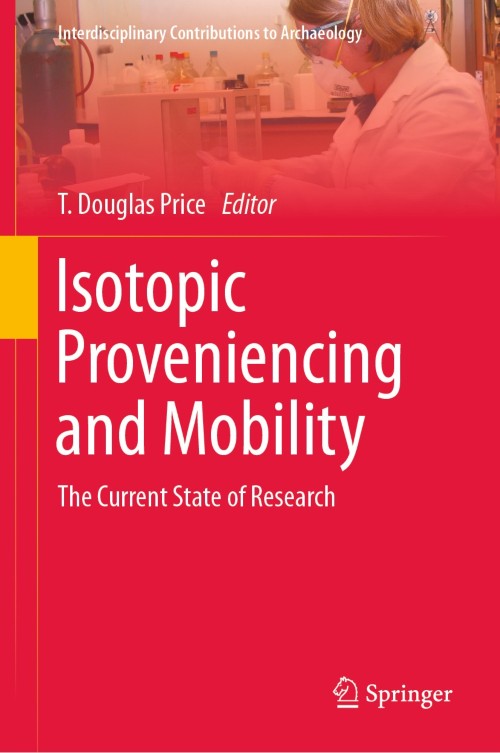
245 10|aIsotopic Proveniencing and Mobility|h[electronic resource] :|bThe Current State of Research /|cedited by T. Douglas Price.
250 |a1st ed. 2023.
264 1|aCham :|bSpringer International Publishing :|bImprint: Springer,|c2023.
300 |aVIII, 273 p. 1 illus.|bonline resource.
336 |atext|btxt|2rdacontent
337 |acomputer|bc|2rdamedia
338 |aonline resource|bcr|2rdacarrier
347 |atext file|bPDF|2rda
490 1 |aInterdisciplinary Contributions to Archaeology,|x2730-6984
505 0 |aPreface -- Chapter 1. An Introduction to isotopic proveniencing (T.D. Price) -- Chapter 2. Isotopic analyses in the Andes: From the macro- to micro-scale (K. Knudson, Christina M. Torres, and William Pestle) -- Chapter 3. Oxygen isotope values in the Maya Region (C. Freiwald) -- Chapter 4. Common ground: investigating land use and community through strontium isotope analysis of Bronze Age cremations from Dunragit, southwest Scotland (R. Schulting, John Pouncett, Christophe Snoeck, Hannah F. James, and Warren Bailie) -- Chapter 5. Traveling up hill and down dale: using isotopic studies of human and animal mobility in Chalcolithic Portugal to investigate intraregional patterns of social and economic relationships in late prehistory (A. Waterman) -- Chapter 6. The transition to agriculture (T.D. Price and Dusan Boriç) -- Chapter 7. Pb isotopes and human mobility: natural, cultural, or diagenetic signal? (G. Kamenov & J. Krigbaum) -- Chapter 8. Sulphur isotope ratios of archaeological human collagen as a mobility indicator (M.P. Richards) -- Chapter 9. Application of Gaussian-Mixture Model clustering for the resolution of multi-isotope fingerprints (A. Göhring, G. Grupe, and P. Kröger) -- Chapter 10. Conclusions and recommendations (T.D. Price) -- Index.
520 |aThis volume provides a state-of-the-art presentation and discussion of procedures, especially what works and what doesn’t — on isotopic proveniencing, learned over the last 30 years. The volume focuses on application, not method, to emphasize to the reader the wide range of questions that can be addressed using isotopic proveniencing. Topics covered include samples, baselines, isoscapes, and place of origin. Isotopic proveniencing has become almost standard procedure in the analysis of archaeological burials as a means of distinguishing locals from foreigners. The combination of isotopic proveniencing and DNA has moved archaeological interest in migration and mobility to the fore, but there is very little synthetic work published for either technology.The field has evolved and new procedures and guidelines have emerged that have not been widely heard and this volume seeks to rectify this. The contributors have been selected from among the leaders in the field, those withactive research and hands-on experience with the technology. This volume is of relevance to archaeologists.
650 0|aArchaeology|xMethodology.
650 0|aArchaeology.
650 14|aArchaeological Methods and Modelling.
650 24|aArchaeology.
700 1 |aPrice, T. Douglas.|eeditor.|4edt|4http://id.loc.gov/vocabulary/relators/edt
773 0 |tSpringer Nature eBook
776 08|iPrinted edition:|z9783031257216
776 08|iPrinted edition:|z9783031257230
776 08|iPrinted edition:|z9783031257247
830 0|aInterdisciplinary Contributions to Archaeology,|x2730-6984
856 40|uhttps://doi.org/10.1007/978-3-031-25722-3
912 |aZDB-2-HTY
912 |aZDB-2-SXH
950 |aHistory (SpringerNature-41172)
950 |aHistory (R0) (SpringerNature-43722)