

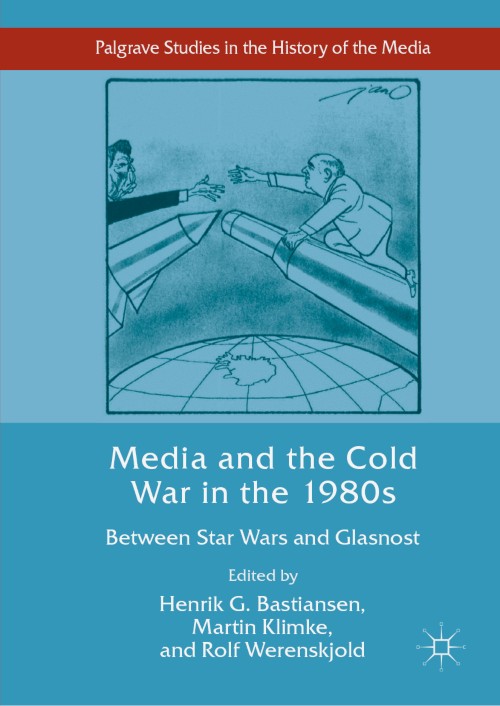
Media and the Cold War in the 1980s [electronic resource] : Between Star Wars and Glasnost / edited by Henrik G. Bastiansen, Martin Klimke, Rolf Werenskjold.
Erişim Adresi
ISBN
9783319983820
Dil Kodu
İngilizce
Yer Numarası
DK/2022
Basım Bildirimi
1st ed. 2019.
Yayın Bilgisi
Cham : Springer International Publishing : Imprint: Palgrave Macmillan, 2019.
Fiziksel Niteleme
XIX, 346 p. 25 illus., 16 illus. in color. online resource.
Dizi
Palgrave Studies in the History of the Media, 2634-6583
İçindekiler Notu
1. Introduction: Mapping the Role of the Media in the Late Cold War: Methodological and Transnational Perspectives -- 2. Selling "Star Wars" in American Mass Media -- 3. Interviewing the Enemy and Other Cold War Players: U.S. Foreign Policy as Seen through Playboy during the Reagan Years -- 4. Going Atmospheric and Elemental: Roger Moore's and Timothy Dalton's James Bond and Cold War Geo-Politics -- 5. Civil Cold War Aviation as Television Drama: The Popular Miniseries Treffpunkt Flughafen (GDR 1986) -- 6. Photojournalism East/West: The Cold War, the Iron Curtain, and the Trade of Photographs -- 7. Irony in Polish Punk of the 1980s as a Form of Contestation -- 8. Mediating Alternative Culture: Two Controversial Exhibitions in Hungary during the 1980s -- 9. The Cold War Reporters: The Norwegian Foreign-News Journalists and Foreign-News Correspondents, 1945–95 -- 10. Orions belte: The Birth of the Norwegian “High-Concept” Movie in the Shadow of the Second Cold War -- 11. Reporting Glasnost: The Changing Soviet News in a Norwegian Daily, 1985–88 -- 12. Revolution as Memory: The “History Boom” on Late Socialist Television -- 13. Power and the Body: Images of the Leaders in Soviet Magazines during the Cold War -- 14. The Iconic Photograph and Its Political Space: The Case of Tiananmen Square, 1989.
Özet, vb.
The Cold War was a media phenomenon. It was a daily cultural political struggle for the hearts and minds of ordinary people—and for government leaders, a struggle to undermine their enemies’ ability to control the domestic public sphere. This collection examines how this struggle played out on screen, radio, and in print from the late 1970s through the early 1990s, a time when breaking news stories such as Ronald Reagan’s “Star Wars” program and Mikhail Gorbachev’s policy of glasnost captured the world’s attention. Ranging from the United States to the Soviet Union and China, these essays cover photojournalism on both sides of the Iron Curtain, Polish punk, Norwegian film, Soviet magazines, and more, concluding with a contribution from Stuart Franklin, one of the creators of the iconic “Tank Man” image during the Tiananmen Square protests. By investigating an array of media actors and networks, as well as narrative and visual frames on a local and transnational level, this volume laysthe groundwork for writing media into the history of the late Cold War.
Konu
World history.
Communication.
Russia __ History.
Europe, Eastern __ History.
Soviet Union __ History.
United States __ History.
Europe, Central __ History.
World History, Global and Transnational History.
Media and Communication.
Russian, Soviet, and East European History.
US History.
History of Germany and Central Europe.
Communication.
Russia __ History.
Europe, Eastern __ History.
Soviet Union __ History.
United States __ History.
Europe, Central __ History.
World History, Global and Transnational History.
Media and Communication.
Russian, Soviet, and East European History.
US History.
History of Germany and Central Europe.
Diğer Yazarlar
Eseri Alıntıla
Referansları kullanmadan önce gözden geçirmeniz ve varsa gerekli düzeltmeleri yapmanız önerilir.
Dijital Kaynak
MARC Görünümü
LEADER 04728nam a22006015i 4500
001 609350
003 TR_AnAIT
005 20250627070213
007 cr nn 008mamaa
008 181108s2019 sz | s |||| 0|eng d
020 |a9783319983820|9978-3-319-98382-0
024 7 |a10.1007/978-3-319-98382-0|2doi
041 |aeng
049 |aTürk Tarih Kurumu Kütüphanesi
050 4|aD17-24.5
072 7|aHBG|2bicssc
072 7|aHIS037000|2bisacsh
072 7|aNHB|2thema
082 04|a909|223
090 |aDK/2022
245 10|aMedia and the Cold War in the 1980s|h[electronic resource] :|bBetween Star Wars and Glasnost /|cedited by Henrik G. Bastiansen, Martin Klimke, Rolf Werenskjold.
250 |a1st ed. 2019.
264 1|aCham :|bSpringer International Publishing :|bImprint: Palgrave Macmillan,|c2019.
300 |aXIX, 346 p. 25 illus., 16 illus. in color.|bonline resource.
336 |atext|btxt|2rdacontent
337 |acomputer|bc|2rdamedia
338 |aonline resource|bcr|2rdacarrier
347 |atext file|bPDF|2rda
490 1 |aPalgrave Studies in the History of the Media,|x2634-6583
505 0 |a1. Introduction: Mapping the Role of the Media in the Late Cold War: Methodological and Transnational Perspectives -- 2. Selling "Star Wars" in American Mass Media -- 3. Interviewing the Enemy and Other Cold War Players: U.S. Foreign Policy as Seen through Playboy during the Reagan Years -- 4. Going Atmospheric and Elemental: Roger Moore's and Timothy Dalton's James Bond and Cold War Geo-Politics -- 5. Civil Cold War Aviation as Television Drama: The Popular Miniseries Treffpunkt Flughafen (GDR 1986) -- 6. Photojournalism East/West: The Cold War, the Iron Curtain, and the Trade of Photographs -- 7. Irony in Polish Punk of the 1980s as a Form of Contestation -- 8. Mediating Alternative Culture: Two Controversial Exhibitions in Hungary during the 1980s -- 9. The Cold War Reporters: The Norwegian Foreign-News Journalists and Foreign-News Correspondents, 1945–95 -- 10. Orions belte: The Birth of the Norwegian “High-Concept” Movie in the Shadow of the Second Cold War -- 11. Reporting Glasnost: The Changing Soviet News in a Norwegian Daily, 1985–88 -- 12. Revolution as Memory: The “History Boom” on Late Socialist Television -- 13. Power and the Body: Images of the Leaders in Soviet Magazines during the Cold War -- 14. The Iconic Photograph and Its Political Space: The Case of Tiananmen Square, 1989.
520 |aThe Cold War was a media phenomenon. It was a daily cultural political struggle for the hearts and minds of ordinary people—and for government leaders, a struggle to undermine their enemies’ ability to control the domestic public sphere. This collection examines how this struggle played out on screen, radio, and in print from the late 1970s through the early 1990s, a time when breaking news stories such as Ronald Reagan’s “Star Wars” program and Mikhail Gorbachev’s policy of glasnost captured the world’s attention. Ranging from the United States to the Soviet Union and China, these essays cover photojournalism on both sides of the Iron Curtain, Polish punk, Norwegian film, Soviet magazines, and more, concluding with a contribution from Stuart Franklin, one of the creators of the iconic “Tank Man” image during the Tiananmen Square protests. By investigating an array of media actors and networks, as well as narrative and visual frames on a local and transnational level, this volume laysthe groundwork for writing media into the history of the late Cold War.
650 0|aWorld history.
650 0|aCommunication.
650 0|aRussia|xHistory.
650 0|aEurope, Eastern|xHistory.
650 0|aSoviet Union|xHistory.
650 0|aUnited States|xHistory.
650 0|aEurope, Central|xHistory.
650 14|aWorld History, Global and Transnational History.
650 24|aMedia and Communication.
650 24|aRussian, Soviet, and East European History.
650 24|aUS History.
650 24|aHistory of Germany and Central Europe.
700 1 |aBastiansen, Henrik G.|eeditor.|4edt|4http://id.loc.gov/vocabulary/relators/edt
700 1 |aKlimke, Martin.|eeditor.|4edt|4http://id.loc.gov/vocabulary/relators/edt
700 1 |aWerenskjold, Rolf.|eeditor.|4edt|4http://id.loc.gov/vocabulary/relators/edt
773 0 |tSpringer Nature eBook
776 08|iPrinted edition:|z9783319983813
776 08|iPrinted edition:|z9783319983837
830 0|aPalgrave Studies in the History of the Media,|x2634-6583
856 40|uhttps://doi.org/10.1007/978-3-319-98382-0
912 |aZDB-2-HTY
912 |aZDB-2-SXH
950 |aHistory (SpringerNature-41172)
950 |aHistory (R0) (SpringerNature-43722)
001 609350
003 TR_AnAIT
005 20250627070213
007 cr nn 008mamaa
008 181108s2019 sz | s |||| 0|eng d
020 |a9783319983820|9978-3-319-98382-0
024 7 |a10.1007/978-3-319-98382-0|2doi
041 |aeng
049 |aTürk Tarih Kurumu Kütüphanesi
050 4|aD17-24.5
072 7|aHBG|2bicssc
072 7|aHIS037000|2bisacsh
072 7|aNHB|2thema
082 04|a909|223
090 |aDK/2022
245 10|aMedia and the Cold War in the 1980s|h[electronic resource] :|bBetween Star Wars and Glasnost /|cedited by Henrik G. Bastiansen, Martin Klimke, Rolf Werenskjold.
250 |a1st ed. 2019.
264 1|aCham :|bSpringer International Publishing :|bImprint: Palgrave Macmillan,|c2019.
300 |aXIX, 346 p. 25 illus., 16 illus. in color.|bonline resource.
336 |atext|btxt|2rdacontent
337 |acomputer|bc|2rdamedia
338 |aonline resource|bcr|2rdacarrier
347 |atext file|bPDF|2rda
490 1 |aPalgrave Studies in the History of the Media,|x2634-6583
505 0 |a1. Introduction: Mapping the Role of the Media in the Late Cold War: Methodological and Transnational Perspectives -- 2. Selling "Star Wars" in American Mass Media -- 3. Interviewing the Enemy and Other Cold War Players: U.S. Foreign Policy as Seen through Playboy during the Reagan Years -- 4. Going Atmospheric and Elemental: Roger Moore's and Timothy Dalton's James Bond and Cold War Geo-Politics -- 5. Civil Cold War Aviation as Television Drama: The Popular Miniseries Treffpunkt Flughafen (GDR 1986) -- 6. Photojournalism East/West: The Cold War, the Iron Curtain, and the Trade of Photographs -- 7. Irony in Polish Punk of the 1980s as a Form of Contestation -- 8. Mediating Alternative Culture: Two Controversial Exhibitions in Hungary during the 1980s -- 9. The Cold War Reporters: The Norwegian Foreign-News Journalists and Foreign-News Correspondents, 1945–95 -- 10. Orions belte: The Birth of the Norwegian “High-Concept” Movie in the Shadow of the Second Cold War -- 11. Reporting Glasnost: The Changing Soviet News in a Norwegian Daily, 1985–88 -- 12. Revolution as Memory: The “History Boom” on Late Socialist Television -- 13. Power and the Body: Images of the Leaders in Soviet Magazines during the Cold War -- 14. The Iconic Photograph and Its Political Space: The Case of Tiananmen Square, 1989.
520 |aThe Cold War was a media phenomenon. It was a daily cultural political struggle for the hearts and minds of ordinary people—and for government leaders, a struggle to undermine their enemies’ ability to control the domestic public sphere. This collection examines how this struggle played out on screen, radio, and in print from the late 1970s through the early 1990s, a time when breaking news stories such as Ronald Reagan’s “Star Wars” program and Mikhail Gorbachev’s policy of glasnost captured the world’s attention. Ranging from the United States to the Soviet Union and China, these essays cover photojournalism on both sides of the Iron Curtain, Polish punk, Norwegian film, Soviet magazines, and more, concluding with a contribution from Stuart Franklin, one of the creators of the iconic “Tank Man” image during the Tiananmen Square protests. By investigating an array of media actors and networks, as well as narrative and visual frames on a local and transnational level, this volume laysthe groundwork for writing media into the history of the late Cold War.
650 0|aWorld history.
650 0|aCommunication.
650 0|aRussia|xHistory.
650 0|aEurope, Eastern|xHistory.
650 0|aSoviet Union|xHistory.
650 0|aUnited States|xHistory.
650 0|aEurope, Central|xHistory.
650 14|aWorld History, Global and Transnational History.
650 24|aMedia and Communication.
650 24|aRussian, Soviet, and East European History.
650 24|aUS History.
650 24|aHistory of Germany and Central Europe.
700 1 |aBastiansen, Henrik G.|eeditor.|4edt|4http://id.loc.gov/vocabulary/relators/edt
700 1 |aKlimke, Martin.|eeditor.|4edt|4http://id.loc.gov/vocabulary/relators/edt
700 1 |aWerenskjold, Rolf.|eeditor.|4edt|4http://id.loc.gov/vocabulary/relators/edt
773 0 |tSpringer Nature eBook
776 08|iPrinted edition:|z9783319983813
776 08|iPrinted edition:|z9783319983837
830 0|aPalgrave Studies in the History of the Media,|x2634-6583
856 40|uhttps://doi.org/10.1007/978-3-319-98382-0
912 |aZDB-2-HTY
912 |aZDB-2-SXH
950 |aHistory (SpringerNature-41172)
950 |aHistory (R0) (SpringerNature-43722)
Materyaller
Depodan talep edilen materyal sadece kütüphane içerisinde kullanılmaktadır.
Materyal dışarıya ödünç verilmemektedir.
Materyal dışarıya ödünç verilmemektedir.
