

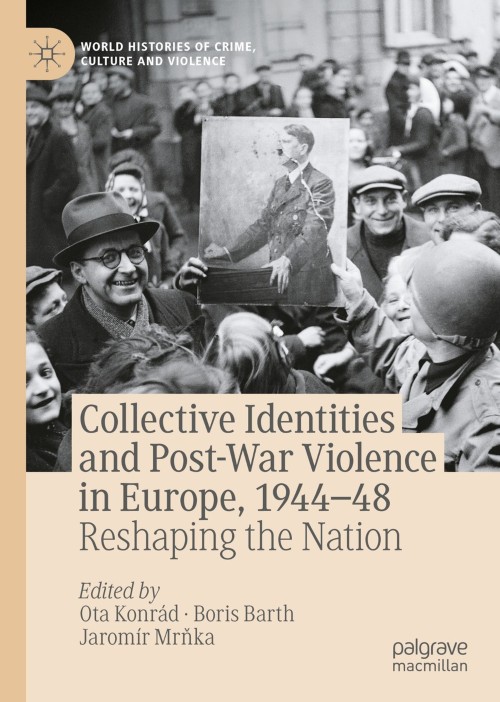
Collective Identities and Post-War Violence in Europe, 1944–48 [electronic resource] : Reshaping the Nation / edited by Ota Konrád, Boris Barth, Jaromír Mrňka.
Erişim Adresi
ISBN
9783030783860
Dil Kodu
İngilizce
Yer Numarası
DK/2035
Basım Bildirimi
1st ed. 2022.
Yayın Bilgisi
Cham : Springer International Publishing : Imprint: Palgrave Macmillan, 2022.
Fiziksel Niteleme
XI, 334 p. online resource.
Dizi
World Histories of Crime, Culture and Violence, 2730-9649
İçindekiler Notu
PART I. RESHAPING THE NATION -- Introduction; Ota Konrád, Boris Barth, Jaromír Mrňka -- The End of the War and the Beginning of the Peace: Where Violence Leaves Off and Reconstruction Begins: Continental Europe, 1944-1947; Norman Naimark -- PART II. JUSTICE -- Redefining National Identities through Justice: A Comparative Analysis of Italy and France; Barbara De Luna and Greta Fedele -- Purges, Patriotism, and Political Violence: The Danish Case, 1944-1945; Henrik Lundtofte -- 'Mentalities of War, Mentalities of Peace': Capital Punishment in the Norwegian ‘Treason Trials’, 1941-1948; Anika Seemann -- PART III. GENDER -- 'German Brats and Tarts': Gender, Sexuality, and Collective Memory in Post-War Norway; Caroline Nilsen -- Gender, Ethnicity, and Multidirectional Violence during the Last Months of German Rule in Lithuania: A Case Study of Local Force Battalions; Justina Smalkyté -- PART IV. NATION AND NATIONALISM -- Assessing National 'Consciousness': The Belarusian Home Guard, 1944-1945; Aleksandra Pomiecko -- Cleansing Greece of the Miasma of its 'Sudeten': Macedonian Slavs as an Unwanted Minority in the Aftermath of the Second World War; Tasos Kostopoulos -- Between Nation and Religion: Czech Protestants and the Transfer of the Sudeten Germans, 1945-1948; Ondřej Matějka -- PART V. CITIZENSHIP -- 'Pure Christians' vs. 'Working Citizens of the Democratic Era': How the Claimants of Jewish Property perceived Citizenship in Hungary; Borbála Klacsmann -- A Glass Half Full or Half Empty? The Postwar Treatment of the German Minority in Denmark; Peter Thaler -- PART VI. CONCLUSION -- Conclusion; Christoph Cornelißen.
Özet, vb.
This book analyses the process of ‘reshaping’ liberated societies in post-1945 Europe. Post-war societies tried to solve three main questions immediately after the dark times of occupation: Who could be considered a patriot and a valuable member of the respective national community? How could relations between men and women be (re-)established? How could the respective society strengthen national cohesion? Violence in rather different forms appeared to be a powerful tool for such a complex reshaping of societies. The chapters are based on present primary research about specific cases and consider the different political, mental, and cultural developments in various nation-states between 1944 and 1948. Examples from Italy, France, Norway, Denmark, Greece, Ukraine, Lithuania, Belarus, Czechoslovakia, and Hungary demonstrate a new comparative and fascinating picture of post-war Europe. This perspective overcomes the notorious East-West dividing line, without covering the manifold differences between individual European countries. Ota Konrád is Associate Professor of Modern History at Charles University in Prague, Czech Republic. He has worked on topics dealing with the history of East-Central Europe in the twentieth century. Recently, he co-edited In the Shadow of the Great War: Physical Violence in East-Central Europe, 1917-1923 (2021). Boris Barth is Professor of Modern and Contemporary History at Charles University in Prague, Czech Republic. His publications include Europa nach dem Großen Krieg. Die Krise der Demokratie in der Zwischenkriegszeit 1918-1938 (2016) and Civilizing Missions in the Twentieth Century (edited with Rolf Hobson, 2020). Jaromír Mrňka is Researcher at the Institute for the Study of Totalitarian Regimes, and Junior Research Fellow at Charles University in Prague, Czech Republic. He has studied the social mechanisms of denunciation, collective violence, and conflict-related acts of sexual violence in the Czech Lands during the Second World War and its aftermath.
Konu
World War, 1939-1945.
Europe __ History __ 1492-.
History, Modern.
History of World War II and the Holocaust.
History of Modern Europe.
Modern History.
Europe __ History __ 1492-.
History, Modern.
History of World War II and the Holocaust.
History of Modern Europe.
Modern History.
Diğer Yazarlar
Eseri Alıntıla
Referansları kullanmadan önce gözden geçirmeniz ve varsa gerekli düzeltmeleri yapmanız önerilir.
Dijital Kaynak
MARC Görünümü
LEADER 05746nam a22005415i 4500
001 609363
003 TR_AnAIT
005 20250627070142
007 cr nn 008mamaa
008 211127s2022 sz | s |||| 0|eng d
020 |a9783030783860|9978-3-030-78386-0
024 7 |a10.1007/978-3-030-78386-0|2doi
041 |aeng
049 |aTürk Tarih Kurumu Kütüphanesi
050 4|aD731-838
072 7|aHBWQ|2bicssc
072 7|aHIS027100|2bisacsh
072 7|aNHWR7|2thema
082 04|a940.53|223
090 |aDK/2035
245 10|aCollective Identities and Post-War Violence in Europe, 1944–48|h[electronic resource] :|bReshaping the Nation /|cedited by Ota Konrád, Boris Barth, Jaromír Mrňka.
250 |a1st ed. 2022.
264 1|aCham :|bSpringer International Publishing :|bImprint: Palgrave Macmillan,|c2022.
300 |aXI, 334 p.|bonline resource.
336 |atext|btxt|2rdacontent
337 |acomputer|bc|2rdamedia
338 |aonline resource|bcr|2rdacarrier
347 |atext file|bPDF|2rda
490 1 |aWorld Histories of Crime, Culture and Violence,|x2730-9649
505 0 |aPART I. RESHAPING THE NATION -- Introduction; Ota Konrád, Boris Barth, Jaromír Mrňka -- The End of the War and the Beginning of the Peace: Where Violence Leaves Off and Reconstruction Begins: Continental Europe, 1944-1947; Norman Naimark -- PART II. JUSTICE -- Redefining National Identities through Justice: A Comparative Analysis of Italy and France; Barbara De Luna and Greta Fedele -- Purges, Patriotism, and Political Violence: The Danish Case, 1944-1945; Henrik Lundtofte -- 'Mentalities of War, Mentalities of Peace': Capital Punishment in the Norwegian ‘Treason Trials’, 1941-1948; Anika Seemann -- PART III. GENDER -- 'German Brats and Tarts': Gender, Sexuality, and Collective Memory in Post-War Norway; Caroline Nilsen -- Gender, Ethnicity, and Multidirectional Violence during the Last Months of German Rule in Lithuania: A Case Study of Local Force Battalions; Justina Smalkyté -- PART IV. NATION AND NATIONALISM -- Assessing National 'Consciousness': The Belarusian Home Guard, 1944-1945; Aleksandra Pomiecko -- Cleansing Greece of the Miasma of its 'Sudeten': Macedonian Slavs as an Unwanted Minority in the Aftermath of the Second World War; Tasos Kostopoulos -- Between Nation and Religion: Czech Protestants and the Transfer of the Sudeten Germans, 1945-1948; Ondřej Matějka -- PART V. CITIZENSHIP -- 'Pure Christians' vs. 'Working Citizens of the Democratic Era': How the Claimants of Jewish Property perceived Citizenship in Hungary; Borbála Klacsmann -- A Glass Half Full or Half Empty? The Postwar Treatment of the German Minority in Denmark; Peter Thaler -- PART VI. CONCLUSION -- Conclusion; Christoph Cornelißen.
520 |aThis book analyses the process of ‘reshaping’ liberated societies in post-1945 Europe. Post-war societies tried to solve three main questions immediately after the dark times of occupation: Who could be considered a patriot and a valuable member of the respective national community? How could relations between men and women be (re-)established? How could the respective society strengthen national cohesion? Violence in rather different forms appeared to be a powerful tool for such a complex reshaping of societies. The chapters are based on present primary research about specific cases and consider the different political, mental, and cultural developments in various nation-states between 1944 and 1948. Examples from Italy, France, Norway, Denmark, Greece, Ukraine, Lithuania, Belarus, Czechoslovakia, and Hungary demonstrate a new comparative and fascinating picture of post-war Europe. This perspective overcomes the notorious East-West dividing line, without covering the manifold differences between individual European countries. Ota Konrád is Associate Professor of Modern History at Charles University in Prague, Czech Republic. He has worked on topics dealing with the history of East-Central Europe in the twentieth century. Recently, he co-edited In the Shadow of the Great War: Physical Violence in East-Central Europe, 1917-1923 (2021). Boris Barth is Professor of Modern and Contemporary History at Charles University in Prague, Czech Republic. His publications include Europa nach dem Großen Krieg. Die Krise der Demokratie in der Zwischenkriegszeit 1918-1938 (2016) and Civilizing Missions in the Twentieth Century (edited with Rolf Hobson, 2020). Jaromír Mrňka is Researcher at the Institute for the Study of Totalitarian Regimes, and Junior Research Fellow at Charles University in Prague, Czech Republic. He has studied the social mechanisms of denunciation, collective violence, and conflict-related acts of sexual violence in the Czech Lands during the Second World War and its aftermath.
650 0|aWorld War, 1939-1945.
650 0|aEurope|xHistory|x1492-.
650 0|aHistory, Modern.
650 14|aHistory of World War II and the Holocaust.
650 24|aHistory of Modern Europe.
650 24|aModern History.
700 1 |aKonrád, Ota.|eeditor.|4edt|4http://id.loc.gov/vocabulary/relators/edt
700 1 |aBarth, Boris.|eeditor.|4edt|4http://id.loc.gov/vocabulary/relators/edt
700 1 |aMrňka, Jaromír.|eeditor.|4edt|4http://id.loc.gov/vocabulary/relators/edt
773 0 |tSpringer Nature eBook
776 08|iPrinted edition:|z9783030783853
776 08|iPrinted edition:|z9783030783877
776 08|iPrinted edition:|z9783030783884
830 0|aWorld Histories of Crime, Culture and Violence,|x2730-9649
856 40|uhttps://doi.org/10.1007/978-3-030-78386-0
912 |aZDB-2-HTY
912 |aZDB-2-SXH
950 |aHistory (SpringerNature-41172)
950 |aHistory (R0) (SpringerNature-43722)
001 609363
003 TR_AnAIT
005 20250627070142
007 cr nn 008mamaa
008 211127s2022 sz | s |||| 0|eng d
020 |a9783030783860|9978-3-030-78386-0
024 7 |a10.1007/978-3-030-78386-0|2doi
041 |aeng
049 |aTürk Tarih Kurumu Kütüphanesi
050 4|aD731-838
072 7|aHBWQ|2bicssc
072 7|aHIS027100|2bisacsh
072 7|aNHWR7|2thema
082 04|a940.53|223
090 |aDK/2035
245 10|aCollective Identities and Post-War Violence in Europe, 1944–48|h[electronic resource] :|bReshaping the Nation /|cedited by Ota Konrád, Boris Barth, Jaromír Mrňka.
250 |a1st ed. 2022.
264 1|aCham :|bSpringer International Publishing :|bImprint: Palgrave Macmillan,|c2022.
300 |aXI, 334 p.|bonline resource.
336 |atext|btxt|2rdacontent
337 |acomputer|bc|2rdamedia
338 |aonline resource|bcr|2rdacarrier
347 |atext file|bPDF|2rda
490 1 |aWorld Histories of Crime, Culture and Violence,|x2730-9649
505 0 |aPART I. RESHAPING THE NATION -- Introduction; Ota Konrád, Boris Barth, Jaromír Mrňka -- The End of the War and the Beginning of the Peace: Where Violence Leaves Off and Reconstruction Begins: Continental Europe, 1944-1947; Norman Naimark -- PART II. JUSTICE -- Redefining National Identities through Justice: A Comparative Analysis of Italy and France; Barbara De Luna and Greta Fedele -- Purges, Patriotism, and Political Violence: The Danish Case, 1944-1945; Henrik Lundtofte -- 'Mentalities of War, Mentalities of Peace': Capital Punishment in the Norwegian ‘Treason Trials’, 1941-1948; Anika Seemann -- PART III. GENDER -- 'German Brats and Tarts': Gender, Sexuality, and Collective Memory in Post-War Norway; Caroline Nilsen -- Gender, Ethnicity, and Multidirectional Violence during the Last Months of German Rule in Lithuania: A Case Study of Local Force Battalions; Justina Smalkyté -- PART IV. NATION AND NATIONALISM -- Assessing National 'Consciousness': The Belarusian Home Guard, 1944-1945; Aleksandra Pomiecko -- Cleansing Greece of the Miasma of its 'Sudeten': Macedonian Slavs as an Unwanted Minority in the Aftermath of the Second World War; Tasos Kostopoulos -- Between Nation and Religion: Czech Protestants and the Transfer of the Sudeten Germans, 1945-1948; Ondřej Matějka -- PART V. CITIZENSHIP -- 'Pure Christians' vs. 'Working Citizens of the Democratic Era': How the Claimants of Jewish Property perceived Citizenship in Hungary; Borbála Klacsmann -- A Glass Half Full or Half Empty? The Postwar Treatment of the German Minority in Denmark; Peter Thaler -- PART VI. CONCLUSION -- Conclusion; Christoph Cornelißen.
520 |aThis book analyses the process of ‘reshaping’ liberated societies in post-1945 Europe. Post-war societies tried to solve three main questions immediately after the dark times of occupation: Who could be considered a patriot and a valuable member of the respective national community? How could relations between men and women be (re-)established? How could the respective society strengthen national cohesion? Violence in rather different forms appeared to be a powerful tool for such a complex reshaping of societies. The chapters are based on present primary research about specific cases and consider the different political, mental, and cultural developments in various nation-states between 1944 and 1948. Examples from Italy, France, Norway, Denmark, Greece, Ukraine, Lithuania, Belarus, Czechoslovakia, and Hungary demonstrate a new comparative and fascinating picture of post-war Europe. This perspective overcomes the notorious East-West dividing line, without covering the manifold differences between individual European countries. Ota Konrád is Associate Professor of Modern History at Charles University in Prague, Czech Republic. He has worked on topics dealing with the history of East-Central Europe in the twentieth century. Recently, he co-edited In the Shadow of the Great War: Physical Violence in East-Central Europe, 1917-1923 (2021). Boris Barth is Professor of Modern and Contemporary History at Charles University in Prague, Czech Republic. His publications include Europa nach dem Großen Krieg. Die Krise der Demokratie in der Zwischenkriegszeit 1918-1938 (2016) and Civilizing Missions in the Twentieth Century (edited with Rolf Hobson, 2020). Jaromír Mrňka is Researcher at the Institute for the Study of Totalitarian Regimes, and Junior Research Fellow at Charles University in Prague, Czech Republic. He has studied the social mechanisms of denunciation, collective violence, and conflict-related acts of sexual violence in the Czech Lands during the Second World War and its aftermath.
650 0|aWorld War, 1939-1945.
650 0|aEurope|xHistory|x1492-.
650 0|aHistory, Modern.
650 14|aHistory of World War II and the Holocaust.
650 24|aHistory of Modern Europe.
650 24|aModern History.
700 1 |aKonrád, Ota.|eeditor.|4edt|4http://id.loc.gov/vocabulary/relators/edt
700 1 |aBarth, Boris.|eeditor.|4edt|4http://id.loc.gov/vocabulary/relators/edt
700 1 |aMrňka, Jaromír.|eeditor.|4edt|4http://id.loc.gov/vocabulary/relators/edt
773 0 |tSpringer Nature eBook
776 08|iPrinted edition:|z9783030783853
776 08|iPrinted edition:|z9783030783877
776 08|iPrinted edition:|z9783030783884
830 0|aWorld Histories of Crime, Culture and Violence,|x2730-9649
856 40|uhttps://doi.org/10.1007/978-3-030-78386-0
912 |aZDB-2-HTY
912 |aZDB-2-SXH
950 |aHistory (SpringerNature-41172)
950 |aHistory (R0) (SpringerNature-43722)
Materyaller
Depodan talep edilen materyal sadece kütüphane içerisinde kullanılmaktadır.
Materyal dışarıya ödünç verilmemektedir.
Materyal dışarıya ödünç verilmemektedir.
