LEADER 03801nam a22005055i 4500
001 609422
003 TR_AnAIT
005 20250627065943
007 cr nn 008mamaa
008 230531s2023 gw | s |||| 0|eng d
020 |a9783658392376|9978-3-658-39237-6
024 7 |a10.1007/978-3-658-39237-6|2doi
041 |aeng
049 |aTürk Tarih Kurumu Kütüphanesi
050 4|aD1-2027
072 7|aHB|2bicssc
072 7|aHBAH|2bicssc
072 7|aHIS000000|2bisacsh
072 7|aNH|2thema
072 7|aNHAH|2thema
082 04|a900|223
090 |aDK/2094
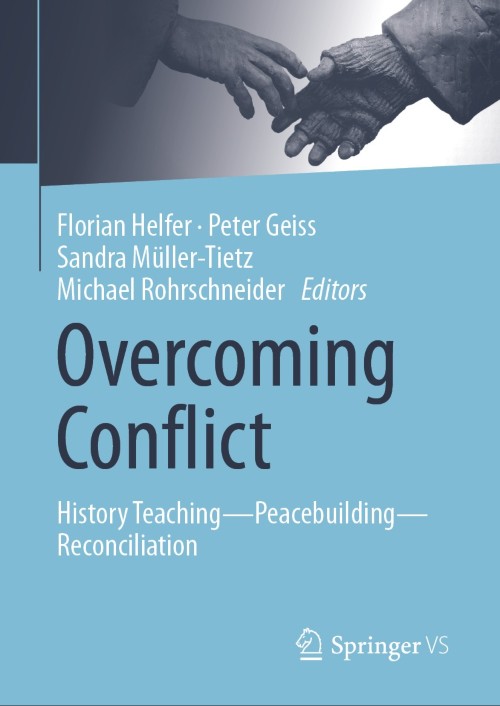
245 10|aOvercoming Conflict|h[electronic resource] :|bHistory Teaching—Peacebuilding—Reconciliation /|cedited by Florian Helfer, Peter Geiss, Sandra Müller-Tietz, Michael Rohrschneider.
250 |a1st ed. 2023.
264 1|aWiesbaden :|bSpringer Fachmedien Wiesbaden :|bImprint: Springer VS,|c2023.
300 |aXI, 286 p. 8 illus., 4 illus. in color.|bonline resource.
336 |atext|btxt|2rdacontent
337 |acomputer|bc|2rdamedia
338 |aonline resource|bcr|2rdacarrier
347 |atext file|bPDF|2rda
505 0 |aForeword -- Introduction: Understanding and overcoming conflict -- I Peacebuilding and reconciliation in the twentieth century -- II Peacebuilding in history teaching today -- III Learning from history? Comparative perspectives -- IV Peacebuilding in the digital realm.
520 |aPeacebuilding and reconciliation between groups and entire nations that share a violent past are among the toughest, yet most important, challenges for modern societies. Opposing perspectives, disagreements about the interpretation of historical events or even entirely different narratives too often impede processes of rapprochement. How can teaching history contribute to overcoming the demarcation lines of such narratives and resolving historical conflicts that are passed on from generation to generation or renewed, amplified and exploited for present political purposes? This volume comprises twelve case studies—from Central and Eastern Europe to South Africa, from the Middle East to East Asia—exploring stories about successes and failures in the never-ending struggle for peaceful coexistence. All of them ultimately reflect the fundamental question of our discipline: Can we learn from history? The Editors Florian Helfer is a Doctoral Research Assistant at the Department of History at the University of Bonn. He teaches and researches History Didactics in the eponymous section of the Department. Peter Geiss is Professor of History Didactics at the Department of History at the University of Bonn. Sandra Müller-Tietz is a Doctoral Research Assistant at the Department of History at the University of Bonn. She teaches and researches History Didactics in the eponymous section of the Department. Michael Rohrschneider is Professor of Early Modern History and Rhenish Regional History at the Department of History and Head of the Centre for Historical Peace Studies at the University of Bonn.
650 0|aHistory.
650 14|aHistory.
700 1 |aHelfer, Florian.|eeditor.|4edt|4http://id.loc.gov/vocabulary/relators/edt
700 1 |aGeiss, Peter.|eeditor.|4edt|4http://id.loc.gov/vocabulary/relators/edt
700 1 |aMüller-Tietz, Sandra.|eeditor.|4edt|4http://id.loc.gov/vocabulary/relators/edt
700 1 |aRohrschneider, Michael.|eeditor.|4edt|4http://id.loc.gov/vocabulary/relators/edt
773 0 |tSpringer Nature eBook
776 08|iPrinted edition:|z9783658392369
776 08|iPrinted edition:|z9783658392383
776 08|iPrinted edition:|z9783658392390
856 40|uhttps://doi.org/10.1007/978-3-658-39237-6
912 |aZDB-2-HTY
912 |aZDB-2-SXH
950 |aHistory (SpringerNature-41172)
950 |aHistory (R0) (SpringerNature-43722)