

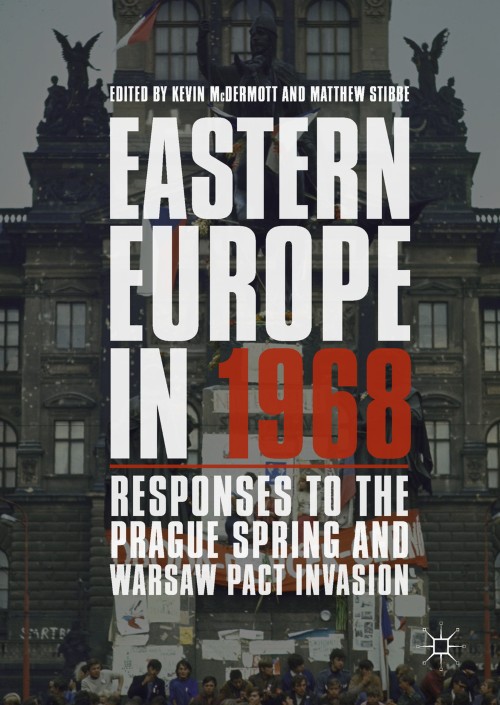
Eastern Europe in 1968 [electronic resource] : Responses to the Prague Spring and Warsaw Pact Invasion / edited by Kevin McDermott, Matthew Stibbe.
Erişim Adresi
ISBN
9783319770697
Dil Kodu
İngilizce
Yer Numarası
DK/2157
Basım Bildirimi
1st ed. 2018.
Yayın Bilgisi
Cham : Springer International Publishing : Imprint: Palgrave Macmillan, 2018.
Fiziksel Niteleme
XXIII, 311 p. online resource.
İçindekiler Notu
1. The Prague Spring and Warsaw Pact Invasion Through the Soviet and East European Lens; Kevin McDermott and Matthew Stibbe -- 2. For a Civic Socialism and the Rule of Law: The Interplay of Jurisprudence, Public Opinion and Dissent in Czechoslovakia, 1960s-1980s; Kieran Williams and James Krapfl -- 3. The 'Anti-Prague Spring': Neo-Stalinist and Ultra-Leftist Extremism in Czechoslovakia, 1968-70; Kevin McDermott and Vítězslav Sommer -- 4. The Impact of the Prague Spring on the USSR; Zbigniew Wojnowski -- 5.Ideological Offensive: The East German Leadership, the Prague Spring and the Warsaw Pact Invasion of August 1968; Matthew Stibbe -- 6. 'To Hell with Sovereignty!': Poland and the Prague Spring; Tony Kemp-Welch -- 7. Hungary 1968: Reform and the Challenge of the Prague Spring; Csaba Békés -- 8. 1968: A Bulgarian Perspective; Jordan Baev -- 9. Ceauşescu's Finest Hour? Memorialising Romanian Responses to the Warsaw Pact Invasion of Czechoslovakia; Calin Goina -- 10. The 'June Events': The 1968 Student Protests in Yugoslavia; Kenneth Morrison -- 11. 1968: The Prague Spring and the Albanian 'Castle'; Ana Lalaj -- 12. Echoes of the Prague Spring in the Soviet Baltic Republics; Irēna Saleniece and Iveta Šķiņķe -- 13. 'Down with Revisionism and Irredentism': The Impact of the Prague Spring on Soviet Moldavia; Igor Caşu -- Index.
Özet, vb.
This collection of thirteen essays examines reactions in Eastern Europe to the Prague Spring and Warsaw Pact invasion of Czechoslovakia in 1968. Countries covered include the Soviet Union and specific Soviet republics (Ukraine, Moldavia, the Baltic States), together with two chapters on Czechoslovakia and one each on East Germany, Poland, Hungary, Bulgaria, Romania, Yugoslavia and Albania. The individual contributions explain why most of these communist regimes opposed Alexander Dubček’s reforms and supported the Soviet-led military intervention in August 1968, and why some stood apart. They also explore public reactions in Eastern Europe to the events of 1968, including instances of popular opposition to the crushing of the Prague Spring, expressions of loyalty to Soviet-style socialism, and cases of indifference or uncertainty. Among the many complex legacies of the East European ‘1968’ was the development of new ways of thinking about regional identity, state borders, de-Stalinisation and the burdens of the past. .
Konu
Russia __ History.
Europe, Eastern __ History.
Soviet Union __ History.
Europe __ History __ 1492-.
World politics.
World War, 1939-1945.
History, Modern.
Russian, Soviet, and East European History.
History of Modern Europe.
Political History.
History of World War II and the Holocaust.
Modern History.
Europe, Eastern __ History.
Soviet Union __ History.
Europe __ History __ 1492-.
World politics.
World War, 1939-1945.
History, Modern.
Russian, Soviet, and East European History.
History of Modern Europe.
Political History.
History of World War II and the Holocaust.
Modern History.
Diğer Yazarlar
Eseri Alıntıla
Referansları kullanmadan önce gözden geçirmeniz ve varsa gerekli düzeltmeleri yapmanız önerilir.
Dijital Kaynak
MARC Görünümü
LEADER 04479nam a22005895i 4500
001 609485
003 TR_AnAIT
005 20250627065735
007 cr nn 008mamaa
008 180529s2018 sz | s |||| 0|eng d
020 |a9783319770697|9978-3-319-77069-7
024 7 |a10.1007/978-3-319-77069-7|2doi
041 |aeng
049 |aTürk Tarih Kurumu Kütüphanesi
050 4|aDK1-949.5
050 4|aDJK1-77
072 7|aHBJ|2bicssc
072 7|aHIS032000|2bisacsh
072 7|aNHQ|2thema
082 04|a947|223
090 |aDK/2157
245 10|aEastern Europe in 1968|h[electronic resource] :|bResponses to the Prague Spring and Warsaw Pact Invasion /|cedited by Kevin McDermott, Matthew Stibbe.
250 |a1st ed. 2018.
264 1|aCham :|bSpringer International Publishing :|bImprint: Palgrave Macmillan,|c2018.
300 |aXXIII, 311 p.|bonline resource.
336 |atext|btxt|2rdacontent
337 |acomputer|bc|2rdamedia
338 |aonline resource|bcr|2rdacarrier
347 |atext file|bPDF|2rda
505 0 |a1. The Prague Spring and Warsaw Pact Invasion Through the Soviet and East European Lens; Kevin McDermott and Matthew Stibbe -- 2. For a Civic Socialism and the Rule of Law: The Interplay of Jurisprudence, Public Opinion and Dissent in Czechoslovakia, 1960s-1980s; Kieran Williams and James Krapfl -- 3. The 'Anti-Prague Spring': Neo-Stalinist and Ultra-Leftist Extremism in Czechoslovakia, 1968-70; Kevin McDermott and Vítězslav Sommer -- 4. The Impact of the Prague Spring on the USSR; Zbigniew Wojnowski -- 5.Ideological Offensive: The East German Leadership, the Prague Spring and the Warsaw Pact Invasion of August 1968; Matthew Stibbe -- 6. 'To Hell with Sovereignty!': Poland and the Prague Spring; Tony Kemp-Welch -- 7. Hungary 1968: Reform and the Challenge of the Prague Spring; Csaba Békés -- 8. 1968: A Bulgarian Perspective; Jordan Baev -- 9. Ceauşescu's Finest Hour? Memorialising Romanian Responses to the Warsaw Pact Invasion of Czechoslovakia; Calin Goina -- 10. The 'June Events': The 1968 Student Protests in Yugoslavia; Kenneth Morrison -- 11. 1968: The Prague Spring and the Albanian 'Castle'; Ana Lalaj -- 12. Echoes of the Prague Spring in the Soviet Baltic Republics; Irēna Saleniece and Iveta Šķiņķe -- 13. 'Down with Revisionism and Irredentism': The Impact of the Prague Spring on Soviet Moldavia; Igor Caşu -- Index.
520 |aThis collection of thirteen essays examines reactions in Eastern Europe to the Prague Spring and Warsaw Pact invasion of Czechoslovakia in 1968. Countries covered include the Soviet Union and specific Soviet republics (Ukraine, Moldavia, the Baltic States), together with two chapters on Czechoslovakia and one each on East Germany, Poland, Hungary, Bulgaria, Romania, Yugoslavia and Albania. The individual contributions explain why most of these communist regimes opposed Alexander Dubček’s reforms and supported the Soviet-led military intervention in August 1968, and why some stood apart. They also explore public reactions in Eastern Europe to the events of 1968, including instances of popular opposition to the crushing of the Prague Spring, expressions of loyalty to Soviet-style socialism, and cases of indifference or uncertainty. Among the many complex legacies of the East European ‘1968’ was the development of new ways of thinking about regional identity, state borders, de-Stalinisation and the burdens of the past. .
650 0|aRussia|xHistory.
650 0|aEurope, Eastern|xHistory.
650 0|aSoviet Union|xHistory.
650 0|aEurope|xHistory|x1492-.
650 0|aWorld politics.
650 0|aWorld War, 1939-1945.
650 0|aHistory, Modern.
650 14|aRussian, Soviet, and East European History.
650 24|aHistory of Modern Europe.
650 24|aPolitical History.
650 24|aHistory of World War II and the Holocaust.
650 24|aModern History.
700 1 |aMcDermott, Kevin.|eeditor.|4edt|4http://id.loc.gov/vocabulary/relators/edt
700 1 |aStibbe, Matthew.|eeditor.|4edt|4http://id.loc.gov/vocabulary/relators/edt
773 0 |tSpringer Nature eBook
776 08|iPrinted edition:|z9783319770680
776 08|iPrinted edition:|z9783319770703
776 08|iPrinted edition:|z9783030083618
856 40|uhttps://doi.org/10.1007/978-3-319-77069-7
912 |aZDB-2-HTY
912 |aZDB-2-SXH
950 |aHistory (SpringerNature-41172)
950 |aHistory (R0) (SpringerNature-43722)
001 609485
003 TR_AnAIT
005 20250627065735
007 cr nn 008mamaa
008 180529s2018 sz | s |||| 0|eng d
020 |a9783319770697|9978-3-319-77069-7
024 7 |a10.1007/978-3-319-77069-7|2doi
041 |aeng
049 |aTürk Tarih Kurumu Kütüphanesi
050 4|aDK1-949.5
050 4|aDJK1-77
072 7|aHBJ|2bicssc
072 7|aHIS032000|2bisacsh
072 7|aNHQ|2thema
082 04|a947|223
090 |aDK/2157
245 10|aEastern Europe in 1968|h[electronic resource] :|bResponses to the Prague Spring and Warsaw Pact Invasion /|cedited by Kevin McDermott, Matthew Stibbe.
250 |a1st ed. 2018.
264 1|aCham :|bSpringer International Publishing :|bImprint: Palgrave Macmillan,|c2018.
300 |aXXIII, 311 p.|bonline resource.
336 |atext|btxt|2rdacontent
337 |acomputer|bc|2rdamedia
338 |aonline resource|bcr|2rdacarrier
347 |atext file|bPDF|2rda
505 0 |a1. The Prague Spring and Warsaw Pact Invasion Through the Soviet and East European Lens; Kevin McDermott and Matthew Stibbe -- 2. For a Civic Socialism and the Rule of Law: The Interplay of Jurisprudence, Public Opinion and Dissent in Czechoslovakia, 1960s-1980s; Kieran Williams and James Krapfl -- 3. The 'Anti-Prague Spring': Neo-Stalinist and Ultra-Leftist Extremism in Czechoslovakia, 1968-70; Kevin McDermott and Vítězslav Sommer -- 4. The Impact of the Prague Spring on the USSR; Zbigniew Wojnowski -- 5.Ideological Offensive: The East German Leadership, the Prague Spring and the Warsaw Pact Invasion of August 1968; Matthew Stibbe -- 6. 'To Hell with Sovereignty!': Poland and the Prague Spring; Tony Kemp-Welch -- 7. Hungary 1968: Reform and the Challenge of the Prague Spring; Csaba Békés -- 8. 1968: A Bulgarian Perspective; Jordan Baev -- 9. Ceauşescu's Finest Hour? Memorialising Romanian Responses to the Warsaw Pact Invasion of Czechoslovakia; Calin Goina -- 10. The 'June Events': The 1968 Student Protests in Yugoslavia; Kenneth Morrison -- 11. 1968: The Prague Spring and the Albanian 'Castle'; Ana Lalaj -- 12. Echoes of the Prague Spring in the Soviet Baltic Republics; Irēna Saleniece and Iveta Šķiņķe -- 13. 'Down with Revisionism and Irredentism': The Impact of the Prague Spring on Soviet Moldavia; Igor Caşu -- Index.
520 |aThis collection of thirteen essays examines reactions in Eastern Europe to the Prague Spring and Warsaw Pact invasion of Czechoslovakia in 1968. Countries covered include the Soviet Union and specific Soviet republics (Ukraine, Moldavia, the Baltic States), together with two chapters on Czechoslovakia and one each on East Germany, Poland, Hungary, Bulgaria, Romania, Yugoslavia and Albania. The individual contributions explain why most of these communist regimes opposed Alexander Dubček’s reforms and supported the Soviet-led military intervention in August 1968, and why some stood apart. They also explore public reactions in Eastern Europe to the events of 1968, including instances of popular opposition to the crushing of the Prague Spring, expressions of loyalty to Soviet-style socialism, and cases of indifference or uncertainty. Among the many complex legacies of the East European ‘1968’ was the development of new ways of thinking about regional identity, state borders, de-Stalinisation and the burdens of the past. .
650 0|aRussia|xHistory.
650 0|aEurope, Eastern|xHistory.
650 0|aSoviet Union|xHistory.
650 0|aEurope|xHistory|x1492-.
650 0|aWorld politics.
650 0|aWorld War, 1939-1945.
650 0|aHistory, Modern.
650 14|aRussian, Soviet, and East European History.
650 24|aHistory of Modern Europe.
650 24|aPolitical History.
650 24|aHistory of World War II and the Holocaust.
650 24|aModern History.
700 1 |aMcDermott, Kevin.|eeditor.|4edt|4http://id.loc.gov/vocabulary/relators/edt
700 1 |aStibbe, Matthew.|eeditor.|4edt|4http://id.loc.gov/vocabulary/relators/edt
773 0 |tSpringer Nature eBook
776 08|iPrinted edition:|z9783319770680
776 08|iPrinted edition:|z9783319770703
776 08|iPrinted edition:|z9783030083618
856 40|uhttps://doi.org/10.1007/978-3-319-77069-7
912 |aZDB-2-HTY
912 |aZDB-2-SXH
950 |aHistory (SpringerNature-41172)
950 |aHistory (R0) (SpringerNature-43722)
Materyaller
Depodan talep edilen materyal sadece kütüphane içerisinde kullanılmaktadır.
Materyal dışarıya ödünç verilmemektedir.
Materyal dışarıya ödünç verilmemektedir.
