

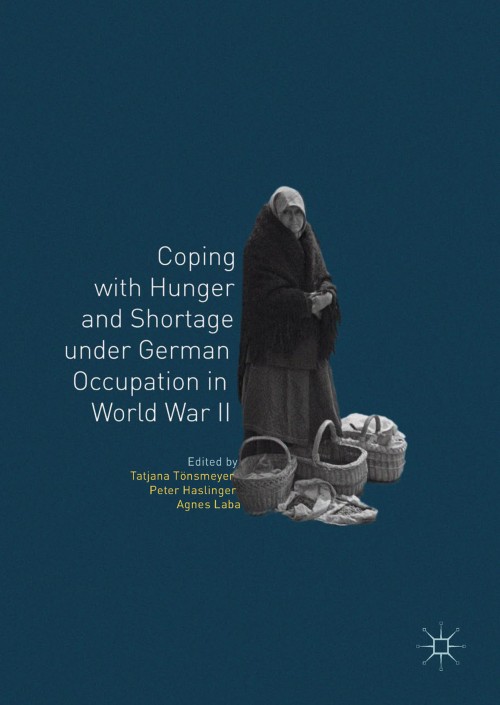
Coping with Hunger and Shortage under German Occupation in World War II [electronic resource] / edited by Tatjana Tönsmeyer, Peter Haslinger, Agnes Laba.
Erişim Adresi
ISBN
9783319774671
Dil Kodu
İngilizce
Yer Numarası
DK/2168
Basım Bildirimi
1st ed. 2018.
Yayın Bilgisi
Cham : Springer International Publishing : Imprint: Palgrave Macmillan, 2018.
Fiziksel Niteleme
XIX, 319 p. 4 illus. online resource.
İçindekiler Notu
Introduction: Supply Situations: Nazi Policies of Exploitation and Economies of Shortage of Occupied Societies during World War II; Tatjana Tönsmeyer -- Part I: Economies of Scarcity and “Ersatz” Site -- Black market in the General Government 1939-1945: Survival strategy or (un)official economy?; Jerzy Kochanowski -- Economies of Scarcity in Belarusian Villages During the Second World War. How New Findings from Oral History Projects put a Perpetrator Centered Historiography in Perspective; Tatsiana Kasataya and Aliaksandr Smalianchuk -- Supplies under pressure. Survival in a fully rationed society: Experiences, cases and innovation in rural and urban regions in occupied Norway; Guri Hjeltnes -- “The Black market is a crime against community”: the failure of the Vichy Government to create an egalitarian distribution and the growth of the black market in France during the German Occupation (1940-1944); Fabrice Grenard -- The black market in occupied Italy and the approach of Italian and German authorities: 1943 – 45; Alessandro Salvador and Jacopo Calussi -- Bones of Contention: The Nazi Recycling Project in Germany and France during the Second World War; Heike Weber and Chad Denton -- Part II: Coping Strategies and Creating Privileges -- Between employer and self-organisation: Belgian workers and miners coping with food shortages under German occupation (1940-44); Dirk Luyten -- “Dem tschechischen Arbeiter das Fressen geben”. Factory canteens in the “Protectorate of Bohemia and Moravia”; Jaromír Balcar -- “With the hope of a piece of sausage or a mug of beer” – Writing a History of Survival Sex in Occupied Europe; Maren Röger -- Part III: Vulnerabilities: At the Bottom of the Supply Pyramid -- Famine in Occupied Greece. On the Particular Role of the Elderly and the Infirm in a Starving Society; Violetta Hionidou -- Food, Money and Barter in the Lvov Ghetto, Eastern Galicia; Natalia Aleksiun -- The North Caucasus and German Exploitation Policies in World War II: Everyday Life Experience of Children during the Occupation; Irina Rebrova and Elena Strekalova -- ‘…have not received any deliveries of potatoes for quite some time…’. Food supply and acquisition in the ghettos of Vilnius and Kaunas; Joachim Tauber -- Fighting Vulnerability: Child-feeding Initiatives during the Dutch Hunger Winter; Ingrid de Zwarte -- Index .
Özet, vb.
This volume demonstrates how German expansion in the Second World War II led to shortages, of food and other necessities including medicine, for the occupied populations, causing many to die from severe hunger or starvation. While the various chapters look at a range of topics, the main focus is on the experiences of ordinary people under occupation; their everyday life, and how this quickly became dominated by the search for supplies and different strategies to fight scarcity. The book discusses various such strategies for surviving increasingly catastrophic circumstances, ranging from how people dealt with rationing systems, to the use of substitute products and recycling, barter, black-marketeering and smuggling, and even survival prostitution. In addressing examples from Norway to Greece and from France to Russia, this volume offers the first pan-European perspective on the history of shortage, malnutrition and hunger resulting from the war, occupation, and aggressive German exploitation policies. .
Konu
World War, 1939-1945.
Europe __ History __ 1492-.
Europe, Central __ History.
Military history.
Social history.
History of World War II and the Holocaust.
History of Modern Europe.
History of Germany and Central Europe.
Military History.
Social History.
Europe __ History __ 1492-.
Europe, Central __ History.
Military history.
Social history.
History of World War II and the Holocaust.
History of Modern Europe.
History of Germany and Central Europe.
Military History.
Social History.
Diğer Yazarlar
Eseri Alıntıla
Referansları kullanmadan önce gözden geçirmeniz ve varsa gerekli düzeltmeleri yapmanız önerilir.
Dijital Kaynak
MARC Görünümü
LEADER 05501nam a22005655i 4500
001 609496
003 TR_AnAIT
005 20250627065714
007 cr nn 008mamaa
008 180622s2018 sz | s |||| 0|eng d
020 |a9783319774671|9978-3-319-77467-1
024 7 |a10.1007/978-3-319-77467-1|2doi
041 |aeng
049 |aTürk Tarih Kurumu Kütüphanesi
050 4|aD731-838
072 7|aHBWQ|2bicssc
072 7|aHIS027100|2bisacsh
072 7|aNHWR7|2thema
082 04|a940.53|223
090 |aDK/2168
245 10|aCoping with Hunger and Shortage under German Occupation in World War II|h[electronic resource] /|cedited by Tatjana Tönsmeyer, Peter Haslinger, Agnes Laba.
250 |a1st ed. 2018.
264 1|aCham :|bSpringer International Publishing :|bImprint: Palgrave Macmillan,|c2018.
300 |aXIX, 319 p. 4 illus.|bonline resource.
336 |atext|btxt|2rdacontent
337 |acomputer|bc|2rdamedia
338 |aonline resource|bcr|2rdacarrier
347 |atext file|bPDF|2rda
505 0 |aIntroduction: Supply Situations: Nazi Policies of Exploitation and Economies of Shortage of Occupied Societies during World War II; Tatjana Tönsmeyer -- Part I: Economies of Scarcity and “Ersatz” Site -- Black market in the General Government 1939-1945: Survival strategy or (un)official economy?; Jerzy Kochanowski -- Economies of Scarcity in Belarusian Villages During the Second World War. How New Findings from Oral History Projects put a Perpetrator Centered Historiography in Perspective; Tatsiana Kasataya and Aliaksandr Smalianchuk -- Supplies under pressure. Survival in a fully rationed society: Experiences, cases and innovation in rural and urban regions in occupied Norway; Guri Hjeltnes -- “The Black market is a crime against community”: the failure of the Vichy Government to create an egalitarian distribution and the growth of the black market in France during the German Occupation (1940-1944); Fabrice Grenard -- The black market in occupied Italy and the approach of Italian and German authorities: 1943 – 45; Alessandro Salvador and Jacopo Calussi -- Bones of Contention: The Nazi Recycling Project in Germany and France during the Second World War; Heike Weber and Chad Denton -- Part II: Coping Strategies and Creating Privileges -- Between employer and self-organisation: Belgian workers and miners coping with food shortages under German occupation (1940-44); Dirk Luyten -- “Dem tschechischen Arbeiter das Fressen geben”. Factory canteens in the “Protectorate of Bohemia and Moravia”; Jaromír Balcar -- “With the hope of a piece of sausage or a mug of beer” – Writing a History of Survival Sex in Occupied Europe; Maren Röger -- Part III: Vulnerabilities: At the Bottom of the Supply Pyramid -- Famine in Occupied Greece. On the Particular Role of the Elderly and the Infirm in a Starving Society; Violetta Hionidou -- Food, Money and Barter in the Lvov Ghetto, Eastern Galicia; Natalia Aleksiun -- The North Caucasus and German Exploitation Policies in World War II: Everyday Life Experience of Children during the Occupation; Irina Rebrova and Elena Strekalova -- ‘…have not received any deliveries of potatoes for quite some time…’. Food supply and acquisition in the ghettos of Vilnius and Kaunas; Joachim Tauber -- Fighting Vulnerability: Child-feeding Initiatives during the Dutch Hunger Winter; Ingrid de Zwarte -- Index .
520 |aThis volume demonstrates how German expansion in the Second World War II led to shortages, of food and other necessities including medicine, for the occupied populations, causing many to die from severe hunger or starvation. While the various chapters look at a range of topics, the main focus is on the experiences of ordinary people under occupation; their everyday life, and how this quickly became dominated by the search for supplies and different strategies to fight scarcity. The book discusses various such strategies for surviving increasingly catastrophic circumstances, ranging from how people dealt with rationing systems, to the use of substitute products and recycling, barter, black-marketeering and smuggling, and even survival prostitution. In addressing examples from Norway to Greece and from France to Russia, this volume offers the first pan-European perspective on the history of shortage, malnutrition and hunger resulting from the war, occupation, and aggressive German exploitation policies. .
650 0|aWorld War, 1939-1945.
650 0|aEurope|xHistory|x1492-.
650 0|aEurope, Central|xHistory.
650 0|aMilitary history.
650 0|aSocial history.
650 14|aHistory of World War II and the Holocaust.
650 24|aHistory of Modern Europe.
650 24|aHistory of Germany and Central Europe.
650 24|aMilitary History.
650 24|aSocial History.
700 1 |aTönsmeyer, Tatjana.|eeditor.|4edt|4http://id.loc.gov/vocabulary/relators/edt
700 1 |aHaslinger, Peter.|eeditor.|4edt|4http://id.loc.gov/vocabulary/relators/edt
700 1 |aLaba, Agnes.|eeditor.|4edt|4http://id.loc.gov/vocabulary/relators/edt
773 0 |tSpringer Nature eBook
776 08|iPrinted edition:|z9783319774664
776 08|iPrinted edition:|z9783319774688
776 08|iPrinted edition:|z9783030084622
856 40|uhttps://doi.org/10.1007/978-3-319-77467-1
912 |aZDB-2-HTY
912 |aZDB-2-SXH
950 |aHistory (SpringerNature-41172)
950 |aHistory (R0) (SpringerNature-43722)
001 609496
003 TR_AnAIT
005 20250627065714
007 cr nn 008mamaa
008 180622s2018 sz | s |||| 0|eng d
020 |a9783319774671|9978-3-319-77467-1
024 7 |a10.1007/978-3-319-77467-1|2doi
041 |aeng
049 |aTürk Tarih Kurumu Kütüphanesi
050 4|aD731-838
072 7|aHBWQ|2bicssc
072 7|aHIS027100|2bisacsh
072 7|aNHWR7|2thema
082 04|a940.53|223
090 |aDK/2168
245 10|aCoping with Hunger and Shortage under German Occupation in World War II|h[electronic resource] /|cedited by Tatjana Tönsmeyer, Peter Haslinger, Agnes Laba.
250 |a1st ed. 2018.
264 1|aCham :|bSpringer International Publishing :|bImprint: Palgrave Macmillan,|c2018.
300 |aXIX, 319 p. 4 illus.|bonline resource.
336 |atext|btxt|2rdacontent
337 |acomputer|bc|2rdamedia
338 |aonline resource|bcr|2rdacarrier
347 |atext file|bPDF|2rda
505 0 |aIntroduction: Supply Situations: Nazi Policies of Exploitation and Economies of Shortage of Occupied Societies during World War II; Tatjana Tönsmeyer -- Part I: Economies of Scarcity and “Ersatz” Site -- Black market in the General Government 1939-1945: Survival strategy or (un)official economy?; Jerzy Kochanowski -- Economies of Scarcity in Belarusian Villages During the Second World War. How New Findings from Oral History Projects put a Perpetrator Centered Historiography in Perspective; Tatsiana Kasataya and Aliaksandr Smalianchuk -- Supplies under pressure. Survival in a fully rationed society: Experiences, cases and innovation in rural and urban regions in occupied Norway; Guri Hjeltnes -- “The Black market is a crime against community”: the failure of the Vichy Government to create an egalitarian distribution and the growth of the black market in France during the German Occupation (1940-1944); Fabrice Grenard -- The black market in occupied Italy and the approach of Italian and German authorities: 1943 – 45; Alessandro Salvador and Jacopo Calussi -- Bones of Contention: The Nazi Recycling Project in Germany and France during the Second World War; Heike Weber and Chad Denton -- Part II: Coping Strategies and Creating Privileges -- Between employer and self-organisation: Belgian workers and miners coping with food shortages under German occupation (1940-44); Dirk Luyten -- “Dem tschechischen Arbeiter das Fressen geben”. Factory canteens in the “Protectorate of Bohemia and Moravia”; Jaromír Balcar -- “With the hope of a piece of sausage or a mug of beer” – Writing a History of Survival Sex in Occupied Europe; Maren Röger -- Part III: Vulnerabilities: At the Bottom of the Supply Pyramid -- Famine in Occupied Greece. On the Particular Role of the Elderly and the Infirm in a Starving Society; Violetta Hionidou -- Food, Money and Barter in the Lvov Ghetto, Eastern Galicia; Natalia Aleksiun -- The North Caucasus and German Exploitation Policies in World War II: Everyday Life Experience of Children during the Occupation; Irina Rebrova and Elena Strekalova -- ‘…have not received any deliveries of potatoes for quite some time…’. Food supply and acquisition in the ghettos of Vilnius and Kaunas; Joachim Tauber -- Fighting Vulnerability: Child-feeding Initiatives during the Dutch Hunger Winter; Ingrid de Zwarte -- Index .
520 |aThis volume demonstrates how German expansion in the Second World War II led to shortages, of food and other necessities including medicine, for the occupied populations, causing many to die from severe hunger or starvation. While the various chapters look at a range of topics, the main focus is on the experiences of ordinary people under occupation; their everyday life, and how this quickly became dominated by the search for supplies and different strategies to fight scarcity. The book discusses various such strategies for surviving increasingly catastrophic circumstances, ranging from how people dealt with rationing systems, to the use of substitute products and recycling, barter, black-marketeering and smuggling, and even survival prostitution. In addressing examples from Norway to Greece and from France to Russia, this volume offers the first pan-European perspective on the history of shortage, malnutrition and hunger resulting from the war, occupation, and aggressive German exploitation policies. .
650 0|aWorld War, 1939-1945.
650 0|aEurope|xHistory|x1492-.
650 0|aEurope, Central|xHistory.
650 0|aMilitary history.
650 0|aSocial history.
650 14|aHistory of World War II and the Holocaust.
650 24|aHistory of Modern Europe.
650 24|aHistory of Germany and Central Europe.
650 24|aMilitary History.
650 24|aSocial History.
700 1 |aTönsmeyer, Tatjana.|eeditor.|4edt|4http://id.loc.gov/vocabulary/relators/edt
700 1 |aHaslinger, Peter.|eeditor.|4edt|4http://id.loc.gov/vocabulary/relators/edt
700 1 |aLaba, Agnes.|eeditor.|4edt|4http://id.loc.gov/vocabulary/relators/edt
773 0 |tSpringer Nature eBook
776 08|iPrinted edition:|z9783319774664
776 08|iPrinted edition:|z9783319774688
776 08|iPrinted edition:|z9783030084622
856 40|uhttps://doi.org/10.1007/978-3-319-77467-1
912 |aZDB-2-HTY
912 |aZDB-2-SXH
950 |aHistory (SpringerNature-41172)
950 |aHistory (R0) (SpringerNature-43722)
Materyaller
Depodan talep edilen materyal sadece kütüphane içerisinde kullanılmaktadır.
Materyal dışarıya ödünç verilmemektedir.
Materyal dışarıya ödünç verilmemektedir.
