LEADER 03628nam a22005295i 4500
001 609502
003 TR_AnAIT
005 20250627065703
007 cr nn 008mamaa
008 220124s2022 sz | s |||| 0|eng d
020 |a9783030772802|9978-3-030-77280-2
024 7 |a10.1007/978-3-030-77280-2|2doi
041 |aeng
049 |aTürk Tarih Kurumu Kütüphanesi
050 4|aD13-15
050 4|aD16-16.18
072 7|aHBAH|2bicssc
072 7|aHIS016000|2bisacsh
072 7|aNHAH|2thema
082 04|a907.2|223
090 |aDK/2174
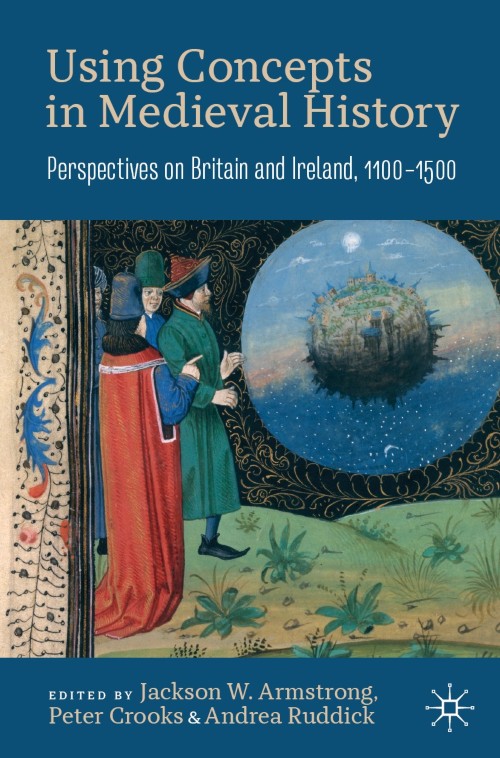
245 10|aUsing Concepts in Medieval History|h[electronic resource] :|bPerspectives on Britain and Ireland, 1100–1500 /|cedited by Jackson W. Armstrong, Peter Crooks, Andrea Ruddick.
250 |a1st ed. 2022.
264 1|aCham :|bSpringer International Publishing :|bImprint: Palgrave Macmillan,|c2022.
300 |aXI, 201 p. 1 illus.|bonline resource.
336 |atext|btxt|2rdacontent
337 |acomputer|bc|2rdamedia
338 |aonline resource|bcr|2rdacarrier
347 |atext file|bPDF|2rda
505 0 |aPart I -- 1. ‘Tyrannous Constructs’ or Tools of The Trade? The Use and Abuse of Concepts in Medieval History - Jackson W. Armstrong, Peter Crooks, Andrea Ruddick -- 2. Feudalism: Reflections on a Tyrannical Construct’s Fate, from Paradigm to Personae - E.A.R. Brown -- Part II -- 3. Colony - Peter Crooks -- 4. Crisis - Carl Watkins -- 5. Frontier - Jackson W. Armstrong -- 6. Identity - Andrea Ruddick -- 7. Magic - Sophie Page -- 8. Networks - Eliza Hartrich -- 9. Politics - Chris Fletcher -- Part III -- 10. Reflections on Using Concepts - John Watts.
520 |aThis book is the first of its kind to engage explicitly with the practice of conceptual history as it relates to the study of the Middle Ages, exploring the pay-offs and pitfalls of using concepts in medieval history. Concepts are indispensable to historians as a means of understanding past societies, but those concepts conjured in an effort to bring order to the infinite complexity of the past have a bad habit of taking on a life of their own and inordinately influencing historical interpretation. The most famous example is ‘feudalism’, whose fate as a concept is reviewed here by E.A.R. Brown nearly fifty years after her seminal article on the topic. The volume’s contributors offer a series of case studies of other concepts – 'colony', 'crisis', 'frontier', 'identity', 'magic', 'networks' and 'politics' – that have been influential, particularly among historians of Britain and Ireland in the later Middle Ages. The book explores the creative friction between historical ideas and analytical categories, and the potential for fresh and meaningful understandings to emerge from their dialogue.
650 0|aHistoriography.
650 0|aHistory|xMethodology.
650 0|aEurope|xHistory|x476-1492.
650 0|aLiterature, Medieval.
650 14|aHistoriography and Method.
650 24|aHistory of Medieval Europe.
650 24|aMedieval Literature.
700 1 |aArmstrong, Jackson W.|eeditor.|4edt|4http://id.loc.gov/vocabulary/relators/edt
700 1 |aCrooks, Peter.|eeditor.|4edt|4http://id.loc.gov/vocabulary/relators/edt
700 1 |aRuddick, Andrea.|eeditor.|4edt|4http://id.loc.gov/vocabulary/relators/edt
773 0 |tSpringer Nature eBook
776 08|iPrinted edition:|z9783030772796
776 08|iPrinted edition:|z9783030772819
856 40|uhttps://doi.org/10.1007/978-3-030-77280-2
912 |aZDB-2-HTY
912 |aZDB-2-SXH
950 |aHistory (SpringerNature-41172)
950 |aHistory (R0) (SpringerNature-43722)