

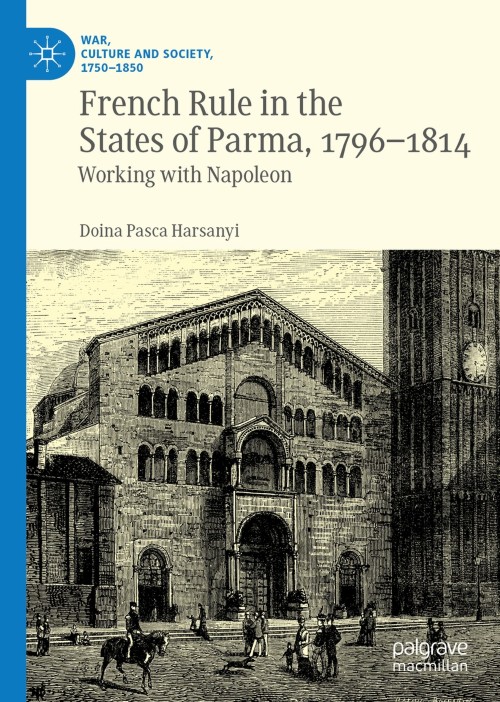
French Rule in the States of Parma, 1796-1814 [electronic resource] : Working with Napoleon / by Doina Pasca Harsanyi.
Erişim Adresi
ISBN
9783030973407
Dil Kodu
İngilizce
Yer Numarası
DK/2196
Yazar
Basım Bildirimi
1st ed. 2022.
Yayın Bilgisi
Cham : Springer International Publishing : Imprint: Palgrave Macmillan, 2022.
Fiziksel Niteleme
XIII, 285 p. online resource.
Dizi
War, Culture and Society, 1750–1850, 2634-6702
İçindekiler Notu
1. Introduction -- 2. Prelude to Napoleon -- 3. Parma and Bonaparte -- 4. From Duchies of Parma to States of Parma -- 5. Watershed: The Insurrection -- 6. Explanatory Narratives: Brigandage -- 7. Pacification -- 8. Order into Chaos -- 9. Wooing the Elites -- 10. Elite Collaboration -- 11. The End of the Road: Conclusions.
Özet, vb.
“This scholarly and nuanced account of the lands of the Duchy of Parma in the Napoleonic era ranks with major works by Carlo Zaghi, Livio Antonielli, and Michael Broers in brilliantly illuminating the still contested era period of French domination in Italy. Harsanyi describes the evolution of a system that was vicious, grasping, capricious and always underpinned by the French occupiers’ conviction of their own cultural superiority, which could legitimate pretty much anything from the systematic theft of art to the imposition of conscription. Yet she also brilliantly shows how the French presence was fl exible, modernising, and brought positive and progressive reform. Harsanyi reveals a story of the pragmatic collaboration of local élites, based on career and stability rather than affection or ideology, who were skilled at tweaking French directives to their own ends. While French exploitation could trigger insurrection and resistance, French offi cials on the ground often displayed remarkable good sense. This brilliant book tells us not just about Parma and the wider Italian situation in the period of French domination, but about the very nature of empire.” —David Laven, University of Nottingham, UK This book addresses the interplay between collaboration and resistance during the Revolutionary/Napoleonic era in the Duchies of Parma, Piacenza and Guastalla, renamed States of Parma in 1802 and Department of Taro in 1808. Considered no more than a docile backwater in 1796, the country exploded in violent rebellion at the end of 1805, to the astonishment of the French imperial establishment and of Napoleon himself. Yet, the insurgency – duly suppressed by the French military – did not beget further confrontation. French administrators determined to demonstrate that the empire was a force for good and local citizens compelled to reassess their circumstances realistically settled for cooperation in the form of protracted give and take arrangements. In recounting the events, this book highlights local agency and the myriad ways Parma’s population harnessed the power of empire to shape what eventually became the Napoleonic legacy in the region. Doina Pasca Harsanyi is Professor of History at Central Michigan University, USA. Her previous publications include Lettres de la duchesse de La Rochefoucauld à William Short (2001), Lessons from America: Liberal French Nobles in Exile, 1793-1798 (2010), and numerous articles on French-American and French-Italian subjects.
Konu
France __ History.
Italy __ History.
Military history.
Imperialism.
History of France.
History of Italy.
Military History.
Imperialism and Colonialism.
Italy __ History.
Military history.
Imperialism.
History of France.
History of Italy.
Military History.
Imperialism and Colonialism.
Eseri Alıntıla
Referansları kullanmadan önce gözden geçirmeniz ve varsa gerekli düzeltmeleri yapmanız önerilir.
Dijital Kaynak
MARC Görünümü
LEADER 04737nam a22005535i 4500
001 609524
003 TR_AnAIT
005 20250627065621
007 cr nn 008mamaa
008 220428s2022 sz | s |||| 0|eng d
020 |a9783030973407|9978-3-030-97340-7
024 7 |a10.1007/978-3-030-97340-7|2doi
041 |aeng
049 |aTürk Tarih Kurumu Kütüphanesi
050 4|aDC
072 7|aHBJD|2bicssc
072 7|a1DDF|2bicssc
072 7|aHIS013000|2bisacsh
072 7|aNHD|x1DDF|2thema
082 04|a944|223
090 |aDK/2196
100 1 |aHarsanyi, Doina Pasca.|eauthor.|4aut|4http://id.loc.gov/vocabulary/relators/aut
245 10|aFrench Rule in the States of Parma, 1796-1814|h[electronic resource] :|bWorking with Napoleon /|cby Doina Pasca Harsanyi.
250 |a1st ed. 2022.
264 1|aCham :|bSpringer International Publishing :|bImprint: Palgrave Macmillan,|c2022.
300 |aXIII, 285 p.|bonline resource.
336 |atext|btxt|2rdacontent
337 |acomputer|bc|2rdamedia
338 |aonline resource|bcr|2rdacarrier
347 |atext file|bPDF|2rda
490 1 |aWar, Culture and Society, 1750–1850,|x2634-6702
505 0 |a1. Introduction -- 2. Prelude to Napoleon -- 3. Parma and Bonaparte -- 4. From Duchies of Parma to States of Parma -- 5. Watershed: The Insurrection -- 6. Explanatory Narratives: Brigandage -- 7. Pacification -- 8. Order into Chaos -- 9. Wooing the Elites -- 10. Elite Collaboration -- 11. The End of the Road: Conclusions.
520 |a“This scholarly and nuanced account of the lands of the Duchy of Parma in the Napoleonic era ranks with major works by Carlo Zaghi, Livio Antonielli, and Michael Broers in brilliantly illuminating the still contested era period of French domination in Italy. Harsanyi describes the evolution of a system that was vicious, grasping, capricious and always underpinned by the French occupiers’ conviction of their own cultural superiority, which could legitimate pretty much anything from the systematic theft of art to the imposition of conscription. Yet she also brilliantly shows how the French presence was fl exible, modernising, and brought positive and progressive reform. Harsanyi reveals a story of the pragmatic collaboration of local élites, based on career and stability rather than affection or ideology, who were skilled at tweaking French directives to their own ends. While French exploitation could trigger insurrection and resistance, French offi cials on the ground often displayed remarkable good sense. This brilliant book tells us not just about Parma and the wider Italian situation in the period of French domination, but about the very nature of empire.” —David Laven, University of Nottingham, UK This book addresses the interplay between collaboration and resistance during the Revolutionary/Napoleonic era in the Duchies of Parma, Piacenza and Guastalla, renamed States of Parma in 1802 and Department of Taro in 1808. Considered no more than a docile backwater in 1796, the country exploded in violent rebellion at the end of 1805, to the astonishment of the French imperial establishment and of Napoleon himself. Yet, the insurgency – duly suppressed by the French military – did not beget further confrontation. French administrators determined to demonstrate that the empire was a force for good and local citizens compelled to reassess their circumstances realistically settled for cooperation in the form of protracted give and take arrangements. In recounting the events, this book highlights local agency and the myriad ways Parma’s population harnessed the power of empire to shape what eventually became the Napoleonic legacy in the region. Doina Pasca Harsanyi is Professor of History at Central Michigan University, USA. Her previous publications include Lettres de la duchesse de La Rochefoucauld à William Short (2001), Lessons from America: Liberal French Nobles in Exile, 1793-1798 (2010), and numerous articles on French-American and French-Italian subjects.
650 0|aFrance|xHistory.
650 0|aItaly|xHistory.
650 0|aMilitary history.
650 0|aImperialism.
650 14|aHistory of France.
650 24|aHistory of Italy.
650 24|aMilitary History.
650 24|aImperialism and Colonialism.
773 0 |tSpringer Nature eBook
776 08|iPrinted edition:|z9783030973391
776 08|iPrinted edition:|z9783030973414
776 08|iPrinted edition:|z9783030973421
830 0|aWar, Culture and Society, 1750–1850,|x2634-6702
856 40|uhttps://doi.org/10.1007/978-3-030-97340-7
912 |aZDB-2-HTY
912 |aZDB-2-SXH
950 |aHistory (SpringerNature-41172)
950 |aHistory (R0) (SpringerNature-43722)
001 609524
003 TR_AnAIT
005 20250627065621
007 cr nn 008mamaa
008 220428s2022 sz | s |||| 0|eng d
020 |a9783030973407|9978-3-030-97340-7
024 7 |a10.1007/978-3-030-97340-7|2doi
041 |aeng
049 |aTürk Tarih Kurumu Kütüphanesi
050 4|aDC
072 7|aHBJD|2bicssc
072 7|a1DDF|2bicssc
072 7|aHIS013000|2bisacsh
072 7|aNHD|x1DDF|2thema
082 04|a944|223
090 |aDK/2196
100 1 |aHarsanyi, Doina Pasca.|eauthor.|4aut|4http://id.loc.gov/vocabulary/relators/aut
245 10|aFrench Rule in the States of Parma, 1796-1814|h[electronic resource] :|bWorking with Napoleon /|cby Doina Pasca Harsanyi.
250 |a1st ed. 2022.
264 1|aCham :|bSpringer International Publishing :|bImprint: Palgrave Macmillan,|c2022.
300 |aXIII, 285 p.|bonline resource.
336 |atext|btxt|2rdacontent
337 |acomputer|bc|2rdamedia
338 |aonline resource|bcr|2rdacarrier
347 |atext file|bPDF|2rda
490 1 |aWar, Culture and Society, 1750–1850,|x2634-6702
505 0 |a1. Introduction -- 2. Prelude to Napoleon -- 3. Parma and Bonaparte -- 4. From Duchies of Parma to States of Parma -- 5. Watershed: The Insurrection -- 6. Explanatory Narratives: Brigandage -- 7. Pacification -- 8. Order into Chaos -- 9. Wooing the Elites -- 10. Elite Collaboration -- 11. The End of the Road: Conclusions.
520 |a“This scholarly and nuanced account of the lands of the Duchy of Parma in the Napoleonic era ranks with major works by Carlo Zaghi, Livio Antonielli, and Michael Broers in brilliantly illuminating the still contested era period of French domination in Italy. Harsanyi describes the evolution of a system that was vicious, grasping, capricious and always underpinned by the French occupiers’ conviction of their own cultural superiority, which could legitimate pretty much anything from the systematic theft of art to the imposition of conscription. Yet she also brilliantly shows how the French presence was fl exible, modernising, and brought positive and progressive reform. Harsanyi reveals a story of the pragmatic collaboration of local élites, based on career and stability rather than affection or ideology, who were skilled at tweaking French directives to their own ends. While French exploitation could trigger insurrection and resistance, French offi cials on the ground often displayed remarkable good sense. This brilliant book tells us not just about Parma and the wider Italian situation in the period of French domination, but about the very nature of empire.” —David Laven, University of Nottingham, UK This book addresses the interplay between collaboration and resistance during the Revolutionary/Napoleonic era in the Duchies of Parma, Piacenza and Guastalla, renamed States of Parma in 1802 and Department of Taro in 1808. Considered no more than a docile backwater in 1796, the country exploded in violent rebellion at the end of 1805, to the astonishment of the French imperial establishment and of Napoleon himself. Yet, the insurgency – duly suppressed by the French military – did not beget further confrontation. French administrators determined to demonstrate that the empire was a force for good and local citizens compelled to reassess their circumstances realistically settled for cooperation in the form of protracted give and take arrangements. In recounting the events, this book highlights local agency and the myriad ways Parma’s population harnessed the power of empire to shape what eventually became the Napoleonic legacy in the region. Doina Pasca Harsanyi is Professor of History at Central Michigan University, USA. Her previous publications include Lettres de la duchesse de La Rochefoucauld à William Short (2001), Lessons from America: Liberal French Nobles in Exile, 1793-1798 (2010), and numerous articles on French-American and French-Italian subjects.
650 0|aFrance|xHistory.
650 0|aItaly|xHistory.
650 0|aMilitary history.
650 0|aImperialism.
650 14|aHistory of France.
650 24|aHistory of Italy.
650 24|aMilitary History.
650 24|aImperialism and Colonialism.
773 0 |tSpringer Nature eBook
776 08|iPrinted edition:|z9783030973391
776 08|iPrinted edition:|z9783030973414
776 08|iPrinted edition:|z9783030973421
830 0|aWar, Culture and Society, 1750–1850,|x2634-6702
856 40|uhttps://doi.org/10.1007/978-3-030-97340-7
912 |aZDB-2-HTY
912 |aZDB-2-SXH
950 |aHistory (SpringerNature-41172)
950 |aHistory (R0) (SpringerNature-43722)
Materyaller
Depodan talep edilen materyal sadece kütüphane içerisinde kullanılmaktadır.
Materyal dışarıya ödünç verilmemektedir.
Materyal dışarıya ödünç verilmemektedir.
