

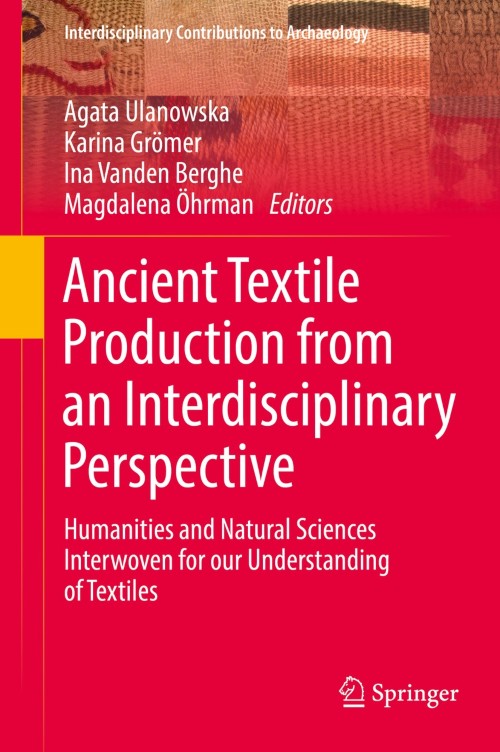
Ancient Textile Production from an Interdisciplinary Perspective [electronic resource] : Humanities and Natural Sciences Interwoven for our Understanding of Textiles / edited by Agata Ulanowska, Karina Grömer, Ina Vanden Berghe, Magdalena Öhrman.
Erişim Adresi
ISBN
9783030921705
Dil Kodu
İngilizce
Yer Numarası
DK/2197
Basım Bildirimi
1st ed. 2022.
Yayın Bilgisi
Cham : Springer International Publishing : Imprint: Springer, 2022.
Fiziksel Niteleme
X, 338 p. 1 illus. online resource.
Dizi
Interdisciplinary Contributions to Archaeology, 2730-6984
İçindekiler Notu
List of contributors -- Part I: About this volume and textile research in 2020 -- Chapter 1. Introduction (Agata Ulanowska, Karina Grömer, Ina Vanden Berghe and Magdalena Öhrman) -- Chapter 2. Old Textiles – New Possibilities. Ten Years on (Eva Andersson Strand, Ulla Mannering and Marie-Louise Nosch) -- Part II: Interdisciplinarity of Colour: Dye analyses and dyeing technologies -- Chapter 3. Monobromoindigo: The Singular Chromatic Biomarker for the Identification of the Malacological Provenance of Archaeological Purple Pigments from Hexaplex Trunculus Species (Zvi C. Koren) -- Chapter 4. Sasanid Dyes from Ancient Persia – Case Study Chehrābād in Northern Iran (Ina Vanden Berghe and Karina Grömer) -- Part III: Interdisciplinary Approaches to Textile Tools -- Chapter 5. Textile Production in Some Early Neolithic Settlements in North Macedonia (Zlata Blažeska and Jasemin Nazim) -- Chapter 6. Tradition versus Innovation? Horizontal (Ground-) and Vertical (Warp-weighted) Looms at Koukonisi, Lemnos (Tina Boloti) -- Chapter 7. Weaving Traditions in Archaic Sicily: The Case Study of Portella Sant’Anna (Gabriella Longhitano) -- Chapter 8. Visible Tools, Invisible Craft: An Analysis of Textile Tools across the Iron Age South Coast of Britain (Lewis Ferrero) -- Chapter 9. Combing the Data: Re-evaluating ‘Weaving’ Combs in the Textile Production Sequence During the British Iron Age (Jennifer Beamer) -- Chapter 10. From Use Wear to User: Working with Literary Sources on Worn Textile Tools (Magdalena Öhrman) -- Part IV: Traditions and Contexts: Fibres, Fabrics, Techniques, Uses and Meanings -- Chapter 11. Lime Bast Winning: Know-How, Labour Input and Quantity Needed for the Production of Two Selected Neolithic Finds (Sabine Karg) -- Chapter 12. Food for Thought or Threads for Weaving: Can we Identify the Uses for Ancient Flaxseeds Discovered in the Southern Levant? (Deborah Cassuto, Andrea Orendi and Itzhaq Shai) -- Chapter 13. The Relationship between Textile Remains in a Hoard of Alexander II Zabinas Coins and Loom Weights Discovered at Hellenistic Tell Iẓṭabba (Beth She’an, Nysa-Scythopolis), Israel (Orit Shamir, Achim Lichtenberger and Oren Tal) -- Chapter 14. Unravelling the Threads of the Nubian Openworks. New Inquiries on a Unique Textile Tradition from Meroitic Sudan (c. 350 BCE–350 CE) (Elsa Yvanez and Ulrikka Mokdad) -- Chapter 15. Interdisciplinary Methods and New Perspectives on Inscribed Textiles: A Case Study of Christian ‘Tiraz’ (Julia L. Galliker and Helga Rösel-Mautendorfer) -- Chapter 16. Weaving Experiments with the Rigid Heddle: Woven-in Metal Spirals from Siksälä and ‘Auleja’ technique (Ronja Lau) -- Part V: Digital Tools -- Chapter 17. Investigating Relations between Textile Production and Seals and Sealing Practices in Bronze Age Greece: A Presentation of the New “Textile and Seals” Project Database (Agata Ulanowska) -- Chapter 18. 3D Visualization of the 2400-Year-Old Garments of Salt Man 4 from Chehrābād, Iran (Aleksei Moskvin, Karina Grömer, Mariia Moskvina, Victor Kuzmichev, Abolfazl Aali and Thomas Stöllner).
Özet, vb.
The diverse developments in textile research of the last decade, along with the increased recognition of the importance of textile studies in adjacent fields, now merit a dedicated, full-length publication entitled “Ancient Textile Production from an Interdisciplinary Perspective: Humanities and Natural Sciences Interwoven for our Understanding of Textiles”. With this volume, the authors and the editors wish to illustrate to the current impact of textile archaeology on the scholarly perception of the past (not limited to archaeology alone). The volume presents new insights into the consumption, meaning, use and re-use of textiles and dyes, all of which are topics of growing importance in textile research. As indicated by the title, we demonstrate the continued importance of interdisciplinarity by showcasing several ‘interwoven’ approaches to environmental and archaeological remains, textual and iconographic sources, archaeological experiments and ethnographic data, from a large area covering Europe and the Mediterranean, Near East, Africa and Asia. The chronological span is deliberately wide, including materials dating from c. 6th millennium BCE to c. mid-14th century CE. The volume is organised in four parts that aim to reflect the main areas of the textile research in 2020. After the two introductory chapters (Part I: About this Volume and Textile Research in 2020), follow two chapters referring to dyes and dyeing technology in which analytical and material-based studies are linked to contextual sources (Part II: Interdisciplinarity of Colour: Dye Analyses and Dyeing Technologies). The six chapters of Part III: Interdisciplinary Approaches to Textile Tools discuss textiles and textileproduction starting from the analyses of tools, whether functional or as representative of technological developments or user identity. Archaeological and cultural contexts as well as textile traditions are the main topics of the six chapters in Part IV: Traditions and Contexts: Fibres, Fabrics, Techniques, Uses and Meanings. The two final chapters in Part V: Digital Tools refer to the use of digital tools in textile research, presenting two different case studies. .
Konu
Archaeology.
History.
Materials science.
Environmental management.
Archaeology.
History.
Materials Science.
Environmental Management.
History.
Materials science.
Environmental management.
Archaeology.
History.
Materials Science.
Environmental Management.
Eseri Alıntıla
Referansları kullanmadan önce gözden geçirmeniz ve varsa gerekli düzeltmeleri yapmanız önerilir.
Dijital Kaynak
MARC Görünümü
LEADER 07585nam a22005775i 4500
001 609525
003 TR_AnAIT
005 20250627065618
007 cr nn 008mamaa
008 220429s2022 sz | s |||| 0|eng d
020 |a9783030921705|9978-3-030-92170-5
024 7 |a10.1007/978-3-030-92170-5|2doi
041 |aeng
049 |aTürk Tarih Kurumu Kütüphanesi
050 4|aCC1-960
072 7|aHD|2bicssc
072 7|aSOC003000|2bisacsh
072 7|aNK|2thema
082 04|a930.1|223
090 |aDK/2197
245 10|aAncient Textile Production from an Interdisciplinary Perspective|h[electronic resource] :|bHumanities and Natural Sciences Interwoven for our Understanding of Textiles /|cedited by Agata Ulanowska, Karina Grömer, Ina Vanden Berghe, Magdalena Öhrman.
250 |a1st ed. 2022.
264 1|aCham :|bSpringer International Publishing :|bImprint: Springer,|c2022.
300 |aX, 338 p. 1 illus.|bonline resource.
336 |atext|btxt|2rdacontent
337 |acomputer|bc|2rdamedia
338 |aonline resource|bcr|2rdacarrier
347 |atext file|bPDF|2rda
490 1 |aInterdisciplinary Contributions to Archaeology,|x2730-6984
505 0 |aList of contributors -- Part I: About this volume and textile research in 2020 -- Chapter 1. Introduction (Agata Ulanowska, Karina Grömer, Ina Vanden Berghe and Magdalena Öhrman) -- Chapter 2. Old Textiles – New Possibilities. Ten Years on (Eva Andersson Strand, Ulla Mannering and Marie-Louise Nosch) -- Part II: Interdisciplinarity of Colour: Dye analyses and dyeing technologies -- Chapter 3. Monobromoindigo: The Singular Chromatic Biomarker for the Identification of the Malacological Provenance of Archaeological Purple Pigments from Hexaplex Trunculus Species (Zvi C. Koren) -- Chapter 4. Sasanid Dyes from Ancient Persia – Case Study Chehrābād in Northern Iran (Ina Vanden Berghe and Karina Grömer) -- Part III: Interdisciplinary Approaches to Textile Tools -- Chapter 5. Textile Production in Some Early Neolithic Settlements in North Macedonia (Zlata Blažeska and Jasemin Nazim) -- Chapter 6. Tradition versus Innovation? Horizontal (Ground-) and Vertical (Warp-weighted) Looms at Koukonisi, Lemnos (Tina Boloti) -- Chapter 7. Weaving Traditions in Archaic Sicily: The Case Study of Portella Sant’Anna (Gabriella Longhitano) -- Chapter 8. Visible Tools, Invisible Craft: An Analysis of Textile Tools across the Iron Age South Coast of Britain (Lewis Ferrero) -- Chapter 9. Combing the Data: Re-evaluating ‘Weaving’ Combs in the Textile Production Sequence During the British Iron Age (Jennifer Beamer) -- Chapter 10. From Use Wear to User: Working with Literary Sources on Worn Textile Tools (Magdalena Öhrman) -- Part IV: Traditions and Contexts: Fibres, Fabrics, Techniques, Uses and Meanings -- Chapter 11. Lime Bast Winning: Know-How, Labour Input and Quantity Needed for the Production of Two Selected Neolithic Finds (Sabine Karg) -- Chapter 12. Food for Thought or Threads for Weaving: Can we Identify the Uses for Ancient Flaxseeds Discovered in the Southern Levant? (Deborah Cassuto, Andrea Orendi and Itzhaq Shai) -- Chapter 13. The Relationship between Textile Remains in a Hoard of Alexander II Zabinas Coins and Loom Weights Discovered at Hellenistic Tell Iẓṭabba (Beth She’an, Nysa-Scythopolis), Israel (Orit Shamir, Achim Lichtenberger and Oren Tal) -- Chapter 14. Unravelling the Threads of the Nubian Openworks. New Inquiries on a Unique Textile Tradition from Meroitic Sudan (c. 350 BCE–350 CE) (Elsa Yvanez and Ulrikka Mokdad) -- Chapter 15. Interdisciplinary Methods and New Perspectives on Inscribed Textiles: A Case Study of Christian ‘Tiraz’ (Julia L. Galliker and Helga Rösel-Mautendorfer) -- Chapter 16. Weaving Experiments with the Rigid Heddle: Woven-in Metal Spirals from Siksälä and ‘Auleja’ technique (Ronja Lau) -- Part V: Digital Tools -- Chapter 17. Investigating Relations between Textile Production and Seals and Sealing Practices in Bronze Age Greece: A Presentation of the New “Textile and Seals” Project Database (Agata Ulanowska) -- Chapter 18. 3D Visualization of the 2400-Year-Old Garments of Salt Man 4 from Chehrābād, Iran (Aleksei Moskvin, Karina Grömer, Mariia Moskvina, Victor Kuzmichev, Abolfazl Aali and Thomas Stöllner).
520 |aThe diverse developments in textile research of the last decade, along with the increased recognition of the importance of textile studies in adjacent fields, now merit a dedicated, full-length publication entitled “Ancient Textile Production from an Interdisciplinary Perspective: Humanities and Natural Sciences Interwoven for our Understanding of Textiles”. With this volume, the authors and the editors wish to illustrate to the current impact of textile archaeology on the scholarly perception of the past (not limited to archaeology alone). The volume presents new insights into the consumption, meaning, use and re-use of textiles and dyes, all of which are topics of growing importance in textile research. As indicated by the title, we demonstrate the continued importance of interdisciplinarity by showcasing several ‘interwoven’ approaches to environmental and archaeological remains, textual and iconographic sources, archaeological experiments and ethnographic data, from a large area covering Europe and the Mediterranean, Near East, Africa and Asia. The chronological span is deliberately wide, including materials dating from c. 6th millennium BCE to c. mid-14th century CE. The volume is organised in four parts that aim to reflect the main areas of the textile research in 2020. After the two introductory chapters (Part I: About this Volume and Textile Research in 2020), follow two chapters referring to dyes and dyeing technology in which analytical and material-based studies are linked to contextual sources (Part II: Interdisciplinarity of Colour: Dye Analyses and Dyeing Technologies). The six chapters of Part III: Interdisciplinary Approaches to Textile Tools discuss textiles and textileproduction starting from the analyses of tools, whether functional or as representative of technological developments or user identity. Archaeological and cultural contexts as well as textile traditions are the main topics of the six chapters in Part IV: Traditions and Contexts: Fibres, Fabrics, Techniques, Uses and Meanings. The two final chapters in Part V: Digital Tools refer to the use of digital tools in textile research, presenting two different case studies. .
650 0|aArchaeology.
650 0|aHistory.
650 0|aMaterials science.
650 0|aEnvironmental management.
650 14|aArchaeology.
650 24|aHistory.
650 24|aMaterials Science.
650 24|aEnvironmental Management.
700 1 |aUlanowska, Agata.|eeditor.|4edt|4http://id.loc.gov/vocabulary/relators/edt
700 1 |aGrömer, Karina.|eeditor.|4edt|4http://id.loc.gov/vocabulary/relators/edt
700 1 |aVanden Berghe, Ina.|eeditor.|4edt|4http://id.loc.gov/vocabulary/relators/edt
700 1 |aÖhrman, Magdalena.|eeditor.|4edt|4http://id.loc.gov/vocabulary/relators/edt
773 0 |tSpringer Nature eBook
776 08|iPrinted edition:|z9783030921699
776 08|iPrinted edition:|z9783030921712
776 08|iPrinted edition:|z9783030921729
830 0|aInterdisciplinary Contributions to Archaeology,|x2730-6984
856 40|uhttps://doi.org/10.1007/978-3-030-92170-5
912 |aZDB-2-HTY
912 |aZDB-2-SXH
950 |aHistory (SpringerNature-41172)
950 |aHistory (R0) (SpringerNature-43722)
001 609525
003 TR_AnAIT
005 20250627065618
007 cr nn 008mamaa
008 220429s2022 sz | s |||| 0|eng d
020 |a9783030921705|9978-3-030-92170-5
024 7 |a10.1007/978-3-030-92170-5|2doi
041 |aeng
049 |aTürk Tarih Kurumu Kütüphanesi
050 4|aCC1-960
072 7|aHD|2bicssc
072 7|aSOC003000|2bisacsh
072 7|aNK|2thema
082 04|a930.1|223
090 |aDK/2197
245 10|aAncient Textile Production from an Interdisciplinary Perspective|h[electronic resource] :|bHumanities and Natural Sciences Interwoven for our Understanding of Textiles /|cedited by Agata Ulanowska, Karina Grömer, Ina Vanden Berghe, Magdalena Öhrman.
250 |a1st ed. 2022.
264 1|aCham :|bSpringer International Publishing :|bImprint: Springer,|c2022.
300 |aX, 338 p. 1 illus.|bonline resource.
336 |atext|btxt|2rdacontent
337 |acomputer|bc|2rdamedia
338 |aonline resource|bcr|2rdacarrier
347 |atext file|bPDF|2rda
490 1 |aInterdisciplinary Contributions to Archaeology,|x2730-6984
505 0 |aList of contributors -- Part I: About this volume and textile research in 2020 -- Chapter 1. Introduction (Agata Ulanowska, Karina Grömer, Ina Vanden Berghe and Magdalena Öhrman) -- Chapter 2. Old Textiles – New Possibilities. Ten Years on (Eva Andersson Strand, Ulla Mannering and Marie-Louise Nosch) -- Part II: Interdisciplinarity of Colour: Dye analyses and dyeing technologies -- Chapter 3. Monobromoindigo: The Singular Chromatic Biomarker for the Identification of the Malacological Provenance of Archaeological Purple Pigments from Hexaplex Trunculus Species (Zvi C. Koren) -- Chapter 4. Sasanid Dyes from Ancient Persia – Case Study Chehrābād in Northern Iran (Ina Vanden Berghe and Karina Grömer) -- Part III: Interdisciplinary Approaches to Textile Tools -- Chapter 5. Textile Production in Some Early Neolithic Settlements in North Macedonia (Zlata Blažeska and Jasemin Nazim) -- Chapter 6. Tradition versus Innovation? Horizontal (Ground-) and Vertical (Warp-weighted) Looms at Koukonisi, Lemnos (Tina Boloti) -- Chapter 7. Weaving Traditions in Archaic Sicily: The Case Study of Portella Sant’Anna (Gabriella Longhitano) -- Chapter 8. Visible Tools, Invisible Craft: An Analysis of Textile Tools across the Iron Age South Coast of Britain (Lewis Ferrero) -- Chapter 9. Combing the Data: Re-evaluating ‘Weaving’ Combs in the Textile Production Sequence During the British Iron Age (Jennifer Beamer) -- Chapter 10. From Use Wear to User: Working with Literary Sources on Worn Textile Tools (Magdalena Öhrman) -- Part IV: Traditions and Contexts: Fibres, Fabrics, Techniques, Uses and Meanings -- Chapter 11. Lime Bast Winning: Know-How, Labour Input and Quantity Needed for the Production of Two Selected Neolithic Finds (Sabine Karg) -- Chapter 12. Food for Thought or Threads for Weaving: Can we Identify the Uses for Ancient Flaxseeds Discovered in the Southern Levant? (Deborah Cassuto, Andrea Orendi and Itzhaq Shai) -- Chapter 13. The Relationship between Textile Remains in a Hoard of Alexander II Zabinas Coins and Loom Weights Discovered at Hellenistic Tell Iẓṭabba (Beth She’an, Nysa-Scythopolis), Israel (Orit Shamir, Achim Lichtenberger and Oren Tal) -- Chapter 14. Unravelling the Threads of the Nubian Openworks. New Inquiries on a Unique Textile Tradition from Meroitic Sudan (c. 350 BCE–350 CE) (Elsa Yvanez and Ulrikka Mokdad) -- Chapter 15. Interdisciplinary Methods and New Perspectives on Inscribed Textiles: A Case Study of Christian ‘Tiraz’ (Julia L. Galliker and Helga Rösel-Mautendorfer) -- Chapter 16. Weaving Experiments with the Rigid Heddle: Woven-in Metal Spirals from Siksälä and ‘Auleja’ technique (Ronja Lau) -- Part V: Digital Tools -- Chapter 17. Investigating Relations between Textile Production and Seals and Sealing Practices in Bronze Age Greece: A Presentation of the New “Textile and Seals” Project Database (Agata Ulanowska) -- Chapter 18. 3D Visualization of the 2400-Year-Old Garments of Salt Man 4 from Chehrābād, Iran (Aleksei Moskvin, Karina Grömer, Mariia Moskvina, Victor Kuzmichev, Abolfazl Aali and Thomas Stöllner).
520 |aThe diverse developments in textile research of the last decade, along with the increased recognition of the importance of textile studies in adjacent fields, now merit a dedicated, full-length publication entitled “Ancient Textile Production from an Interdisciplinary Perspective: Humanities and Natural Sciences Interwoven for our Understanding of Textiles”. With this volume, the authors and the editors wish to illustrate to the current impact of textile archaeology on the scholarly perception of the past (not limited to archaeology alone). The volume presents new insights into the consumption, meaning, use and re-use of textiles and dyes, all of which are topics of growing importance in textile research. As indicated by the title, we demonstrate the continued importance of interdisciplinarity by showcasing several ‘interwoven’ approaches to environmental and archaeological remains, textual and iconographic sources, archaeological experiments and ethnographic data, from a large area covering Europe and the Mediterranean, Near East, Africa and Asia. The chronological span is deliberately wide, including materials dating from c. 6th millennium BCE to c. mid-14th century CE. The volume is organised in four parts that aim to reflect the main areas of the textile research in 2020. After the two introductory chapters (Part I: About this Volume and Textile Research in 2020), follow two chapters referring to dyes and dyeing technology in which analytical and material-based studies are linked to contextual sources (Part II: Interdisciplinarity of Colour: Dye Analyses and Dyeing Technologies). The six chapters of Part III: Interdisciplinary Approaches to Textile Tools discuss textiles and textileproduction starting from the analyses of tools, whether functional or as representative of technological developments or user identity. Archaeological and cultural contexts as well as textile traditions are the main topics of the six chapters in Part IV: Traditions and Contexts: Fibres, Fabrics, Techniques, Uses and Meanings. The two final chapters in Part V: Digital Tools refer to the use of digital tools in textile research, presenting two different case studies. .
650 0|aArchaeology.
650 0|aHistory.
650 0|aMaterials science.
650 0|aEnvironmental management.
650 14|aArchaeology.
650 24|aHistory.
650 24|aMaterials Science.
650 24|aEnvironmental Management.
700 1 |aUlanowska, Agata.|eeditor.|4edt|4http://id.loc.gov/vocabulary/relators/edt
700 1 |aGrömer, Karina.|eeditor.|4edt|4http://id.loc.gov/vocabulary/relators/edt
700 1 |aVanden Berghe, Ina.|eeditor.|4edt|4http://id.loc.gov/vocabulary/relators/edt
700 1 |aÖhrman, Magdalena.|eeditor.|4edt|4http://id.loc.gov/vocabulary/relators/edt
773 0 |tSpringer Nature eBook
776 08|iPrinted edition:|z9783030921699
776 08|iPrinted edition:|z9783030921712
776 08|iPrinted edition:|z9783030921729
830 0|aInterdisciplinary Contributions to Archaeology,|x2730-6984
856 40|uhttps://doi.org/10.1007/978-3-030-92170-5
912 |aZDB-2-HTY
912 |aZDB-2-SXH
950 |aHistory (SpringerNature-41172)
950 |aHistory (R0) (SpringerNature-43722)
Materyaller
Depodan talep edilen materyal sadece kütüphane içerisinde kullanılmaktadır.
Materyal dışarıya ödünç verilmemektedir.
Materyal dışarıya ödünç verilmemektedir.
