LEADER 04047nam a22005775i 4500
001 609572
003 TR_AnAIT
005 20250627065440
007 cr nn 008mamaa
008 171011s2018 sz | s |||| 0|eng d
020 |a9783319601137|9978-3-319-60113-7
024 7 |a10.1007/978-3-319-60113-7|2doi
041 |aeng
049 |aTürk Tarih Kurumu Kütüphanesi
050 4|aQ124.6-127.2
072 7|aPDX|2bicssc
072 7|aSCI034000|2bisacsh
072 7|aPDX|2thema
082 04|a509|223
090 |aDK/2244
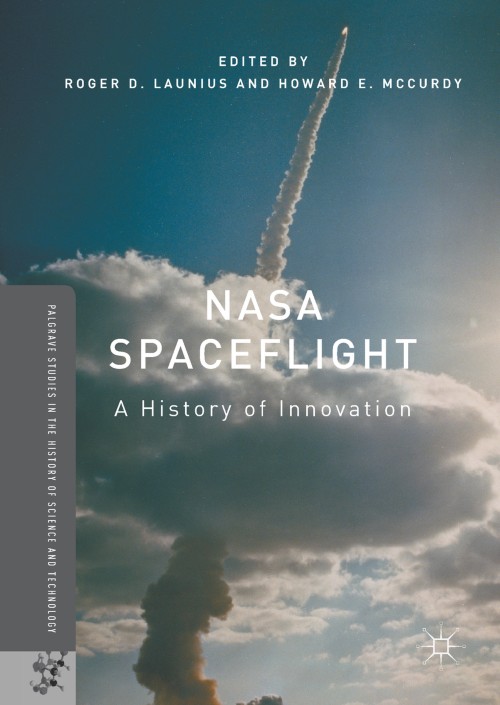
245 10|aNASA Spaceflight|h[electronic resource] :|bA History of Innovation /|cedited by Roger D. Launius, Howard E. McCurdy.
250 |a1st ed. 2018.
264 1|aCham :|bSpringer International Publishing :|bImprint: Palgrave Macmillan,|c2018.
300 |aXXIII, 402 p. 41 illus., 33 illus. in color.|bonline resource.
336 |atext|btxt|2rdacontent
337 |acomputer|bc|2rdamedia
338 |aonline resource|bcr|2rdacarrier
347 |atext file|bPDF|2rda
490 1 |aPalgrave Studies in the History of Science and Technology,|x2730-9738
505 0 |a1. Introduction: Partnerships for Innovation -- 2. The Origins and Flagship Project of NASA's International Program—The Ariel Case Study -- 3. Global Instantaneous Telecommunications and the Development of Satellite Technology -- 4. The Other Side of Moore's Law—The Apollo Guidance Computer, the Integrated Circuit, and the Mircoelectronics Revolution, 1962–1975 -- 5. NASA's Mission Control Center—The Space Program's Capitol as Innovative Capital -- 6. Lessons of Landsat—From Experimental Program to Commercial Land Imaging, 1969–1989 -- 7. Selling the Space Shuttle—Early Developments -- 8. Something Borrowed, Something Blue—Re-purposing NASA's Spacecraft -- 9. Encouraging New Space Firms -- 10. The Discovery Program—Competition, Innovation, and Risk in Planetary Exploration -- 11. Partnerships for Innovation—The X-33/VentureStar -- 12. Microgravity, Macro Investment—Overcoming International Space Station Utilization Challenges through Managerial Innovation -- 12. NASA, Industry, and the CommercialCrew Development Program—The Politics of Partnership -- 13. Conclusion—What Matters?
520 |aThis book presents the first comprehensive history of innovation at NASA, bringing together experts in the field to illuminate how public-private and international partnerships have fueled new ways of exploring space since the beginning of space travel itself. Twelve case studies trace the messy, risky history of such partnerships, exploring the role of AT&T in the early development of satellite technology, the connections between the Apollo program and Silicon Valley, the rise of SpaceX, and more. Some of these projects have succeeded, and some have failed; all have challenged conventional methods of doing the public’s business in space. Together, these essays offer new insights into how innovation happens, with invaluable lessons for policymakers, investors, economists, and members of the space community.
650 0|aScience|xHistory.
650 0|aUnited States|xHistory.
650 0|aPolitical planning.
650 0|aAmerica|xPolitics and government.
650 0|aEconomic policy.
650 14|aHistory of Science.
650 24|aUS History.
650 24|aPublic Policy.
650 24|aAmerican Politics.
650 24|aEconomic Policy.
700 1 |aLaunius, Roger D.|eeditor.|4edt|4http://id.loc.gov/vocabulary/relators/edt
700 1 |aMcCurdy, Howard E.|eeditor.|4edt|4http://id.loc.gov/vocabulary/relators/edt
773 0 |tSpringer Nature eBook
776 08|iPrinted edition:|z9783319601120
776 08|iPrinted edition:|z9783319601144
776 08|iPrinted edition:|z9783319867816
830 0|aPalgrave Studies in the History of Science and Technology,|x2730-9738
856 40|uhttps://doi.org/10.1007/978-3-319-60113-7
912 |aZDB-2-HTY
912 |aZDB-2-SXH
950 |aHistory (SpringerNature-41172)
950 |aHistory (R0) (SpringerNature-43722)