LEADER 03836nam a22005415i 4500
001 609576
003 TR_AnAIT
005 20250627065433
007 cr nn 008mamaa
008 160416s2016 xxk| s |||| 0|eng d
020 |a9781137484987|9978-1-137-48498-7
024 7 |a10.1057/978-1-137-48498-7|2doi
041 |aeng
049 |aTürk Tarih Kurumu Kütüphanesi
050 4|aHT111-150
072 7|aHBT|2bicssc
072 7|aHIS054000|2bisacsh
072 7|aNHT|2thema
082 04|a900.91732|223
090 |aDK/2248
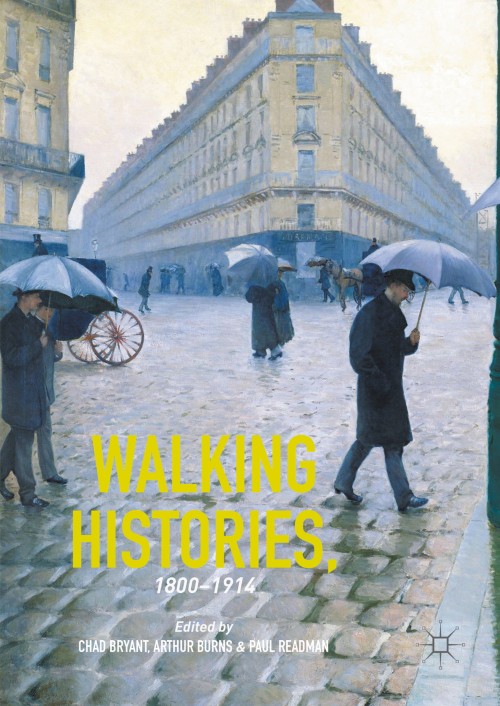
245 10|aWalking Histories, 1800-1914|h[electronic resource] /|cedited by Chad Bryant, Arthur Burns, Paul Readman.
250 |a1st ed. 2016.
264 1|aLondon :|bPalgrave Macmillan UK :|bImprint: Palgrave Macmillan,|c2016.
300 |aXV, 332 p.|bonline resource.
336 |atext|btxt|2rdacontent
337 |acomputer|bc|2rdamedia
338 |aonline resource|bcr|2rdacarrier
347 |atext file|bPDF|2rda
505 0 |aIntroduction: Modern Walks; Chad Bryant, Arthur Burns and Paul Readman -- PART I: WALKING, SPACE, AND BOUNDARIES -- 1. Walking the Boundaries between Modernity and Tradition; Robert Gray -- 2. Strolling the Romantic City; Chad Bryant -- 3. Rites of Passage; Simon Sleight -- PART II: THE OPTICS OF WALKING -- 4. Walking as Labour in Henry Mayhew’s London; Elizabeth Coggin Womack -- 5. ‘Efficiency on Foot’? The Well-Run Estate of Nineteenth-Century Britain; Julie Hipperson -- PART III: WEEKEND WALKING, OR NOT -- 6. Accidents Will Happen; Arthur Burns -- 7. ‘A Good Walk Spoiled?’ Golfers and the Experience of Landscape during the Late Nineteenth Century; Clare V. J. Griffiths -- 8. Urban Space and Travel on the Jewish Sabbath in the Nineteenth Century; Barry Stiefel -- PART IV: WALKING, CONTEMPLATION, AND THE SELF -- 9. The Saints Who Walk; Iqbal Sevea -- 10. Walking in Andrei Bely’s Petersburg; Angeliki Sioli -- 11. Walking and Environmentalism in the Career of James Bryce; Paul Readman -- .
520 |aFew historians have written about walking, despite its obvious centrality to the human condition. Focusing on the period 1800-1914, this book examines the practices and meanings of walking in the context of transformative modernity. It boldly suggests that once historians place walking at the heart of their analyses, exciting new perspectives on themes central to the ‘long nineteenth century’ emerge. Walking Histories, 1800-1914 adopts a global perspective, including contributions from specialists in the history and culture of Great Britain, North America, Australia, Russia, East-Central Europe, and South Asia. Critically engaging with recent research, the contributions within offer fresh insights for academic experts, while remaining accessible to student readers. This book will be essential reading for those interested in movement, travel, leisure, urban history, and environmental history.
650 0|aCities and towns|xHistory.
650 0|aCivilization|xHistory.
650 0|aWorld history.
650 0|aSocial history.
650 14|aUrban History.
650 24|aCultural History.
650 24|aWorld History, Global and Transnational History.
650 24|aSocial History.
700 1 |aBryant, Chad.|eeditor.|4edt|4http://id.loc.gov/vocabulary/relators/edt
700 1 |aBurns, Arthur.|eeditor.|4edt|4http://id.loc.gov/vocabulary/relators/edt
700 1 |aReadman, Paul.|eeditor.|4edt|4http://id.loc.gov/vocabulary/relators/edt
773 0 |tSpringer Nature eBook
776 08|iPrinted edition:|z9781137484970
776 08|iPrinted edition:|z9781349694907
776 08|iPrinted edition:|z9781349694914
856 40|uhttps://doi.org/10.1057/978-1-137-48498-7
912 |aZDB-2-HTY
912 |aZDB-2-SXH
950 |aHistory (SpringerNature-41172)
950 |aHistory (R0) (SpringerNature-43722)